I met Parker, an ecologist also staying at the Abisko Scientific Research Station, outside of my dormitory at 7:30 in the morning. It was July in the Swedish Arctic and the sun hung in the sky at an angle that, for those of us accustomed to life at lower latitudes, made the day feel timeless. I had already spent eight months at the station conducting ethnography with environmental researchers, learning how doing science at an Arctic field station in the shadow of anthropogenic climate change shifts the practices of environmental researchers. That day, Parker was taking me on a two-hour hike to some of the vegetation plots she studies, nestled in front of the nearest mountain ridge.
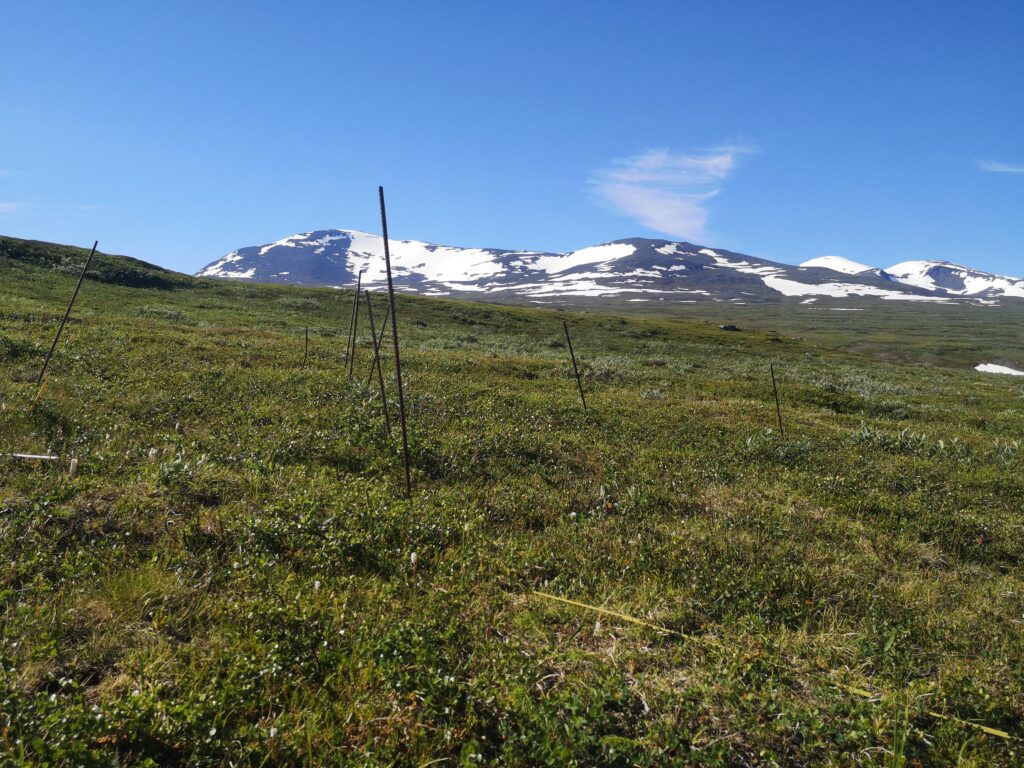
A vegetation plot outside of Abisko. Photo by Hanna Oosterveen.
Along the trail, I asked Parker to explain what it means to be an environmental researcher, to which she replied that she attempts to explain reality with “as good of a representation as we know how to do.” She went on to add that, unlike in the lab where you can manipulate everything, scientific methods out in the field are not chosen solely based on what will provide the best representation of the research object, but researchers also consider how to maintain the integrity of the things they study. In a place like Abisko, where environmental researchers produce a significant proportion of the world’s information on Arctic climate change (Metcalfe et al. 2018), share the land with Sámi reindeer herders, and operate within and around a national park, I asked myself, how do environmental researchers decide how much manipulation to ecological beings is warranted?
When I would ask similar questions to researchers at the station, most replied that their decisions were based on an assessment that their manipulation of the trees, fish passing through a section of a river, riverbed, plants, soils, or permafrost contributed to the “greater good.” The ubiquitousness of the idea of the “greater good” shifted my attention and I began asking, how do environmental researchers define and become driven to contribute to the “greater good”?
In what follows, I will share examples of how environmental researchers in Abisko form their understandings of science for the “greater good” and how this is reflected in their scientific practices. Unpacking moments when researchers in Abisko deliberate which scientific practices might lead to the “greatest good,” this piece shows that these deliberations reflect researchers’ orientations towards the perceived potential of their work to contribute to governance structures that aim to foster more sustainable relationships between humans and the planet.
Seb, a permafrost researcher who has been working in Abisko for a decade, invited me and a couple of his students on a tour of a palsa mire located a few minutes down the highway from the research station. A palsa mire occurs where mounds of peat are underlain with permafrost, forming uneven and often soggy terrain. The palsa mires around Abisko are home to some of the most degraded and well-studied permafrost in the world. Permafrost is ground that has remained frozen for at least two consecutive years. Because of its potential to contribute significant amounts of greenhouse gasses to the atmosphere as it thaws, it is considered a climatic tipping point (see Turetsky et al. 2019; Sjöberg et al. 2020; Du et al. 2022).
At the end of our tour, Seb guided us towards a small pond in the palsa mire. He explained that the pond was formed after a technical mishap some years ago. The drill they were using to extract permafrost from the ground broke in the middle of the procedure, requiring a small excavator to dig out the drill bit. The weight of the excavator on the soggy ground compacted the soil, insulating the ground, which eventually caused the permafrost to thaw. The thawing of permafrost caused the ground to collapse, creating a pond. Seb openly shared this anecdote, which reflected what I came to know as his commitment to transparency. It was also clear that, while unfortunate, the incident did not present any major ethical dilemmas for him and his research team.
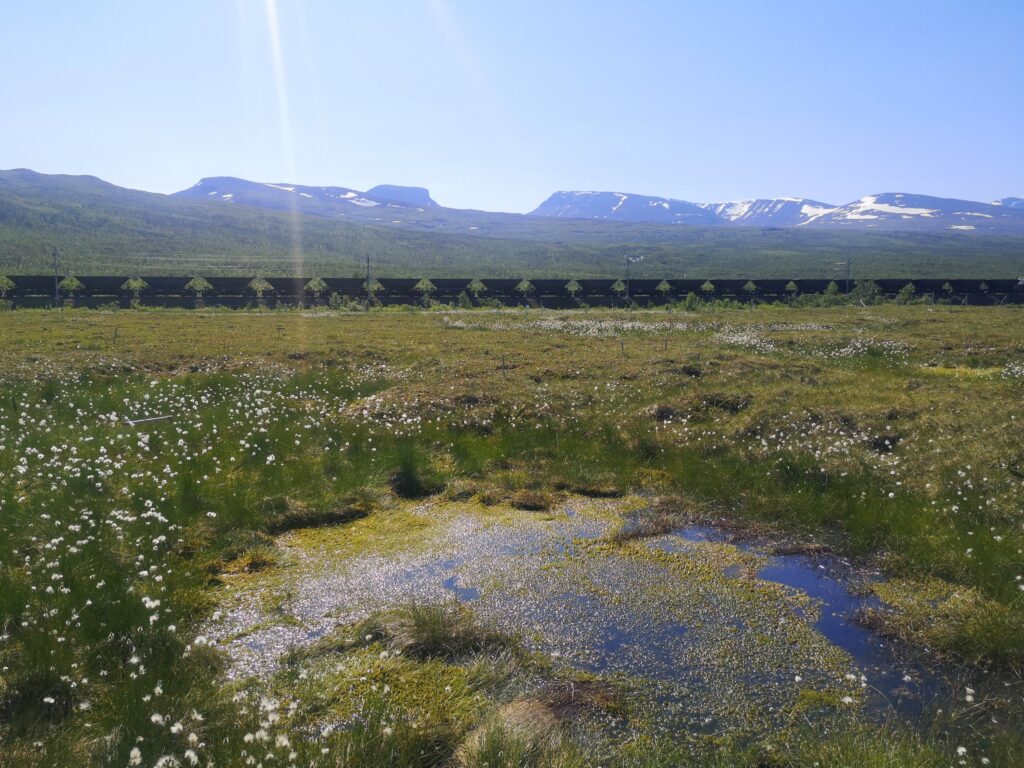
The palsa mire with carriages of iron ore passing by on a railroad. Photo by Hanna Oosterveen.
The next day, Seb gave a talk at the national park information center for tourists and fellow environmental researchers. He explained that according to the best available projections, even if we maintain current human greenhouse gas emissions, thawing permafrost alone would release enough carbon to match roughly another decade of human emissions. In one of his last slides called “What can we do?” Seb shared that we can work to reduce uncertainty by forming a more detailed picture of how permafrost works: “We cannot reach a target unless we know what that target is.” At the end of his presentation, I asked how building a more detailed picture of permafrost decreases uncertainty. He responded, “In mechanistic science, you just try to understand how permafrost works, which may or may not help clarify our understanding of the impacts of permafrost thaw or presence, but you must try.” Seb’s assertion that permafrost researchers must accept that their work may or may not be useful for setting and enforcing climate targets, in conversation with his view that his work is ethically sound, provides a perspective on what some scientists might mean when they say their work is for the “greater good.” For Seb, the “greater good” does not have to be a tangible impact, but rather, have the potential to contribute to climate target formation in the future.
According to Karen-Sue Taussig et al. (2013), potentiality in the life sciences engages with both utopian and dystopian versions of the future, including a sense of moral obligation. In Seb’s view, the imagined potential of scientific knowledge to contribute to sustainable climate change management exists in relation to the potential of an ever-intensifying climate crisis. His work appears to be fueled by a moral obligation. As long as environmental science has the potential for informing better climate governance decisions, projects must be conducted. This framing of the relationship between morality and potentiality helps clarify why Seb assessed the permafrost drill mishap as ethically sound.
At another public talk, a senior researcher gave a presentation on climate change simulation experiments at the same palsa mire. She showed how researchers use plastic net fences to accumulate snow on one side, simulating the increased snowfall predicted as the Arctic warms. In the summer, permafrost researchers measure the depth of thawed ground above the permafrost layer to gauge how increased snowfall will impact future permafrost thaw dynamics. After the researcher’s presentation, an audience member questioned the ethics of thawing a piece of what little permafrost is left in the Swedish Arctic—a conversation I had had many times during dinners, mostly with the early-career researchers I was living with at the station. The researcher replied that the project remains ethically sound because it could help form more accurate global climate targets and provide insights to other Arctic regions on how their permafrost may respond to future warming. Again, the project was for the “greater good.” The silence and shared looks in the audience, which consisted mostly of field assistants pursuing bachelor’s and master’s degrees in Ecology, pointed to some mild dissatisfaction with her response. The researcher’s conviction that the project is worthwhile was also palpable.
Conceptions of the “greater good” are unstable. For people to ascribe potentiality to their work, as the researcher does with her work on the snow fences, they must believe in the possibility of change (Taussig et al., 2013). Perhaps the gap between the moral assessment of the researcher and some of the more junior audience members could be explained by differences in the degree to which people believed in the potential of the environmental sciences to influence climate governance. In his book, Facing Gaia, Bruno Latour (2017) explains that we are no longer in a state of crisis when it comes to climate change because that would connote that climate change is temporary, manageable, and can be resolved. Rather, Latour posits that mutation better describes our relationship with nature, as we surpass tipping points, with apocalyptic scenes on the horizon—and some already realized.
In my analysis, the tensions in the above debates reflect a divergence between those who see our relationship with the earth as in a state of crisis, which holds the potential for management, and those who see our relationship with the earth as one of mutation. The latter would render management impossible and make an act like deliberately thawing permafrost seem unwarranted. If, as suggested by the responses of younger scientists, this “mutation” framing is becoming more prevalent among emerging cohorts, it may indicate a broader generational shift in expectations about what environmental science can plausibly achieve, and consequently a redefinition of what counts as a meaningful or ethically defensible intervention within the “greater good.”
Insights from my interlocutor Inge shed light on the formation of perspectives on the potential of environmental science to contribute to desirable futures. Inge and I spent days together hiking through the bush and the rocky terrain around Abisko, finding her decade-old plots so we could set up her long-term experiment for another season. As an accomplished researcher who had just been promoted to Professor, I asked her what motivates her in her career. She shared that when she was younger, she was driven by the idea that she was contributing to building political consensus that climate change is real and the Arctic is warming. However, when the climate change question became less debated, she struggled to find meaning in her work. Latour (2017), drawing on the work of Jean-Baptiste Fressoz (a historian of science, technology, and the environment), explains how scientists’ warnings of climate change passed over decision makers as it became normalized and ultimately disregarded—a process of dis-integration. For Fressoz, the process of dis-integration is part of the project of modernity. In the simultaneous acceptance and disregard of climate change by those who could have headed the calls of scientists, Inge’s sense that her work might potentially serve the “greater good” faltered.
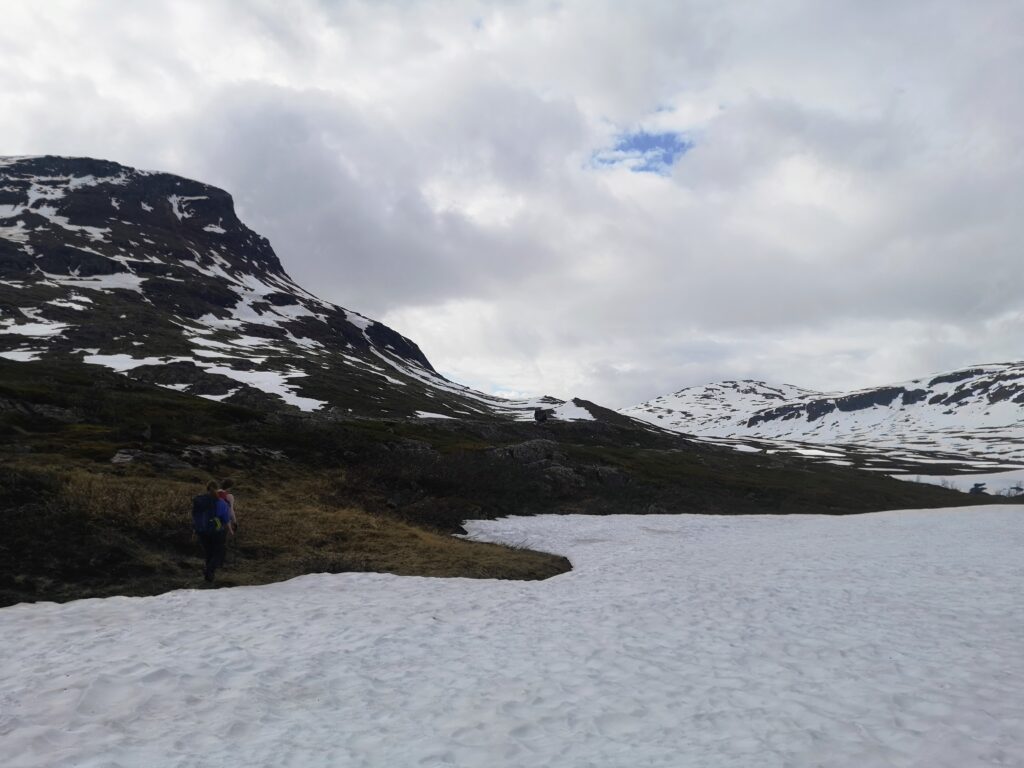
Hiking out to the field site near Abisko. Photo by Hanna Oosterveen.
Faced with feelings of disorientation in her career, Inge reached out to a mentor and spent time reflecting on what she believed her work had the potential to do. She now finds peace in knowing that she applies the expertise she has amassed through the years to produce information that has the potential to contribute to solutions to better care for the environment. The shift in Inge’s source of motivation in her work shows that belief in the potential of environmental science can be attached to different projects, which often reflect broader societal challenges. Inge’s trajectory also sheds light on how these ideas of potentiality are not inherent but are negotiated.
This essay began with Parker’s explanation that environmental researchers work to represent their research objects as well as possible while, to varying degrees, maintaining the integrity of these objects. In following the emic term “greater good,” it became clear that the ways environmental researchers gauge what moral behavior is with regards to their research objects depends on their belief in the potentiality of environmental research. In my fieldwork, the potential of science largely referred to the potential for the environmental sciences to contribute to the production of climate governance decisions that will limit carbon emissions in the future. Therefore, disagreements on the ethics of destroying sections of permafrost from some of the younger researchers at the station can be seen as a result of their disbelief in the potential for the experiments to lead to sound climate governance. Without a belief in the potential for global benefits of the research, preserving what permafrost is left becomes more valuable. Researchers’ work is thus shaped by divergent understandings of environmental sciences’ potential contributions to the futures promised by dominant climate governance processes.
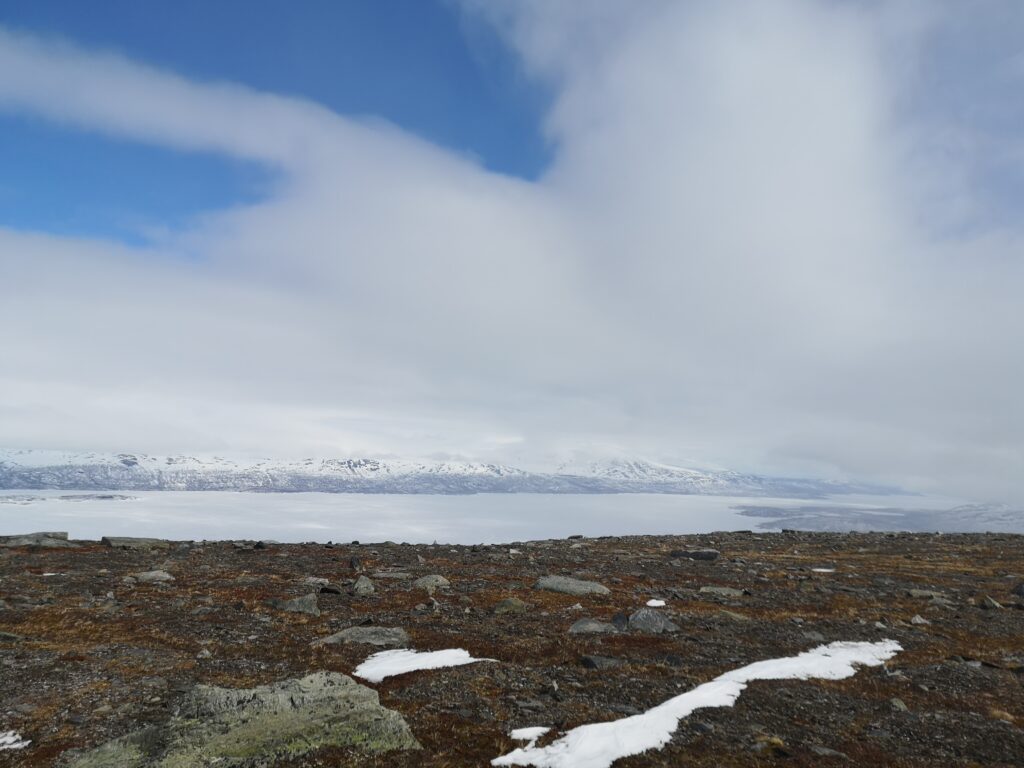
Lake Torneträsk from the foot of Čuonjávággi. Photo by Hanna Oosterveen.
References
Du, Qingsong, Guoyu Li, Dun Chen, et al. 2022. “Bibliometric Analysis of the Permafrost Research: Developments, Impacts, and Trends.” Remote Sensing 15 (1): 234.
Latour, Bruno. 2017. Facing Gaia: Eight Lectures on the New Climatic Regime. Translated by Catherine Porter. Polity.
Metcalfe, Daniel B., Thirze D. G. Hermans, Jenny Ahlstrand, et al. 2018. “Patchy Field Sampling Biases Understanding of Climate Change Impacts across the Arctic.” Nature Ecology & Evolution 2 (9): 1443–48.
Sjöberg, Ylva, Matthias B. Siewert, Ashley C. A. Rudy, et al. 2020. “Hot Trends and Impact in Permafrost Science.” Permafrost and Periglacial Processes 31 (4): 461–71.
Taussig, Karen-Sue, Klaus Hoeyer, and Stefan Helmreich. 2013. “The Anthropology of Potentiality in Biomedicine: An Introduction to Supplement 7.” Current Anthropology 54 (S7): S3–14.
Turetsky, Merritt, Benjamin Abbott, Miriam Jones, et al. 2019. “Permafrost Collapse Is Accelerating Carbon Release.” Nature 569: 32–34.
Acknowledgments
This article is based on research funded by the European Research Council (ERC) under the European Union’s Horizon 2020 research and innovation program (Grant agreement No. 856543). This research has also benefited from transnational access to the Abisko Scientific Research Station, funded by the European Union HORIZON EUROPE through the EU Project POLARIN Grant Agreement ID: 101130949.
Hanna Oosterveen is a PhD Candidate in Social Anthropology at the University of Manchester. Her research explores how environmental scientists orient their practices in a world that is widely considered to be in crisis.
Cite as: Oosterveen, Hanna. 2026. “Whose Science for the Greater Good?” In “Promised Futures,” edited by Ibrahim Ince and Erick Moreno Superlano, American Ethnologist website, 9 July. [https://americanethnologist.org/online-content/collections/promised-futures/whose-science-for-the-greater-good-by-hanna-oosterveen/]
This piece was edited by American Ethnological Society Digital Content Editor Kathryn E. Goldfarb ([email protected]).