She cannot think of the word for “jet lag” in either English or Chinese, so Vale momentarily switches to Italian and asks Ming, another second-generation Italian Qingtianese living in Milan, for differenza oraria.[1] I guess the literal translation would be “time difference,” but we know that she is thinking of 时差 (shicha) and so immediately exclaim in unison, “jet lag.” Vale gives a barely noticeable nod of quick recognition and continues, explaining how she cannot sleep well on her return visits to Qingtian because of this time difference and so she is up all night. Lonely hours which she fills with night strolls. Because her family’s house is by the rivershore, her steps often take her down to the river. Night strolls so full of nostalgia and melancholia that they almost become painful.
On her most recent return to Qingtian, after not having visited the ancestral hometown from which her parents migrated to Italy for many years, she went down to the river on her first sleepless night. Among the Proustian succession of memories that flew to her mind, one stood out: the first moment of romance in her life. She was fourteen, on a summer visit from Italy, and was overtaken by emotion when the young European-Chinese boy with whom she had been strolling down the river shyly reached out and they continued down the river holding hands. “How ugly that whole landscape now is,” she interjects, abruptly bringing the romantic scene to an anticlimactic end. Her recent night walks had not simply served to involuntarily invoke those memories of teenage romance and future possibility; they had permanently ruined them.
Vale’s sleeplessness and disappointment point to a broader condition shaping contemporary Qingtian, the hometown of a vast proportion of Chinese labor migrants in Europe. Drawing on her nocturnal and affective wanderings, I examine the temporal politics of a promised future of migrant homecoming in a town remade through remittances, infrastructural development, and nationalist discourse. I argue that this promised future of return—materialized through European-style architecture, nightly light spectacles, and moral exhortations to return to China—does not so much fail to arrive or remain deferred as forcefully materialize itself in an overbuilt and misaligned form that produces insomnia, alienation, and the erosion of the belief in migration as a life-making project. Across Qingtian, European architectural forms are appropriated, commodified, and then sinicized through party slogans, spectacular illumination, and state narratives of homecoming. The resulting built environment serves as a constant reminder of migrants’ lives abroad while simultaneously casting return to the homeland as the indisputable motivation for and culmination of migration itself. Yet many returnee migrants struggle to inhabit this landscape and find themselves alienated by the very future it seeks to materialize.
This misalignment takes material form along Qingtian’s rivershore. Since that summer of Vale’s romantic stroll, its southern bank has undergone vast transformations. It now displays row upon row of high-rise apartments, an uncanny sight for a tiny river town nestled in a mountain valley that was once so poor that over 70 percent of its population emigrated to Europe. These luxury-looking high-rises—many of which stand empty, as those who can afford their exorbitant prices remain overseas—along with much of the town’s new remittance-financed infrastructure, stand as the most visible proof of this transformation. Over the previous year of fieldwork, I had heard many locals boasting about the town’s new look, yet others spoke more ambiguously or even openly mourned the town’s transformation. A recurring lament I heard, often framed as a half-joking critique of China’s insistence on wenminghua (文明化), the pervasive current state-led imperative to “civilize” the nation, concerned the loss of Qingtian’s once-“virgin” rivershore.
Where locals had bathed and played as children, there now stands a new concrete promenade, celebrated by the local government as the centerpiece of the town’s impressive waterfront regeneration but experienced by many return migrants, for whom Qingtian is a space of the past, as an erasure of childhood intimacy and an assault on their self-defining hometown. Vale undoubtedly belongs to this latter group. “How lame, awful, ugly that bridge is,” she angrily exclaims, referring to the town’s most iconic structure: an off-white, European-style bridge that has become an internet celebrity (网红 wanghong) in China and is seemingly the pride of town. “And all the lights!” she implores, emphatic hand gestures in full display, further underscoring her Italian upbringing. Here Ming joins in, calling them tacky. I laugh and offer the word I have heard countless times in Qingtian: 土 (tu), “earthy,” “unsophisticated.” And it is in this moment that I feel perfectly aligned. Unlike Vale and Ming, I did not grow up with attachments to Qingtian and so cannot fully access those same feelings of desperate nostalgia and deprivation at seeing my childhood home transformed beyond recognition. Yet here was something I, too, knew viscerally: the lightscape of Qingtian and its assault on the senses.
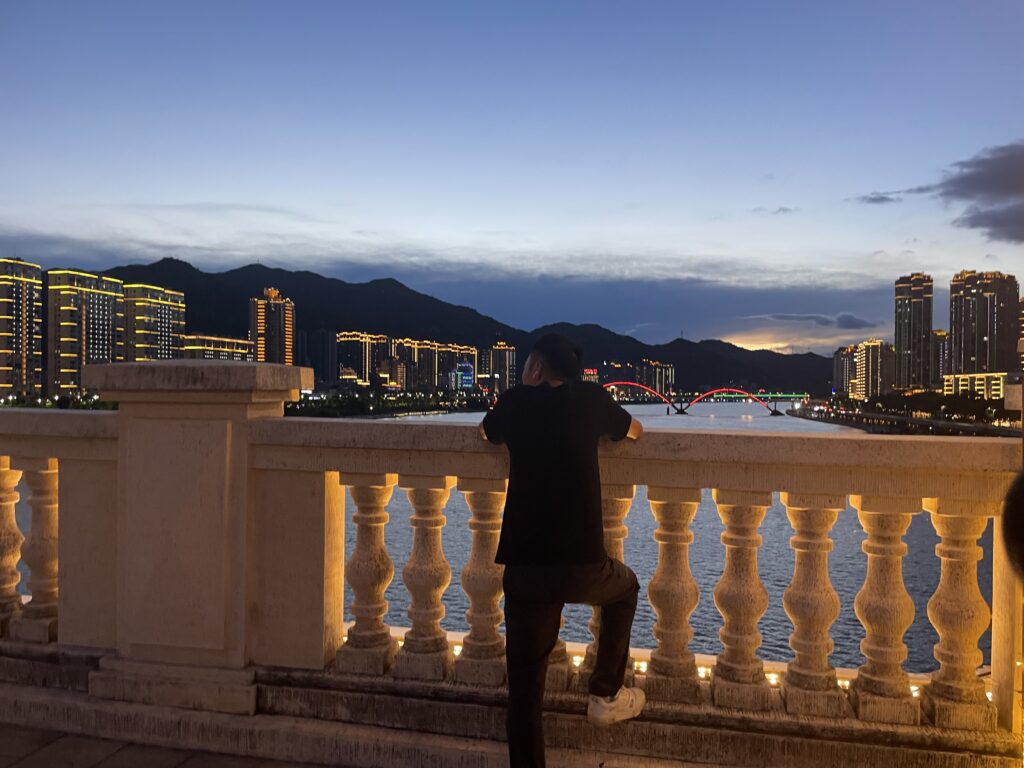
A lone walker on the European bridge stares as Qingtian’s nightly illumination begins. Photo by Teresa Irigoyen-Lopez.
It had taken me months to understand why I was sleeping so poorly during my ethnographic research. The loneliness of fieldwork, the emotional toll of listening to my participants’ migration stories, the sedentary rhythm of a small town largely inhabited by left-behind elderly and children, and the constant jet lag from following participants on their migratory journeys across international borders, all seemed plausible explanations. Only later did I recognize the most obvious factor: the blinding lights of my residential high-rise, one of those new riverside buildings positioned at the end of the famous bridge. Every evening from six to nine, my windows and balcony glowed bright orange. Afterward, often into the early hours, came strobe lights, lasers, and moving head beams that shone directly through my wall-length windows into the bed where I unsuccessfully tried to fall asleep.
My own insomnia became an ethnographic condition. Unable to sleep, I walked. I spent my waking hours walking through town, attending to the migratory stories embedded in Qingtian’s built environment. Over sixteen months, I witnessed the demolition of the old town and its rapid replacement by the state-designed “promised future”: high-rises, the opening of multiple European-themed businesses alongside the closure of others, and the growing success of tourism marketing as domestic visitors arrived daily to photograph the bridge and perform Europeanness.
I watched mountains being literally cut in half to make room for a massive museum complex meant to showcase “Qingtian’s many cultures,” from its traditional stone carvings to its now identity-defining wine and coffee industries. By day, this rapidly changing urban environment clearly reflects the local government’s pragmatic ambitions to construct a modernized hometown to which migrants might one day return. It is at night, however, that the consequences of these ambitions become apparent. As the sun disappears behind the majestic mountains enclosing the town and darkness settles, Qingtian transforms into a surreal spectacle of lights, and it is then that return imaginaries collapse into insomnia and alienation.
At precisely six p.m., endless lights illuminating the new infrastructure across town switch on simultaneously, and the spectacle begins (Debord 1967). Buildings on both riverbanks, numerous bridges, and even the small pagoda perched on the hillside all blaze into color. It is a world-class display deliberately defiant of Western aesthetics paradigms. Vibrant multi-color neon lights illuminate façades while Chinese Communist Party slogans are projected onto high-rise surfaces. Where the town’s daytime aesthetics favor cream and restraint, Qingtian at night rejects Western preferences for neutrals and monochrome in favor of the rich and saturated color palette central to the aesthetic evolution of Chinese urban visual culture.
The scene recalls the Bund in Shanghai, and the parallel is politically charged. Shanghai’s historic riverfront, lined with grand European-style architecture built by foreign powers during the treaty-port era following China’s defeat in the Opium Wars, has long functioned as an emblem of cosmopolitan modernity forged through colonial encounter. Qingtian’s twenty-first-century reclamation of similar European architectural forms presupposes that its overseas migrants can, and should, now claim such aesthetics and identities as their own and inscribe them onto the hometown’s built environment. Yet, where Shanghai’s Bund now stages cosmopolitan heritage for crowds of residents and tourists alike, Qingtian’s nightly spectacle unfolds before a largely absent audience. Except for brief periods around Chinese New Year and August when overseas migrants return for short visits, the rivershore remains empty. Day tourists have left. Local residents are either domestic laborers (and so working long hours with little time for leisurely strolls) or the left-behind elder and younger relatives of those abroad long accustomed to the extravagant nightly flow. The future is performed, but few remain to see it.
This absence becomes crucial. The light pollution and profound sense of loneliness experienced by nocturnal wanderers like Vale in Qingtian are not simply environmental conditions but effects of a town built in anticipation of return. The transformation of the once-serene nightscape into a rivershore saturated with glare, with each empty apartment window acting as a source of intrusive neon light, foregrounds the extent to which return has been planned for materially, even as everyday social life remains largely elsewhere. The lights do not animate the town so much as expose its emptiness, turning infrastructure into a moral surface for the state to, quite literally, imprint migratory memory and future possibility onto the town’s built environment.
A night stroll along the rivershore is impossible without being sensorially assaulted by the massive projected character slogans reminiscent of Mao-era infamous big-character posters (大字报 dazibao). They cycle endlessly across the forty-story Qingtian Overseas Chinese Headquarters Economic Building, the highest building in town strategically positioned at the bridge’s southern end. The projections, displayed every few minutes every single night for years now, begin with the ubiquitous twelve “core values of Chinese Socialism” pervading contemporary China, before shifting to more localized exhortations: a benevolent Qingtian, the directive to press forward in pursuit of truth (求是挺进 qiushi tingjin) and, most strikingly, to “cross mountains and ask the sea” (跨山问海 kuashanwenhai). A recent adaptation of the idiom “crossing mountains and seas” that has recently appeared in Belt and Road Initiative discourse and state narratives of global expansion, metaphorically framing migration as an arduous national endeavor. These messages position migration not as a personal aspiration but as a collective duty. Qingtian’s nocturnal grandeur thus functions as much a tribute to the locals’ overseas success as an effort to mold migrant subjectivities through the moral directive to perform the return duties expected of pragmatic pioneers. And yet, the town’s illuminated emptiness reveals the limits of this vision: remittances have (over)built infrastructure, but not a livable future.
Qingtian’s nightscape constitutes what I term an “architecture of insomnia”: a built environment that materializes promised futures in ways that are temporally misaligned and affectively uninhabitable. Drawing on Sianne Ngai’s notion of noncathartic aesthetic (2005), the lightscape produces no emotional release, only foregrounding suspended anticipation. Overseas migrants, now shaped by decades abroad and attuned to different aesthetic sensibilities, struggle to feel pride in this hyper-visibility. Instead, they describe the lights as tacky, violent, overwhelmingly underwhelming. It is not that the promised future of returnee migrant prosperity has failed to arrive, but, rather, that it has arrived too loudly, too insistently, and for the wrong people.
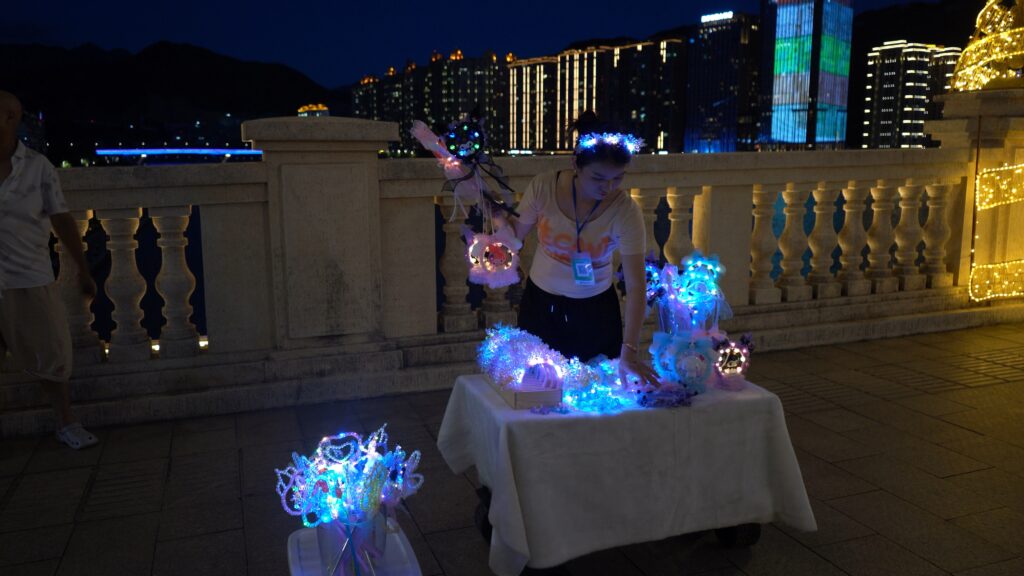
A night vendor sells glowing hairbands and toy wands against Qingtian’s nightly spectacle of lights, where spectacle itself becomes commodified and embodied. Photo by Teresa Irigoyen-Lopez.
The ultimate irony is temporal. Qingtian’s nightscape lights up precisely when the local day ends, while life in Europe, where most Qingtianese actually reside, is in full swing (Bergson 1910). Vale’s jet-lagged night strolls and her unavoidable exposure to the town’s sensorial bombardment expose the embodied afterlife of promised futures: endless labor abroad, sleeplessness upon return, and a hometown that never truly turns off. Overseas migrants return briefly, often to feel out the possibility of permanent homecoming, only to encounter sensory violence and permanent temporal dislocation.
The nightly spectacle, consecutively repeated without audience or catharsis, exemplifies the residents’ growing disillusionment with the grand imaginaries of migration that once sustained hope. Qingtian’s illuminated rivershore makes overseas migrants the sole spectators of a solitude of return. In lighting the town each night, the promise of a better future hardens into insomnia: an embodied condition marked not simply by the inability to sleep, but the slow erosion of belief in the dream that once made migration bearable.
Notes
[1] All personal names in this essay are pseudonyms.
Acknowledgements
This research was made possible by support from the Ramón Areces Foundation, the China Studies Program, and the Sino-British Fellowship Trust. The views expressed here are solely my own.
References
Bergson, Henri. 1910. Time and Free Will: An Essay on the Immediate Data of Consciousness. Translated by F. L. Pogson. George Allen & Unwin.
Debord, Guy. 1967. The Society of the Spectacle. Buchet-Chastel.
Ngai, Sianne. 2005. Ugly Feelings. Harvard University Press.
Teresa Irigoyen-Lopez is a migration scholar currently based at Fudan University. Her research examines differentiated mobility, with a focus on synchronous domestic and international migration in China.
Cite as: Irigoyen-Lopez, Teresa. 2026. “Architecture of Insomnia: Illuminating Absence in a Hometown of Overseas Chinese.” In “Promised Futures,” edited by Ibrahim Ince and Erick Moreno Superlano, American Ethnologist website, 9 July [https://americanethnologist.org/online-content/collections/promised-futures/architecture-of-insomnia-illuminating-absence-in-a-hometown-of-overseas-chinese-by-teresa-irigoyen-lopez/]
This piece was edited by American Ethnological Society Digital Content Editor Kathryn E. Goldfarb ([email protected]).