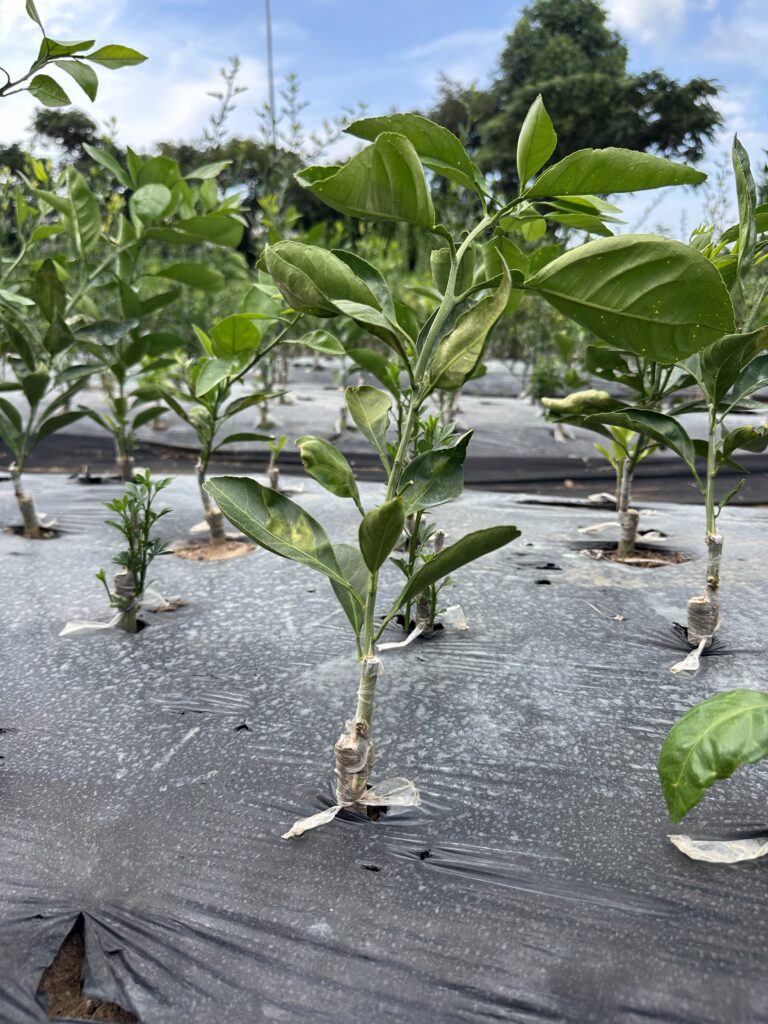
Citrus sapling farm in Jeju, Korea, July 2025. Photograph by June Hee Kwon.
Around seven o’clock on a cold January morning in 2024, I arrived at Kim Jong’s citrus farm in Hahyo—long known as the heart of premium sweet citrus production in Seogwipo, the southern part of Jeju Island, often marketed as the “Hawaii of Korea.” Jong, a farmer in her fifties who manages multiple orchards with her husband, was already in full motion. As I stepped into the office attached to the farm, she was toggling between tasks: preparing mid-morning snacks for her workers, monitoring the pace of the harvest, and ensuring everything stayed on track in the compressed winter picking schedule. After greeting me with a warm smile, she led me to the orchard where four women were already deep into their morning labor so that I could learn the entire harvesting process.
The team—Jong’s sister, sister-in-law, aunt, and a neighbor friend—were all daily laborers, yet also kin or quasi-kin, what Jeju people call gwendang. “Because I have my gwendang like this,” Jong said, “I don’t have to worry about finding pickers.” Her relief was well-founded. During the December–January peak, labor is scarce and fiercely competitive across Jeju. Many farmers depend on migrant workers from Nepal, Vietnam, China, and the Philippines, who circulate from farm to farm based on higher wages or preferred schedules. Jong’s gwendang, by contrast, are rooted in the village; they commit to completing the harvest at Jong’s farm before moving on to other obligations. No contract was signed with them. But deep promises had been made in a kin-like network fostered over time.
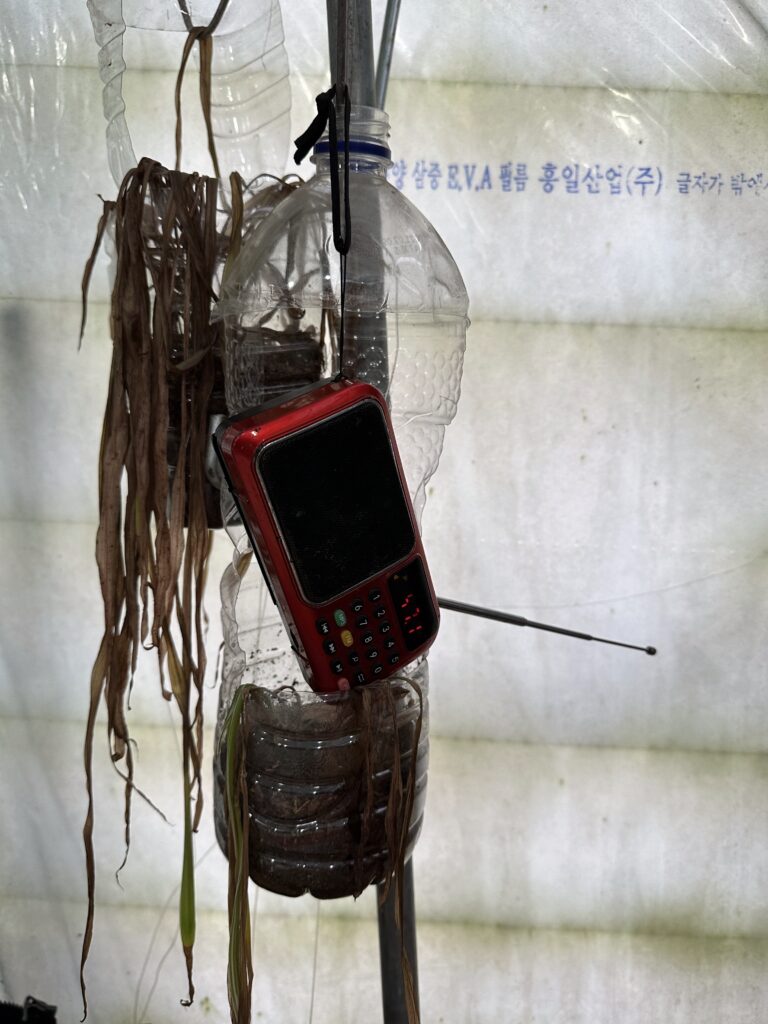
Radio as a Sonic Company in Jeju Korea, January 2025. Photograph by June Hee Kwon.
Working alongside them, I learned to pick citrus the “right” way: not cutting too close to the skin, not injuring the tender new shoots that would become next year’s fruiting branches. My body adjusted to the rhythm and repetition of the work. A small red radio hanging from a branch broadcasted the island dialect chatter and popular songs, sonic company that sustained the long hours of labor. The women rarely engaged in extended conversation but occasionally burst into laughter at something on the radio—moments of collective breath amid the urgency of their deadline: finish this orchard within a week.
On my second day at the farm, I noticed details I had missed the day before—the small saplings planted along the margins of the greenhouse, each only a few inches high, and, in the adjacent greenhouse, rows of slender young trees, not yet mature enough to bear fruit. To my untrained eye, they looked nearly identical, but Jong explained that each row represented a different cultivar, each carrying its own promise and risk:
We planted different cultivar saplings last year for experimenting. They’re not popular in the main market yet. We don’t know if they will grow well here. We are indebted from buying saplings and having no income for the first couple of years. But we’ve planted our future in these trees. Some look promising; some already died. We must wait and see until we know.
The phrase farmers repeatedly used—“until we know”—structured my conversations with Jong and other citrus farmers throughout 2023-24. Taking this idiom as an analytic starting point, I argue that farmers and trees are bound together in a shared waithood, a condition of promised futures or suspended futurity in which livelihoods, care, and investment unfold across multiple, uneven, and unpredictable times. I see waithood not as temporal void or delay, but as obligated continuation of care. This interspecies temporality, or interspecies co-becoming, is central to farming practices shaped by the intersecting rhythms of plants, markets, climate, and national development. Jong’s relationship with citrus trees is not simply an interaction between two “species,” but a multispecies temporal arrangement: a waiting without guarantees, in which futures are promised but held open by the trees’ uncertain responses to weather, soil, pests, cultivars, markets, and care.
“Until we know” is thus not merely a descriptive idiom of future investment but an affective structure that organizes labor rhythms, financial risk, and intergenerational aspiration. It captures a mode of life lived with citrus trees as agents whose growth, survival, and yield continually shape household economies. As part of this farming world, Jong corresponds—“joining awareness to the flow” (Ingold 2021)—with trees and the other actors that compose the orchard. Yet what such correspondence yields is never fully predictable. The relation between farmers and saplings crystallizes a gambling-like investment that defines Jeju’s citrus world: a shared wager, sustained in care and labor, held in suspended promises—until they know.
Citrus time
My regular commute to Jong’s orchard became a tutoring ritual, with lessons in plant physiology, grafting, soil care, and multispecies attunement. Jong passionately spoke of how she listens to her trees and how the trees listen back. Such listening requires intimate observation of biological rhythms: “I am so curious to know how my trees are doing overnight that I want to come out to the farm as soon as I wake up in the morning.” Within this shared futurity that shapes her present, farmers often come to relate to citrus trees not simply as crops or assets but also as kin. Drawing on Haraway’s notion of “making kin” (Haraway 2016), I treat kinship not as sentiment or moral extension but as a temporal relation forged through shared exposure to uncertainty. Citrus trees and farmers become kin not because they resemble each other, but because the trees’ unknowable futures are mutually bound to farmers’ life courses—debt, inheritance, children’s education, and retirement. These kin relationships sustain care when farmers’ calculations alone cannot secure outcomes.
Jong gives sustained attention and care to her citrus trees. In her farming practice, timing is crucial. If she harvests too early, the fruit lacks sweetness; if she waits too long, the tree becomes exhausted and may not bear well the following year. Respecting the tree’s time is thus an investment in future yield. Yet Jong’s schedule—shaped by her agreements with gwendang and by the demands of the New Year’s prime selling season—often forces compromise. Fruits that are not fully ripe must still be picked to meet the highest-value market window. Climate change further unsettles this calculus. Winters sometimes arrive early, while summers grow too harsh for citrus to ripen in time for the peak market season. Within this compressed citrus time, farmers and trees continually negotiate between biological pace and developmental urgency, between slow-growing futures and market-driven deadlines. Citrus farming thus comes to embody multispecies temporal demands.
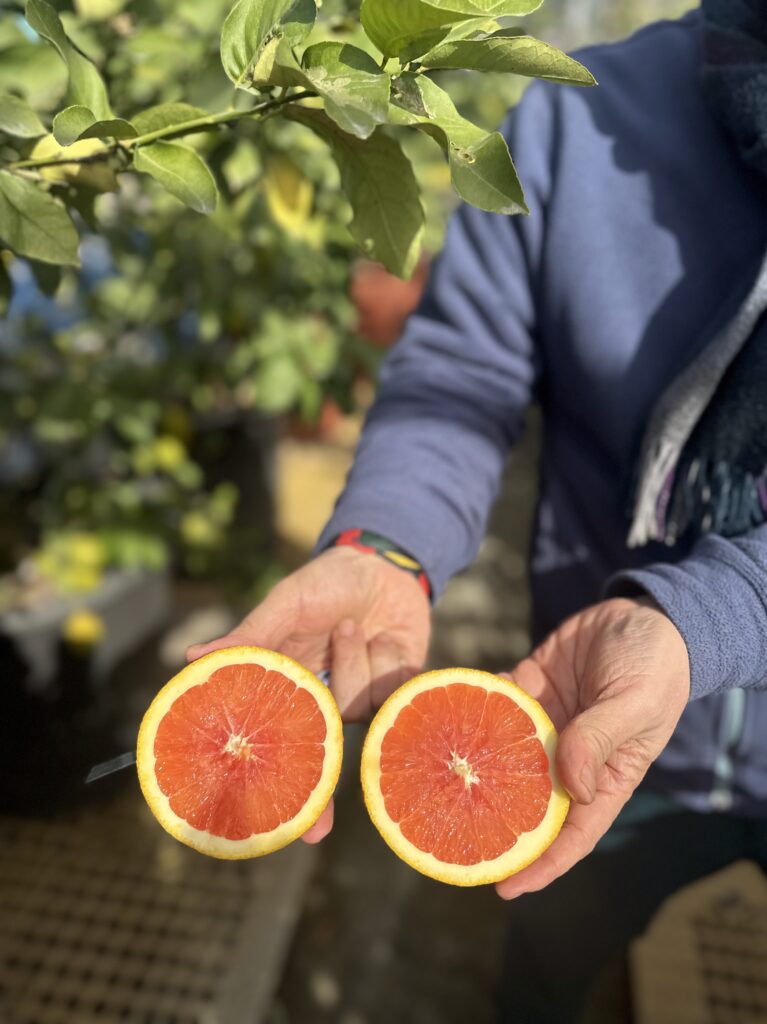
Citrus Cultivar in a decade long experiment in Jeju, Korea, December 2025. Photograph by June Hee Kwon.
At a macro level, citrus time extends into South Korea’s developmental plans of the 1960s. During this period, Jeju was designated as a “frontier” and assigned two distinct roles: a frontier of tourism and a frontier of citrus farming. The latter was possible only on Jeju, given its mild climate and volcanic soils. Citrus trees soon became central agents in reshaping the island, transforming it from a space of poverty, ecological scarcity, and political marginalization, to a space of promise. Within this context, Jeju migrants in Japan—many of whom had left the island because of colonial exploitation, colonial labor recruitments, or political displacement—began sending citrus saplings back to their hometowns in the 1960s as diasporic gifts. These “returning trees,” sent on behalf of islanders themselves under Cold War political constraints, seeded not only a new industry but also a new horizon of possibility, binding Jeju’s development to transnational flows of people, agricultural knowledge, and longing.
However, these saplings also carried profound uncertainty. Farmers had to abandon subsistence crops essential for survival and replace them with an unfamiliar fruit tree whose profitability was untested. When the first saplings arrived in the 1960s, as a farmer testified, citrus trees were planted on remote “bad lands,” deemed expendable because the endeavor itself was experimental, offering no income and demanding years of care before any revenue might be obtained. As citrus rapidly gained national popularity in the 1970s, the geography of cultivation shifted markedly. Orchards migrated from marginal to prime lands. Citrus became so lucrative that farmers affectionately nicknamed them “university trees,” acknowledging their role in funding children’s education on the Korean mainland and reshaping the future of the island—a dream unimaginable for earlier generations. Today, Jeju has, in many ways, become a citrus island: its economy, ecology, and daily life fused with the multiple rhythms and vulnerabilities of these long-lived trees, most of them fifty to sixty years old.
Inherited future
Within this broader history, Jong’s family narrative echoes Jeju’s developmental time. Her parents were among the earliest pioneers to leap into the emerging citrus frontier. Her father, an exceptionally hardworking yet impoverished stone mason, survived the April 3, 1948 uprising but lost both parents, growing up without access to formal schooling. Her mother, who had completed elementary education, became the household’s outward-facing strategist—reading contracts, negotiating loans, and gathering information across the island. When rumors of citrus saplings began to circulate, her mother borrowed money to purchase them, without knowing which cultivars might take root. The early years unfolded as a period of waithood: saplings demanded continuous care but yielded no income, only accumulating debt and interest, conditions that resonate with Jong’s present struggles. Once the trees finally fruited, the family expanded their landholdings slowly, parcel by parcel. Jong’s current prosperity—and the horizon of life possibilities she now inhabits—rests on the uncertain botanical risks and labor investments her parents made half a century ago.
That inheritance is not only economic but temporal. Jong often dated the trees she inherited from her parents in relation to her own life course. “My mother said these were planted when I was born,” she told me. “So they’re as old as me.” Many farmers similarly measured the age of trees through family milestones: “when my daughter started elementary school,” “when my son went to the army.” Trees age alongside the people who care for them, functioning as living archives that record family histories, economic shifts, and the island’s developmental past. The saplings in Jong’s greenhouse, planted along its margins and growing alongside her memories, extend this intimate entanglement of tree life and farmer livelihood. As they mature, they invite continual evaluation: Which saplings survived this year’s disease? Which cultivars might anchor a new orchard—or secure another decade of livelihood? For Jong and her husband, these saplings are not simply promised futures, but companions in an ongoing process of care whose outcomes remain unresolved.
Until we know
The promised future of citrus farming does not lie solely in market revenues or high-quality fruit. It is also carried through inherited land and trees—often marginal, stone-filled plots gradually converted into orchards—along with the varieties passed down, the forms of attention they received, and the embodied knowledge that traveled through grafts, soils, and hands. The future is forged between past and present, inheritance and ongoing work, botanical adaptation and humanmemories. This future takes shape through a shared temporality in which neither farmers nor trees fully control how life unfolds but instead adjust to and correspond with one another over time. Farming, in this sense, is sustained through ongoing relations that demand attentiveness, obligation, and endurance across uneven life rhythms. Waithood—where outcomes remain unknowable until they ripen—is the condition under which both farmers and trees must nonetheless continue their labor. Jeju’s citrus world thus shows that farming futures are not secured through planning alone but cultivated through waithood, as labor and commitment remain bound to futures that may never materialize.
References
Ingold, Tim. 2021. Correspondences. Polity Press.
Haraway, Donna Jeanne. 2016. Staying with the Trouble: Making Kin in the Chthulucene. Duke University Press.
June Hee Kwon is Associate Professor in the Asian Studies Program at California State University, Sacramento. She is the author of Borderland Dreams: The Transnational Lives of Korean Chinese Workers (Duke University Press, 2023). Her research explores how human and nonhuman mobilities reorganize ecologies, economies, and everyday life within and beyond Cold War geopolitical formations across East Asia.
Cite as: Kwon, June Hee. 2026. “Until We Know: The Waithood of Citrus Trees in Jeju, Korea.” In “Promised Futures,” edited by Ibrahim Ince and Erick Moreno Superlano, American Ethnologist website, 9 July. [https://americanethnologist.org/online-content/collections/promised-futures/until-we-know-the-waithood-of-citrus-trees-in-jeju-korea-by-june-hee-kwon/]
This piece was edited by American Ethnological Society Digital Content Editor Kathryn E. Goldfarb ([email protected]).