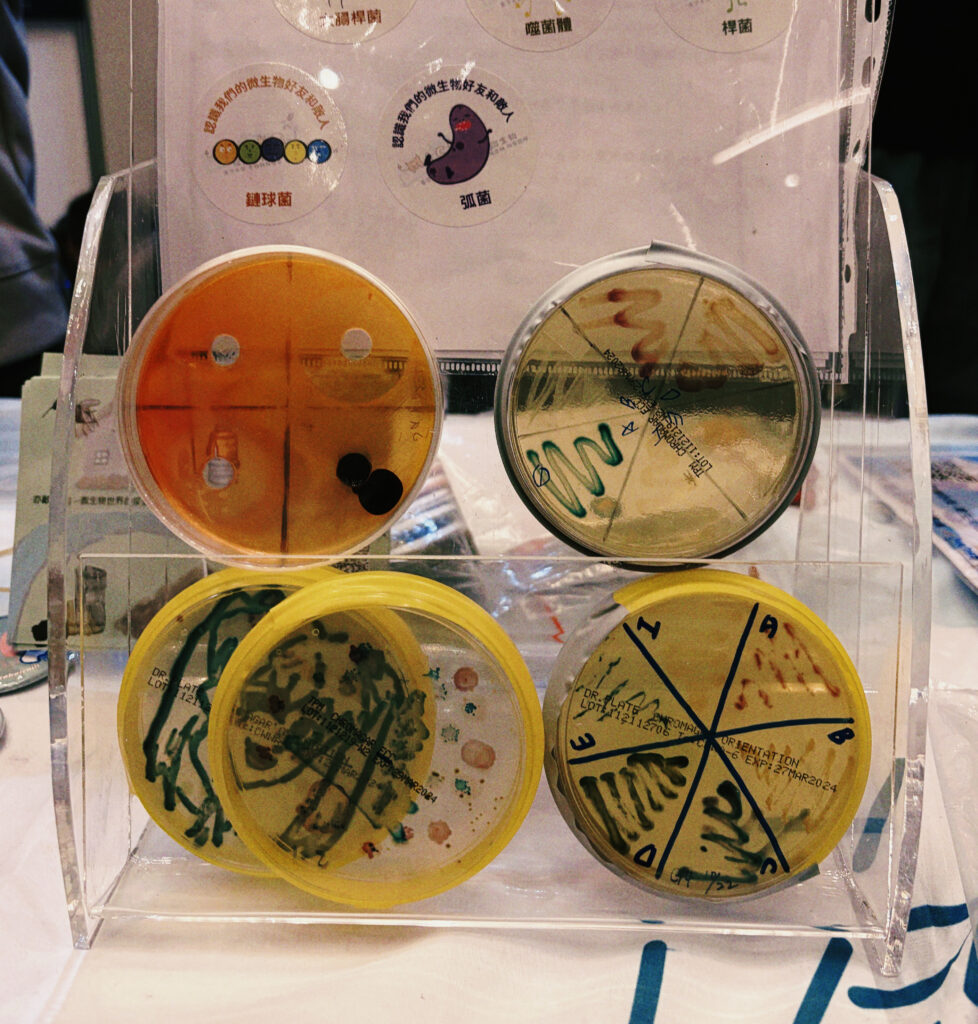
A pedagogical display using microbial Petri dishes designed to assist the public in distinguishing good and harmful bacteria at the Microbiome Carnival in Taipei, January 2026. Photo by Shi Yeu Nga.
In late December 2020, at the height of the COVID pandemic, I secured a position that enabled me to leave Malaysia and relocate to Taiwan after six months of enforced lockdown. During the flight to Taipei, a probiotic commercial, “Healthy Gut, Happy Mind,” appeared on the seatback screen between safety announcements, while a news ticker below warned of the fatal coronavirus. This juxtaposition of life and death was arresting. It foregrounded a tension that would later orient my fieldwork: the contrast between microscopic agents feared for their capacity to disrupt life and those increasingly valorized as its sustainers.
Within the Sinosphere, probiotics (yishengjun, 益生菌) are commonly described as edible, benevolent bacteria that promise vitality, emancipatory possibilities, and ecological balance within the nexus of human bodies, particularly as they are institutionally embedded in Taiwan. Attending to these human-microbial entanglements reveals how individuals in East Asia construct anticipatory orientations and experiment with emergent idioms of wellness. While Judith Farquhar and Qicheng Zhang (2012) trace a publishing boom in self-help during late socialist and post socialist China, coinciding with the partial retreat of state healthcare, Taiwan’s intensified engagement with microbes poses a different question: what, precisely, do probiotics come to represent? As bacteria are enrolled as agents of care, sensory practices within everyday food-medicine continuums are reoriented toward molecularized, quantified, and commercially mediated forms of personalized care. Microbes thus occupy a timely slot in East Asian wellness regimes, promising efficiency, specificity, and futurity at a time when other modes of life maintenance appear inadequate amid proliferating uncertainties.
Friendly microbes circulated not only as commercial slogans but also permeated parenting routines, interpersonal exchanges, domestic care, and urban pet-keeping. In community pharmacies, specialists advised customers on matching particular strains to stress-related symptoms. Metro advertisements marketed digestive balance as a route to anti-aging and emotional consistency. Medical experts and nutritionists disseminated specific formulations on digital platforms as tools for health stewardship (baojian). When I returned to Taiwan in 2024 for extensive fieldwork, these probiotic economies had intensified further, accompanied by heightened optimism. Beneath these propitious tones lies a managerial vision of cultivating commensal microbiota to optimize excretion, reduce toxins, and modulate neurotransmitter activity. Functional formulations of gut care thus reframed ordinary health communication as a pursuit of precision amid pervasive precarity.

Metro station advertisement linking gut health to anti-aging. Photo by Shi Yeu Nga.
What ultimately captured my attention extended beyond the contemporary reframing of microbes as promissory rather than threatening entities (Paxson and Helmreich 2014), which has animated expanding practices of microbial nurturance among both experts and laypeople (Strasser et al. 2019). Equally notable are the intensifying social optimism and interspecies corporeal labor invested in scaling up microscopic care. I became concerned with how probiotics acquired credibility as agents capable of repairing fractured social orders, fostering ecological balance, and reconfiguring mundane textures of care. Their efficacy was never solely clinical. Instead, it emerged through situated practices, interpersonal adjustments in regulating ingestion, the circulation of sensorial testimonies, and the translation of bodily idioms through which people articulated discomfort and risk, thereby gesturing toward more affirmative futures.
Taiwan’s contemporary enthusiasm for probiotics can be traced through the longue durée of its microbial economy, connecting colonial industrial debris to postwar nationalist campaigns and present-day person-centered wellness. In the 1920s, Japanese colonial sugar-refining technologies produced large quantities of molasses as a crystallized byproduct. Rather than discard these residues, technicians converted microbial excess into edible supplements. These commodities—later remembered as vitamin-rich “yeast candies”—functioned as early state-mediated interventions intended to enhance bodily growth. In the postwar period, yeast consumption was incorporated into nationalist projects of population management, distributed through schools and military coups, and, in the 1950s, aligned with the Republic of China’s Cold War campaign of “Opposing Communism and Fighting Soviet Russia,” which framed nutrition and bodily discipline as matters of national survival against the socialist bloc.
By the mid-twentieth century, microbial consumption intersected with the ascent of lactic acid bacteria from Japan. The cultivation of Lactobacillus casei strain Shirota and its commercialization as Yakult introduced a routinized microbial ingestion into Taiwanese households, normalizing the notion that gut function and bowel regularity required continuous supplementation. Together, these histories established microbes as subjects of governance and self-care, rendering probiotic consumption an ordinary technoscientific response to bodily maintenance in contemporary Taiwan.

Early newspaper advertisement promoting Yakult for gut health and physical strength. Source: Economic Daily News, 9 March 1968.
The contemporary probio-scape emerges at the junction of two overlapping yet differently imagined regimes of microbial care. What scientists retrospectively term “first-generation probiotics” were anchored in conventions of food security. Here, “tradition” condenses multiple temporalities: the industrial commercialization of Japan-mediated lactic acid bacteria since the 1930s and Chinese fermentation practices that stretch back millennia. These strains, typically Lactobacillus andBifidobacterium, derived legitimacy through certification, stability, and presumed histories of human consumption, offering generalized promises of digestive balance rather than targeted metabolic intervention.
In recent years, Taiwanese biotechnology firms have advanced a multisectoral horizon under the banner of “next-generation probiotics.” This framing foregrounds scientific precision and, increasingly, planetary health, recasting friendly microbes as targeted instruments engineered to intervene in specific physiological, psychological, or environmental conditions. Unlike earlier probiotic visions, next-generation microbial care begins with a problem-solving imperative: what, exactly, is a given microbe meant to address? Its development rests on intensive human-centered aspirations that draw on microbioinformatics, predictive and preventive medicine, participatory experimentation, and ecological models derived from agriculture and animal husbandry, treating the microbiome as a system to be calibrated. This shift parallels broader transformations in Taiwanese self-care discourse, moving from cultivating gut balance toward redistributing responsibility across planetary imaginaries. Bodily porosity attains somatic prominence here, marking the human body as an ecological passage attuned to toxicity, leakage, and uninhabitability.
Taken together, these probio-articulations—one rooted in inherited metabolic criteria, the other in precision strategies for metabolizing contemporary risks—signal a turn toward precision-oriented microbial care in how wellbeing is imagined and pursued. Mel Chen’s (2012) account of embodiment as constituted through entanglements with contaminants and nonhuman agents resonates with these narratives, presenting bodily porosity as an ordinary condition rather than an exception. Next-generation probiotic discourses similarly treat bodily states as emerging through cross-scalar exchanges and communicative assemblages, casting microbial intervention as a technique for recalibrating metabolic capacity in the face of uncertain futures.
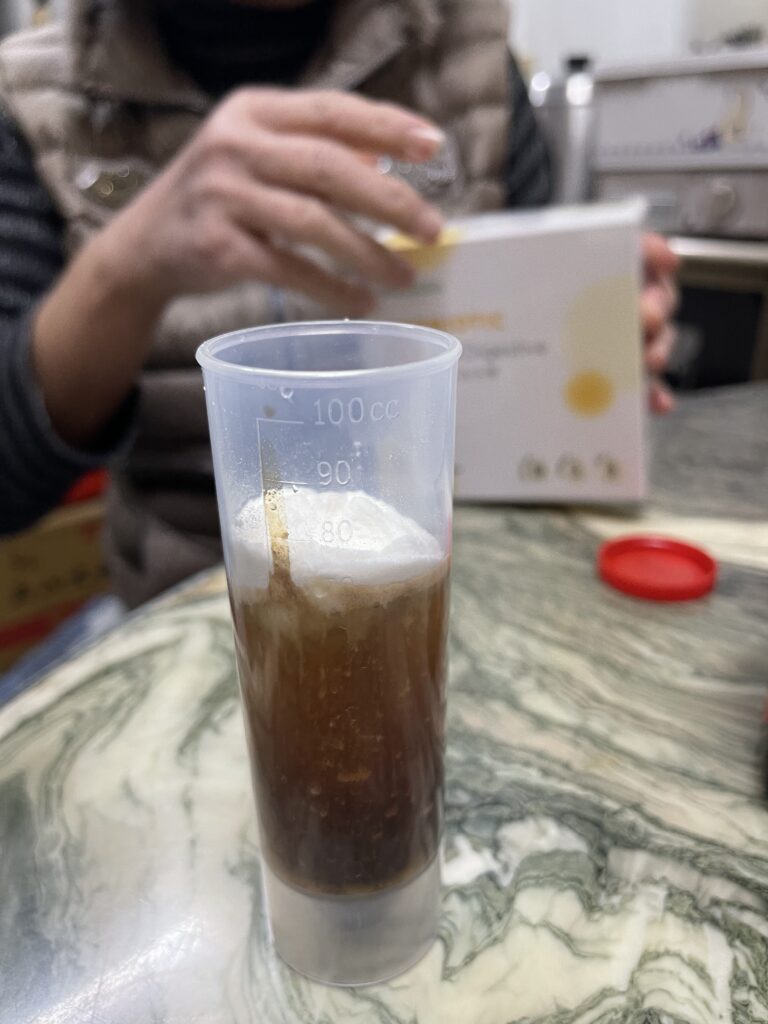
A research contact prepares a probiotic “cocktail” by mixing brands. Photo by Shi Yeu Nga.
I traced probiotic eaters from pharmacies and direct-sales gatherings to domestic spaces, attending to how microbial life was folded into ordinary practices of care. Rather than approaching probiotics solely through questions of biomedical efficacy, I became interested in the reassurance that accompanied their consumption. The following moment occurred during a conversation with an avid probiotic distributor; all personal names for interlocutors are pseudonyms. I wrote in my field notes:
As we talked, Jane rummaged in her sling bag and took out probiotic sachets in several colors. Each color marked a different bacterial strain and its intended function. She tore one open, tipped the fine white powder onto her tongue, and chased it with a sip of water. She then pressed three sachets into my hand to take as well. Noticing my hesitation, she said, “Most people take one or two sachets a day, but I can take several. Sometimes I finish an entire box while watching Korean dramas. There are thirty in a box. It doesn’t matter; whatever exceeds will pass through and come out in your poops. These are good bacteria. They won’t kill you. They’re not germs or viruses.”
I frequently encountered accounts that framed probiotics not merely as supplements but as sensory pleasures rooted in microbial friendliness. This affinity intersects with another register of microbial mass circulating in commercial discourses: the competitive emphasis on colony-forming units (CFU). Across pharmacy shelves and e-commerce platforms, CFU counts serve as persuasive evidence of technological competence, signaling human mastery over bacterial stabilization, storage, and survival through the body’s acidic checkpoints. High counts promise that microbes will reach the human gut alive and ready to colonize.
From the media interfaces of microbiome scientists and innovators, it is common to read the phrase, “to feel what you have eaten.” Experts invoked this expression to explain why probiotics should not be perceived as pharmaceutical interventions that produce immediate and measurable effects. Rather, probiotic efficacy was described in terms of cumulative consumption. Consumers were advised to gradually attune themselves to subtle bodily changes, such as shifts in bowel regularity, sleep quality, and mood, that might become perceptible over time. Yet this was not an invitation to trust bodily sensations indiscriminately. Scientists distinguished these changes from vague subjective feelings, framing them instead as bodily experiences that should correspond to microbiological processes and scientific data. From fermentation laboratories and packaging lines to the moment of consumer choice, the microbial strain’s trajectory is imagined as a passage of attrition and survival. Scientists note, however, that once ingested, probiotic strains encounter unpredictable gastrointestinal ecologies shaped by shifting pH gradients, anaerobic prerequisites, and resident microbial communities that may neutralize or absorb them. Most strains are transient, washing out within a week. In response, manufacturers amplify CFU counts, recasting quantity as anticipatory insurance. Consumers, in turn, interpret this enumeration as a wager on a future in which external microbes will take hold, rendering visceral life more resilient and affectively balanced. The numeric race thus becomes a site where health expectations and probio-technological visions converge. Nevertheless, the habitable gut remains probabilistic; more bacteria increase the likelihood, but not the guarantee, of achieving the desire to feel microbes as an occurring witness in digesting despair in one’s visceral life.
One evening, Tung, a single mother working as a direct seller for a renowned biotech corporation, invited me to an OPP, an “opportunity” presentation in company parlance. The OPP operated as a liminal space where participants sought hope for turning their lives around. The event unfolded in a ballroom lined with banners celebrating top probiotic sellers, many of whom were single parents, caregivers, or individuals emerging from prolonged illness or distress. Promotional videos chronicled their ascent within the company, culminating in award ceremonies conferring public recognition. When they stepped onstage, a leader asked, “Don’t you envy us up here?” The audience replied in unison, “We really envy you!” This echolocation disconcerted me. It was followed by another refrain: “Thank the company, thank yishengjun(probiotics).” In that moment, I sensed a surge of spirited morale, sublimated beyond the human, and a shared anticipation for futures not yet secured seemed to hang in the air.
In subsequent weeks, I attended internal meetings where direct sellers learned to craft probiotic testimonials for social media. Scripts were tightly regulated. Explicit therapeutic claims were prohibited, and references to specific organs were avoided. Instead, testimonies relied on evocative phrasing, affective cues and personal witnessing. Participants narrated past ailments and the moment they sensed a miraculous improvement after taking probiotics. These stories were designed for replication and circulation among netizens, becoming portable narratives of possibility. What struck me was how testimonies transformed someone else’s intimate bodily struggle into a template for hope, a model for imagining what microbial care might make possible.
Attending to probiotic eating in Taiwan reveals a growing preoccupation with promised futures lodged in the viscera, whose arrival is indefinitely deferred yet whose anticipation structures everyday life. Benevolence here draws individuals into a mode of self-care oriented toward potentiality rather than demonstrable outcome. This orientation is sustained through repetitive, monetized routines of monitoring intake, assessing digestion, narrating symptoms, and referencing others’ experiential witnesses. What probiotics offer is not a discrete therapeutic event but a dual orientation: the desire to materialize better futures through microbial habitation and an improvised interior labor of fermenting toward a somatic register of what is yet to come (Livingston 2012).
These practices illuminate the temporal politics of visceral futurity. Such futures unfold not as transformative breakthroughs but as fragile alignments among gut rhythms articulated through the Japanese notion of chōkatsu (腸活), or gut vitality, as well as microscopic currencies and quantifiable exchanges. The anaerobic gut becomes a legible chamber in which promised futures are rendered actionable, moralizing what is fundamentally a political terrain of purchasable possibility (Graeber 2012).
Acknowledgements
I thank my interlocutors for sharing their life stories with me. I am grateful for the generous support of Center for Chinese Studies at the National Central Library in Taipei, Wenner-Gren Foundation, Stockholm University Global Asia Centre, Royal Swedish Academy of Sciences, and European Association of Taiwan Studies. I also thank the Institute of Ethnology at Academia Sinica for their mentorship during my fieldwork in Taiwan. My gratitude to Johan Lindquist, Andrew Johnson, Kymberley Chu, and the editors of this collection, Ibrahim Ince, Erick Moreno Superlano and Kathryn Elissa Goldfarb, for their close reading and kind feedback.
References
Farquhar, Judith, and Qicheng Zhang. 2012. Ten Thousand Things: Nurturing Life in Contemporary Beijing. Zone Books.
Graeber, David. 2012. “On Social Currencies and Human Economies: Some Notes on the Violence of Equivalence.” Social Anthropology 20 (4): 411–28.
Livingston, Julie. 2012. Improvising Medicine: An African Oncology Ward in an Emerging Cancer Epidemic. Duke University Press.
Paxson, Heather, and Stefan Helmreich. 2014. “The Perils and Promises of Microbial Abundance: Novel Natures and Model Ecosystems, from Artisanal Cheese to Alien Seas.” Social Studies of Science 44 (2): 165–93.
Strasser, Bruno J., Jérôme Baudry, Dana Mahr, Gabriela Sanchez, and Elise Tancoigne. 2019. “Citizen Science? Rethinking Science and Public Participation.” Science & Technology Studies 32: 52–76.
Shi Yeu Nga is a PhD candidate in Social Anthropology at Stockholm University and a Wenner-Gren Wadsworth Fellow. His earlier award-winning MA thesis examined Penan Indigenous resistance and the post-environmental movement in East Malaysia. He serves as an editor for Taiwan Insight at the University of Nottingham’s Taiwan Research Hub.
Cite as: Nga, Shi Yeu. 2026. “Visceral Lives in Taiwan’s Probiotic Visions.” In “Promised Futures,” edited by Ibrahim Ince and Erick Moreno Superlano, American Ethnologist website, 9 July. [https://americanethnologist.org/online-content/collections/promised-futures/visceral-lives-in-taiwans-probiotic-visions-by-shi-yeu-nga/]
This piece was edited by American Ethnological Society Digital Content Editor Kathryn E. Goldfarb ([email protected]).