Boundaries of belonging within South Africa’s urban chronotopes
Gauteng Province, South Africa’s industrial and political hub, illustrates how diversity and mobility in southern cities rub uncomfortably against ethics and epistemics of inclusion and place-based belonging. Many such cities lack a dominant ‘host’ community and are shaped by oscillating movements in, out, and through them. Drawing on thirteen oral histories, generated by a team of researchers engaged in a loosely structured process, this piece explores one such site: greater Johannesburg. Conversations occurred in a variety of languages and at locations across the province and were intended to produce unexpected encounters and awkward, unsettling accounts. The oral histories offer multiple chronotopes—geographically layered moralized space-times that contain diverse geographic trajectories and temporal subjectivities—capturing questions of history, progress, and morality which frame perceptions of self and other and through which people create archipelagos of imaginations across geographical and temporal horizons (see Blommaert 2017, 95-96). We published these oral histories in “raw” form in Landau and Pampalone (2018) in an effort to provoke debate and encourage the kind of theorization attempted here.
The following paragraphs explore the experience of a marooned malaise, a way of being encompassing both immigrants and citizens. Marooned malaise is a term that characterizes a loss of agency resulting in being geographically and temporally “trapped.” As such, this essay evokes broader themes of “waiting” now common in urban and migration studies. Here I problematize the subjective temporal linearities underlying work in this vein by outlining the diverse relationships to history, space, and future-making as people navigate radical uncertainty.
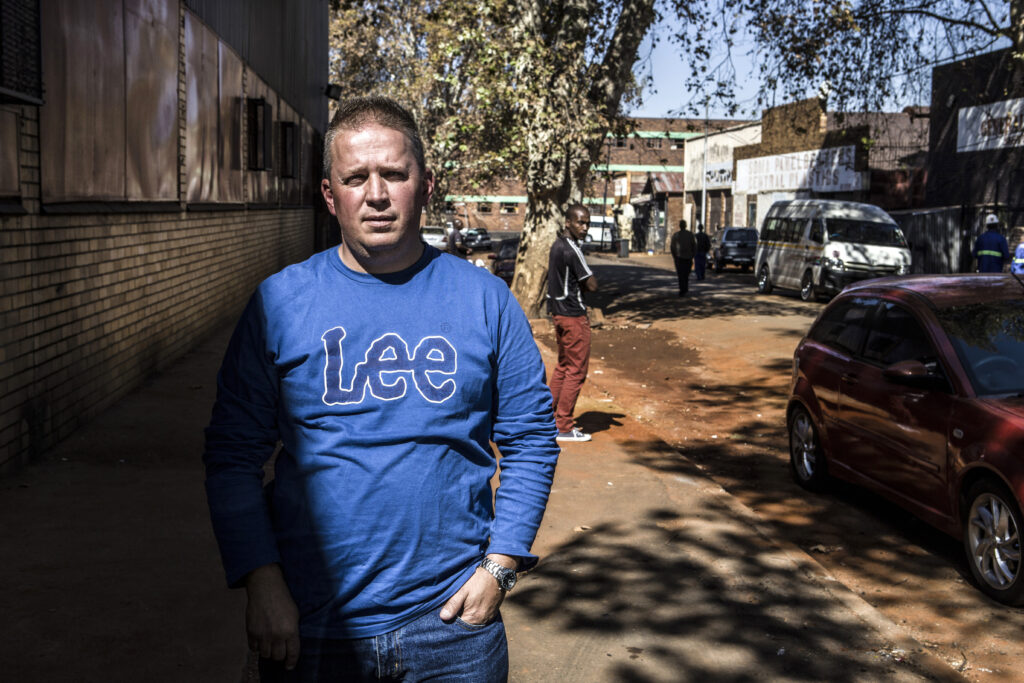
Charalabos (Harry) Koulaxizis. Photo by Mark Lewis.
The marooned malaise
To be marooned is to be stuck in space-time, unable to forge strong local or translocal solidarities, not able to progress or become. Those suffering marooning are diverse, including downwardly mobile (if still privileged) White South Africans, refugees, and other migrants. Yet, this shared temporality is not a basis for mutual recognition or mobilization. It is instead fragmentary, reflecting a loss of agency, denuded futures, and indefinite alienation. Marooned people tend to have difficulty conceptualizing progress or negotiating spatial or temporal return. For White South Africans, this means coping with a loss of the security and upward mobility apartheid promised but which is now unsettled by the national project of empowering the historically disadvantaged. Black South Africans whose social position was tied to oppressive apartheid institutions may also find themselves marooned. Additionally, many international migrants find themselves in this space-time: unable to return to hostile countries or move on, they too face compromised agency and imaginations. In all cases, the promised future remains elusive, a cruel reminder of statis or declining fortunes.
Such malaise permeates the chronotope of Estafanos Worku Abeto, a 72-year-old Ethiopian (see Pampalone 2018). After a political career, he fled Ethiopia during an inter-party conflict: “To save myself, to protect myself, I left my home and my family in Hosaena. How could they come with me? I was in hiding, moving around the country, staying with different friends.” After arrest, he eventually escaped jail and fled south, first to Kenya and eventually to South Africa. Describing his decision to keep moving, he shared, “I knew what was waiting for me at home. In that situation, you can’t go home.”
He once hoped for resettlement to Europe or the US. To maintain his eligibility, he did not pursue documentation that would allow him to stay permanently in South Africa. Moreover, he resisted the kind of socio-economic integration that would damage claims of continued vulnerability. Yet onward movement proved elusive, as have possibilities to return to Ethiopia. In 2008, xenophobic attacks destroyed the small business he had established to sustain himself in South Africa. After months in a displacement camp south of Johannesburg, he decided the country was too uncertain and unsafe for his family. He also came to recognize the futility of his efforts to be resettled. “If they try to deport me [back to Ethiopia], I won’t go. I will go into their prison. If I go to my country, I will die.” He continued, “Let me tell you the truth. South Africa is like prison for me. Prison means you cannot meet family, friends. You cannot relax. I can do nothing… Life is with family. So, I’m still here, for nine years. I’m alone.”
Although having spent most of his life in Johannesburg, Charalabos (Harry) Koulaxizis became stuck in time and space (see Zack 2018). He was born in Rhodesia to Greek immigrant parents. With Zimbabwean independence looming in the late 1970s, the family headed to South Africa. Their White privilege and hard work led to successful businesses in an industrial area now primarily occupied by Black South Africans and African immigrants. Violence shaped his life. At his narrative’s center is a raid by more than seven hundred people on his warehouse (he saw the CCTV video), resulting in hundreds of thousands of dollars in losses. The result was fear of the Black South African “other.” Yet, his broader narrative is filled with competing impulses: commitment to South Africa’s national project and a sense of losing his place in it. He celebrates the cosmopolitanism of Yeoville, the Johannesburg neighborhood where he was raised. This was a space where Greeks, Portuguese, Italian, Spanish, Germans and Jewish people lived. “I grew up on the corner of Rockey and Raymond, where all the drug dealers currently sit. That time Yeoville was still a paradise.”
His nostalgia suggests a kind of racialized security, although one with boundaries. He remains critical of White South Africans of English descent who he feels have never committed to South Africa or its people. Rather, he embraces his new Nigerian neighbors, those very people who Black South Africans blame for frustrating their transition and progress. He compares their entrepreneurialism to his own immigrant experience, contrasting their forward-looking investments and self-discipline to Black South Africans he feels are waiting for the state and party to deliver a promised future. In his telling, every delay leads to anger and violence. He described one interaction where he tried to reclaim property that was occupied. The occupier echoed the language of justice and transformation which centers a form of racialized redress: “All you fucken white people must get off my place. You can’t tell us what to do: this is a Black country.” He explained this in terms that speak about Black South African’s understanding of justice and his own effort to spatially embed his history:
…the police was there last week. There’s nothing I can do, because the police is Zulu and he is a Zulu. But he called me a fucken white person, I must fuck off from this country. I was born here; I’ve got my blood here. My children are born here; my wife is from here. One hundred per cent. My wife is Indian. They don’t speak any other language but English. Where must they go?
In speculating about the future, Harry sounds both trapped and stubbornly determined. Given the limited economic prospects and hostility from his neighbors, the moralized space-time he occupies is infused with a mix of intransigence and resignation:
I won’t abandon Jeppe. I will invest more in Jeppe… It’s not like I’m against them or I’ve got a hate or anything like this. Because of what they did to me—I mean you can’t judge one person; other people in their lives are good, you know what I’m saying? So, you gotta check it, and carry on with your life. Sweep the pieces and move on.
Oddly, a sense of lost futures and agency is shared with Manyathela Mvelase, the induna (a chieftain or petty political leader) who once managed the single-sex hostel that may have raided Harry’s warehouse (see Sosibo 2018). Describing his younger days at the hostel, Manyathela speaks of righteous order despite the racialized system that established an elaborate migrant labor system. In doing so, he differentiates his vision of justice from those speaking of dislocated futures.
There was the law in the streets, there was the law in the hostel, kept firm by the “blackjacks.” Back then it seemed oppressive, but compared to the hostels as they are now, it was a decent way of life… Hostels were messed up during the early nineties… One was never ever fully in control after that. In settings such as this, there has to be a figure of authority… This hasn’t been the case since those days, be it inside or outside the hostel.
His nostalgia is further evident in reverence for gendered hierarchies now being undermined: “Under the [old] system everybody lived a prosperous life, relatively speaking. Everybody bought a cow. Everybody sent money home. It wasn’t a choice; it was like a law to keep everybody straight.” The sense of a promised future denied becomes clearer as he associates these transformations with his personal loss of status as a leader. Where he was once effectively part of the apartheid system of population management, he now has little social status. He claims no institutional authority so instead relies on violence and threat. For Manyathela, his past deeds and position all but foreclose the possibility of respect and position within the new dispensation. Moreover, he has lived so long in Johannesburg and is so materially deprived that going “home” is almost impossible.
In describing the possibilities for living peacefully with others, he has little hope of reconciliation with the White population. In rooting his status in his nostalgia for the Apartheid era, he accepts the timelessness of the racial division that system entrenched. He is willing to live alongside African immigrants, but Manyathela demands they work to the promised future by empowering a historically disadvantaged Black citizenry.
When you arrive at a place, you have to get to know the locals and find ways of working hand in hand. The ones from further north, especially Nigerians, they work only with each other … When you try to reach out to a person and they turn their back on you, danger becomes an unpreventable situation.
Conclusions: Lost promises for the future and spatio-temporal fragmentation
Despite evident enmity among them, this chronotope’s progenitors share a sense of being trapped in space and time, nostalgic for their past geographic and social status but unable to see a path toward change. Yet change is happening around them as city residents pursue varied paths towards spatially dispersed futures (see Landau, et al, 2026). While living in close geographic proximity, their diverse relationships to the past and future shape their relationship to common space and those around them. This creates what Lefebvre (2004, 89) terms “polyrhythmicities” comprised of multiple,intersecting rhythms that can be understood separately and then analytically aggregated as I have done here. Whereas many South Africans feel forward progress has been stalled—and many foreigners look forward to life elsewhere—those within this chronotope have all but surrendered the possibility of authoring or imagining their own futures. They remain aggrieved and angry, but in ways that deny solidarity and collective mobilization.
References
Blommaert, Jan. 2017. “Commentary: Mobility, Contexts, and the Chronotope.” Language in Society 46 (1): 95–99.
Landau, Loren B., and Tanya Pampalone, eds. 2018. I Want to Go Home Forever: Stories of Becoming and Belonging in South Africa’s Great Metropolis. Wits University Press.
Landau, Loren B., Noora Lori. and Anne McNevin, 2026. “Zombies, Miracles, and Memory: Towards a Research Agenda on Mobility, Temporality, and Political Possibility.” Geopolitics 31 (3): 1103–1126.
Lefebvre, Henri. 2004. Rhythmanalysis: Space, Time and Everyday Life. Bloomsbury Academic.
Pampalone, Tanya. 2018. “The Big Man of Hosaena.” In I Want to Go Home Forever: Stories of Becoming and Belonging in South Africa’s Great Metropolis, edited by Loren B. Landau and Tanya Pampalone. Wits University Press.
Sosibo, Kwanele. 2018. “The Induna.” In I Want to Go Home Forever: Stories of Becoming and Belonging in South Africa’s Great Metropolis, edited by Loren B. Landau and Tanya Pampalone. Wits University Press.
Zack, Tanya. 2018. “I Won’t Abandon Jeppe.” In I Want to Go Home Forever: Stories of Becoming and Belonging in South Africa’s Great Metropolis, edited by Loren B. Landau and Tanya Pampalone. Wits University Press.
Loren B. Landau is Professor of Migration and Development at the University of Oxford and a Senior Research with the African Centre for Migration & Society at the University of the Witwatersrand. His interdisciplinary scholarship explores the multi-scalar governance of mobility, temporality, and belonging.
Cite as: Landau, Loren B. 2026. “Nostalgia for Lost Futures in Africa’s Global Metropolis.” In “Promised Futures,” edited by Ibrahim Ince and Erick Moreno Superlano, American Ethnologist website, 9 July. [https://americanethnologist.org/online-content/collections/promised-futures/nostalgia-for-lost-futures-in-africas-global-metropolis-by-loren-b-landau/]
This piece was edited by American Ethnological Society Digital Content Editor Kathryn E. Goldfarb ([email protected]).