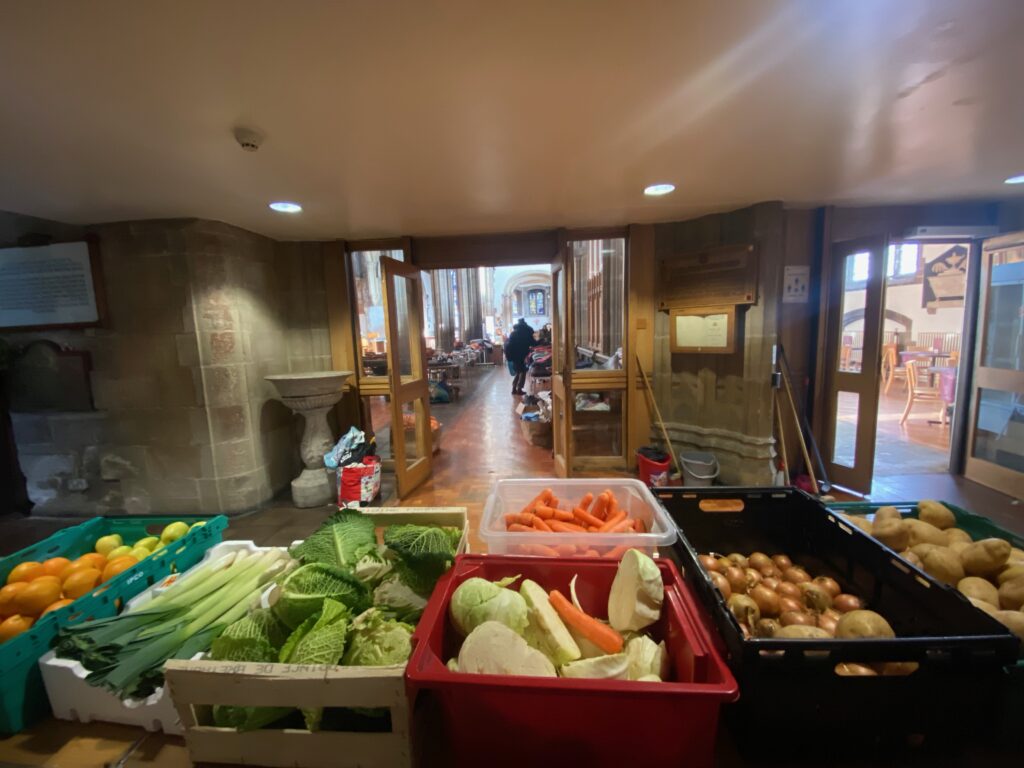
A photo of the drop-in showing the church hall. Photo by Hannah Morgan.
In the week before the Christmas of 2025, I returned to a drop-in for asylum seekers run by a charity. The session was held, as it had been during my fieldwork, inside a large stone church in the city centre of the Northeast of England. I had not been there since completing my PhD fieldwork in August 2023. The space, the activities, the staff, the rhythms and atmospheres were exactly the same as I remembered. The church, one of the main spaces in the city where the drop-in was held, remained temporarily transformed, for the two-hour slot, into a hub of food parcels, second-hand clothing stalls, and various tables set up for specific forms of support: gym vouchers, bus money refunds, and legal/housing advice. There was always something slightly awkward about the fit between the building and what happened inside it. The space was generous in intention, but improvised in practice: a patchwork of small supports offered in the gaps left by the state.
One thing I was not expecting (or perhaps not quite prepared for) was to see people, who had become central to my original research, still there. Not because I did not want to see them, but because remaining in a dispersal city like this one usually signals something else: delay, refusal, stagnation. To still be here, in the same queue, under the same roof almost two years later often only means one thing—being stuck.
The act itself of claiming asylum can be framed as an orientation towards a sense of futurity (Kallio et al. 2021). Geographers, anthropologists and migration scholars have long explored the link between claiming asylum and the temporal projection of the future (Andersson 2014; Griffiths 2014; Mountz 2010). This link is obvious, given that most people who arrive in the UK to claim asylum do not simply “arrive,” but have navigated intense and life-altering personal, political, and practical decisions. Despite mainstream media headlines representing the increasing numbers of asylum seekers arriving to the shores of the UK on small boats as “waves,” “masses,” or “infestations” (Migrant Observatory 2026), each individual who arrives has already reckoned with the emancipatory promises and potential erasure of the future.
During my research, when asked about their journeys to the UK, my participants spoke about constantly grappling with temporal realities: not just before/after, there/here, or then/now, but as a continuous and messy relation with time. The so-called promised future of claiming asylum in the UK and wider Western European context has always been fragmented, contested, and unevenly available (Tazzioli 2018).
But what happens after the geopolitical event of arrival? When the border performances and projections of risky intruders fade into a mundane reality of waiting for a decision on an asylum case? What happens to the future when it comes into friction with the bureaucratic stickiness of the present?
These questions were at the forefront of my mind when meeting one of my research participants again at the drop-in in December. Nala—a woman in her 40s from Pakistan who had been waiting for a decision on her asylum case for over five years—had been an integral part of my original research. At the time, Nala had been actively volunteering with the organisation. Many asylum seekers volunteer since it is illegal to undertake work whilst waiting for a decision, except for specific cases, as set out by the Home Office. Nala had significant influence within the community of asylum-seeking women at the time. Consequently, she not only engaged in my research activities, but became a key interlocutor for recruiting and involving other women into my project, helping to negotiate language and cultural barriers.
When I met Nala again at the drop-in during Christmas, I was happy to see her, but also struck by the awkwardness of navigating the question of why she was still there. I did not ask. The emotional weight that is held within those five words—“Why are you still here?”—is immeasurable. From my research I also know it is impossible to fully empathise with this question as a researcher who has not had lived experience.
The future dangling in front of you, held back only by the state processing your application amidst a backlog of 91,000 other applications (Migration Observatory 2025). In the UK, waiting times for asylum seekers to receive decisions on their claims are lengthy. When I was conducting my research in 2022-2023, many people who I spoke to had been waiting for a decision for over two years due to COVID-19 pausing state processing. Waiting times have now decreased, but only 22% of initial decisions are made within six months. Most people are kept in limbo for extended periods of time without the right to work or resources to build a (“normal”) life (Migration Observatory 2025). In this experience of waiting, the future inevitably crumbles and slips away as an everyday orientation. As Nala told me in 2023,
For me, I don’t even think about the future anymore. There is no point… I have been here for years and we [Nala and her husband] still have no decision from the Home Office. My son [11 years old] goes to school, has friends, learns about the UK… he has a future here. For us, I still don’t know.
Nala did eventually tell me, after an intense catch up, that both she and her husband, Hafiz, had received positive decisions on their cases. In the moment she told me, we celebrated, gushing over the intense relief that receiving a positive decision has on everyday life: “It was the best day of my life. I have never felt so happy to hear something… all this time we spent in the UK has been worth it finally.”
But as we continued to chat—jostling within and alongside the chaos of the drop-in—the promise of a secured future, one that is so often tied to a positive decision made on an asylum application, began to be unstitched, sentence by sentence. The stickiness of the present reemerged. The endless possibilities, that for Nala might once have been associated with getting a positive outcome, were once again met with the stark realities of everyday life. Nala’s experience (like so many others) fundamentally complicates the assumption that a positive asylum decision resolves the temporal violence of the system.
There were two moments in our conversation that complicated the idea of a promised future after the asylum system.
First, Nala recounted her experience of being within the “move on” period of the system. This period—oscillating between 28 and 56 days with recent Home Office shifts and trial pilots for families (NRPF Network Guidance 2025)—marks the transition between being governed within the asylum system and entering “normal” life beyond it. Nala detailed how the overwhelming number of tasks she had to complete in this period put incredible stress on her family: “Setting up a UK bank account, applying for Universal Credit, finding and moving accommodation whilst getting help from the local housing authority.” Many people who enter this “move on” period face extreme poverty and homelessness (The British Red Cross 2020). Systems of support are confusing, difficult to navigate, and unforgiving (Hughes 2025). Although I did not push for details, it was clear that “moving on” was an abrupt and abrasive first step into their family’s future life in the UK. This was so much the case that the very idea of the future was overridden by the intensity of making it through the daily tasks of the “move on” period.
Second, Nala re-oriented our conversation towards the presently felt far future. Under current Home Office regulations, asylum seekers with a positive decision on their case (who claimed asylum before March 1, 2026) may apply for the right to remain in the UK for five years, being offered protection under the Refugee Convention. After this five-year period, individuals become eligible to apply for Indefinite Leave to Remain (ILR). This timeline of bureaucracy continued to hover over Nala’s everyday life. Having lived in the “move-on” period for well over six months, she explained:
Now… I, we, have to think about our indefinite leave to remain. I know it is five years away, but it comes very quickly, and it’s something else that is there in my mind, you know?
Nala’s orientation towards a future life in the UK continues to be fragmented and precarious, shaped by her experiences of prolonged suspension within the asylum system. Her ability to attach securely to a vision of the future is still always-in-anticipation of another step, another bureaucratic threshold to negotiate.
Moreover, this feeling of a fragmenting and precariously reachable future is intensified further by recent Home Office policy changes. For individuals who claimed asylum after March 1, 2026, the “right to remain” period is reduced to 30 months; in the face of Home Office plans to implement “safe returns,” opportunities to apply for ILR are becoming less available (Home Office 2025).
So, while the future is never something that is uniformly promised or securely held, the futures that asylum seekers—and those living beyond the asylum system—project, imagine or orient themselves towards are always intensely negotiated. They are disrupted, foreclosed, stretched, and fragmented. This instability is not accidental: it is a continuation of a temporally organised system of control that functions to deter, exhaust, and displace.
Meeting Nala again in the drop-in space was bittersweet. The weight of the asylum application had lifted, only to be replaced by the bureaucratic loops of life after asylum that are neither anticipated by those in the system, nor widely appreciated in common narratives.
In five years time, I hope to meet Nala again and hear that her sense of the future is banal and ordinary. Not devoid of anticipation, but no longer wholly conditioned by the bureaucracies of a system designed to erode the very possibility of envisioning and attaching to what lies ahead.
References
Andersson, Ruben. 2014. “Time and the Migrant Other: European Border Controls and the Temporal Economics of Illegality.” American Anthropologist 116 (4): 795–80.
British Red Cross. n.d. The Costs of Destitution: The Cost-Benefit Analysis of Extending the Move-On Period for New Refugees. British Red Cross Report.
Griffiths, Melanie B. E. 2014. “Out of Time: The Temporal Uncertainties of Refused Asylum Seekers and Immigration Detainees.” Journal of Ethnic and Migration Studies 40 (12): 1991–2009.
Home Office. 2025. Restoring Order and Control: A statement on the government’s asylum and returns policy. November 21.
Hughes, Sarah. 2025. “Theorising Legal Gaps Geographically: Exploring the Transition from Asylum Seeker to Refugee in the UK.” Transactions of the Institute of British Geographers. Online First.
Kallio, Kirsi Pauliina, Ilse Meier, and Jouni Häkli. 2021. “Radical Hope in Asylum Seeking: Political Agency beyond Linear Temporality.” Journal of Ethnic and Migration Studies 47 (17): 4006–22.
Migration Observatory. 2025. The UK’s Asylum Backlog. Migration Observatory, University of Oxford, May 12, 2025.
Migration Observatory. 2026. People Crossing the English Channel in Small Boats. Migration Observatory, University of Oxford, January 30, 2026.
Mountz, Alison. 2010. Seeking Asylum: Human Smuggling and Bureaucracy at the Border. University of Minnesota Press.
NRPF Network. 2025. When Home Office Support Ends. NRPF Network.
Tazzioli, Martina. 2018. “The Temporal Borders of Asylum: Temporality of Control in the EU Border Regime.” Political Geography 64: 13–22.
Hannah Morgan has a PhD from Durham University and is now working as a Career Development Fellow in Human Geography. Her work explores digital dis/connection within the UK’s asylum system through conceptual engagement with geographies of affect, biopolitics, and critical posthumanism.
Cite as: Morgan, Hannah. 2026. “Negotiating Promised Futures in the Aftermath of Asylum.” In “Promised Futures,” edited by Ibrahim Ince and Erick Moreno Superlano, American Ethnologist website, 9 July. [https://americanethnologist.org/online-content/collections/promised-futures/negotiating-promised-futures-in-the-aftermath-of-asylum-by-hannah-morgan/]
This piece was edited by American Ethnological Society Digital Content Editor Kathryn E. Goldfarb ([email protected]).