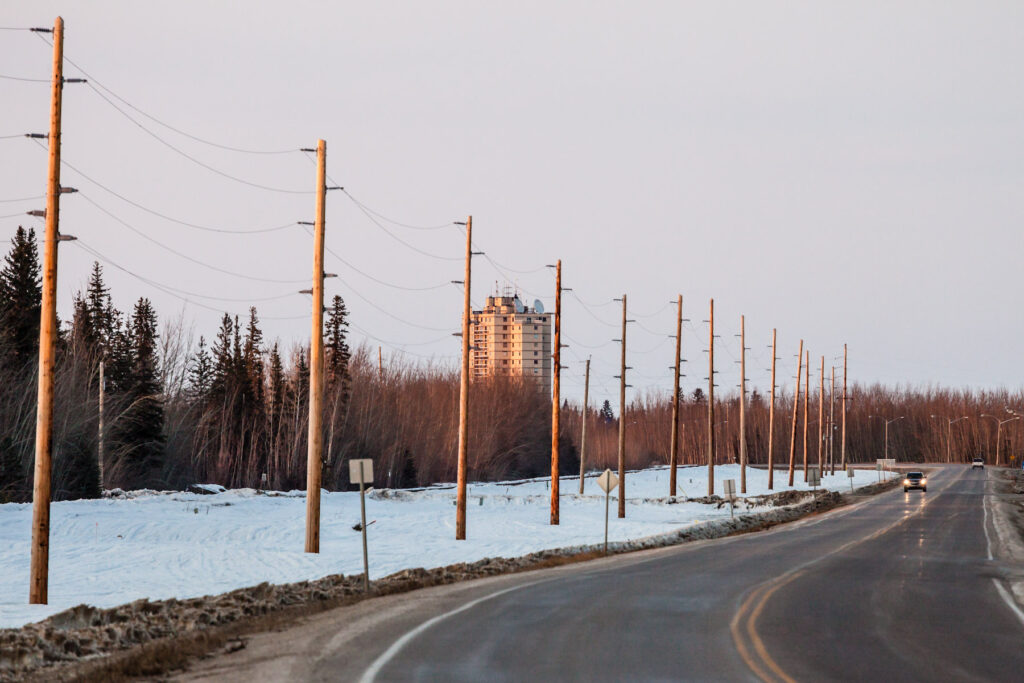
View of Mackenzie Place through a forest of electric polls. “2013_04_22-5D2-395,” from the series “Mackenzie Place 2013—2018.” Photo by Jesse Colin Jackson, 2023.
No lights are on in the Mackenzie Place High Rise. Yet, even in the darkness of a polar mid-winter, the silhouette of the seventeen-story residential building is hard to miss. The structure looms over Hay River, Northwest Territories, an otherwise two-story town of 3,000 in the Canadian sub-arctic. While most post-war towers are bult in clusters in urban or suburban landscapes, Mackenzie Place stands alone.
In 2019, I received dozens of photos of the building in a cloud of black smoke. All 150 tenants had been safely evacuated during a fire. The building has been unoccupied ever since. While many found other housing, over a dozen people, primarily Indigenous residents, had yet to find stable housing a year after the fire (Desmarais 2020). This essay illustrates how Mackenzie Place, empty in disrepair, is an “indispensable eyesore” (van der Hoorn 2009) to contemporary promised futures of the Canadian extractive economy.
Building futures
Postwar towers, like Mackenzie Place, are promised futures in material form. Architecturally and ideologically, they derive from Le Corbusier’s “tower-in-the-park” morphology. Designed for mass production and rapid construction, they became a predominant housing type during post-war reconstruction in Europe and proliferated globally. The design aimed to replace urban congestion with vertical density, providing order to the city.
Between 2008 and 2009, I lived on the seventh floor of Mackenzie Place. Simply called “the High-Rise” by most locals, it is the only building of its type within a 300-mile radius.
At that time, northern Canada was the third-largest producer of rough diamonds in the world (Hall 2022). Corporate, commercial, and governmental messaging promoted diamonds as engines of local economic development and supportive of Indigenous self-determination. I chose to live in the High Rise to be close to those said to benefit most from the promised futures of arctic diamond development: the under- and unemployed. As the most affordable rental option in town, the High-Rise’s tenants were often people who arrived in this peri-urbanizing town in search of work. This included Indigenous (Dene, Inuvialuit, Cree, Métis) people from nearby communities, Settler Canadians from economically depressed parts of Canada, and immigrants to Canada. It was the housing of last resort for labor “just in time” (Purser 2009, 2019).
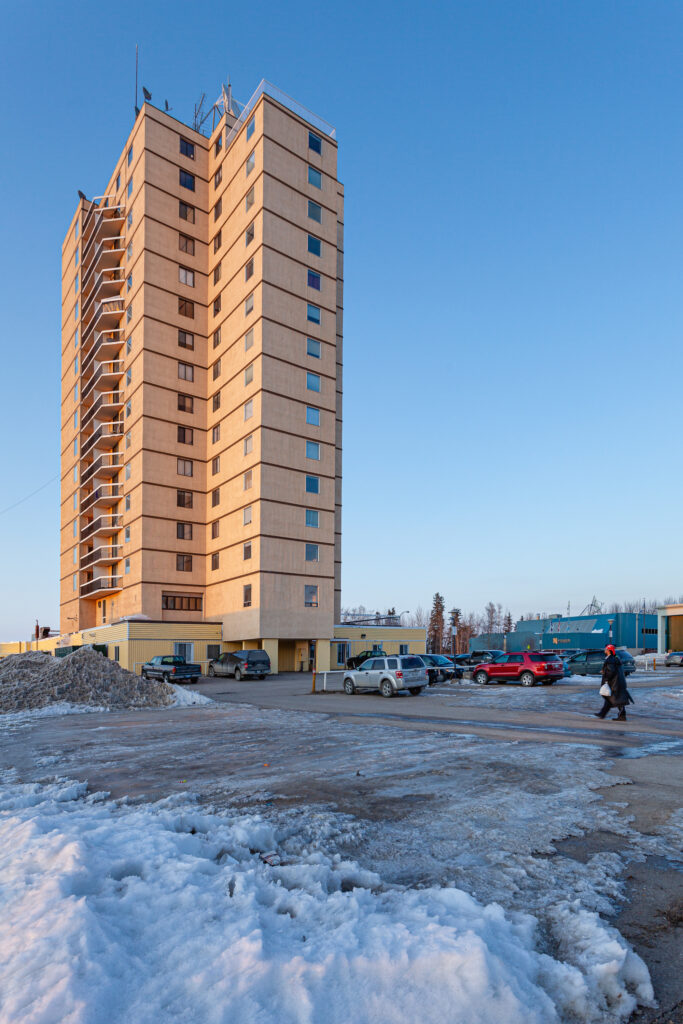
Mackenzie Place stands alone; view from the parking lot. “2013_04_22-5D2-376” from the series “Mackenzie Place 2013—2018.” Photo by Jesse Colin Jackson, 2023.
In the early months of my 2008 fieldwork, the precarious effects of the financial crisis became apparent. Jobs were cut. Mine training programs were put on hold, downsized, or cancelled (Bell 2017). Despite the obvious precarity, many people maintained that mining was good for the region. A more common target of scrutiny, a more easily evoked outlet of frustration, was the High Rise itself. Following the everyday affects of anger and annoyance, I began to pay closer attention to the building itself, its history, and the stories people told in it and about it.
This weathering apartment tower, its multi-ethnic tenants, and the sentiments it engendered revealed key pieces in the architecture of extraction of contemporary global capitalism. As I describe in my book (Bell 2023), architectures of extraction are the structures that yield pressures on present experiences of a mining project, including tangible things like roads and workers’ housing, and less tangible things like laws, affects and public perceptions. Promised futures entail possibilities of disappointment. Rather than undermine the promises of extractive futures, I argue that disappointment is vital to how the layered, failed promised futures of extraction from the past are woven into the fabric of everyday life.
A political economy of disappointments
Destiny hadn’t travelled far to move into the High-Rise apartment next to mine, yet she spoke like she was worlds away from her life on the other side of the river. “I’m never going back,” she said. “Why would I want to be stuck over there?”
From any of Mackenzie Place’s eastward facing units, you can see an expanse of boreal forest just beyond the town’s namesake river below. Once a day, the High-Rise casts its shadow on this blanket of trees that are now part of the Kátł’odeeche First Nation: the first Indigenous reservation in Northern Canada. It includes 33,402 acres of land, with a small townsite and a population of under 300. Even though the town and the First Nation are separated by a relatively narrow stretch of river, travel between the two isn’t always straightforward. Without vehicle access or sufficient resources, Destiny’s reluctance to be “stuck on the reserve” can be taken literally.
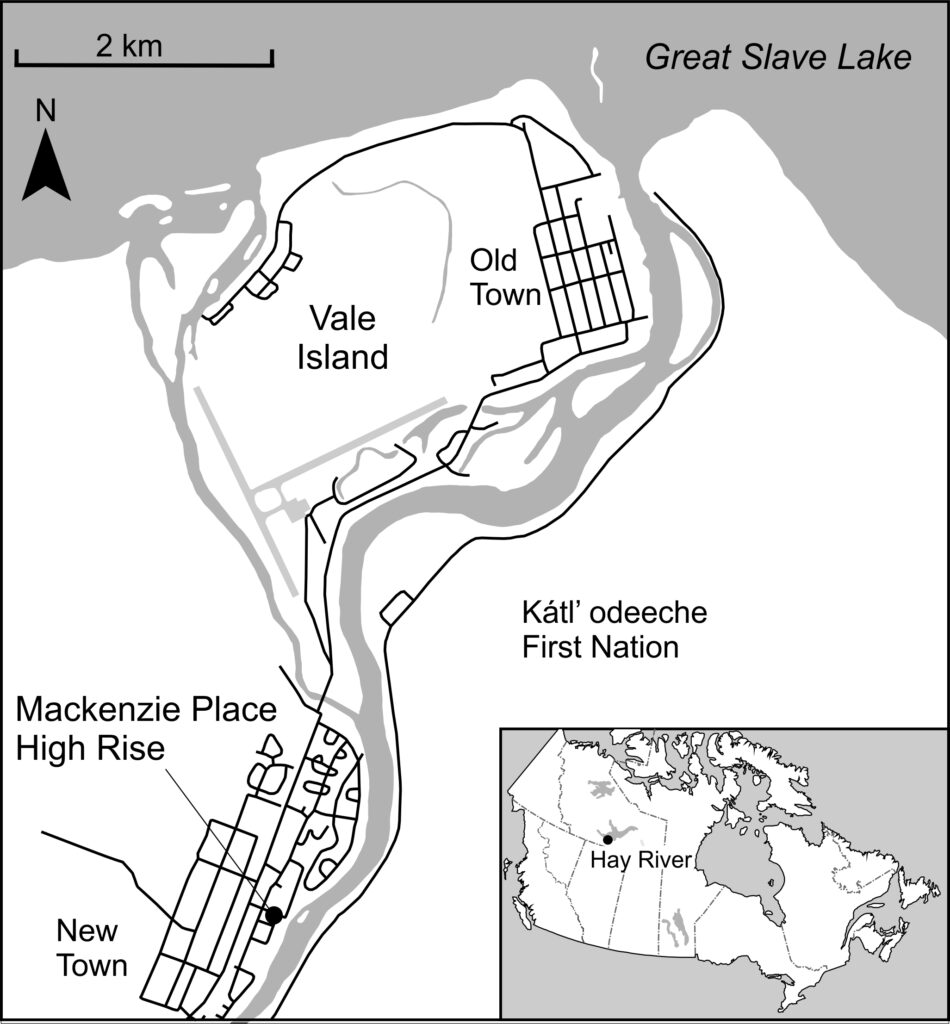
Map showing the spatial relationships between Mackenzie Place and the Kátł’odeeche First Nation. Map by Lindsay A. Bell.
When we met, Destiny was a twenty-something Dene woman with wide social networks on both sides of the river. In warmer months, we stood on our conjoined balconies watching the cars move through the four-way stop that is “downtown.” Determined to be an ideal tenant, Destiny would do a “killer clean” every Saturday before attending to her social plans. She decorated the walls with carefully lined photographs of family, friends, and eventually an anthropologist. She hung a poster of Tupac Shakur next to the Dene Nation flag. She was one of the few tenants hoping to stay. Other than there being “nothing going on,” compared to most tenants she expressed relatively few disappointments, although her life was, and is, characterized by instability.
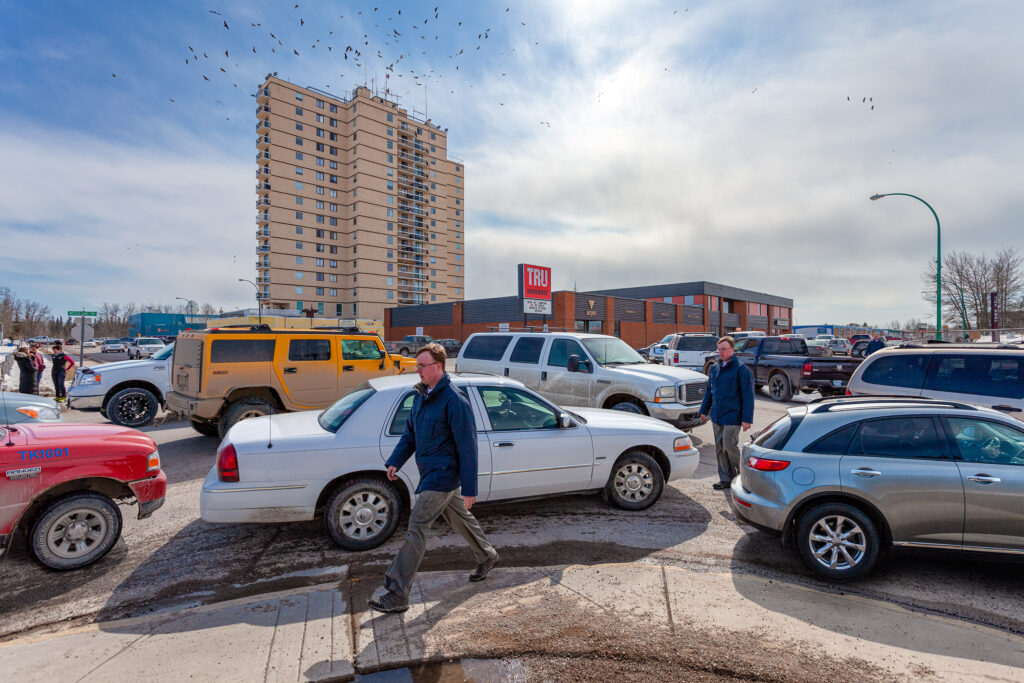
Overlaid Images of Woodland Drive and Commercial Road, Hay River, as seen over five minutes on April 22, 2013. “Nothing Going On redux.” Photo by Jesse Colin Jackson, 2023.
During the middle decades of the twentieth century, federal policy makers and intellectuals worked in fits and starts to transform the region just north of the 60th parallel into “the hub of the North,” a critical transportation node that could move arctic resources from “hinterland to heartland” (Innis 1936; Isard 2010). The new town site plan included the High-Rise as “modern” housing for future (white) residents and “Treaty Housing” (small homes arranged in a circle) for Dene. Neither were received by local people with great enthusiasm.
From its inception, Mackenzie Place signaled a future almost nobody wanted. During its construction in the 1970s, the local newspaper referred to it as a “human filing cabinet.” Likewise, few Dene wanted to move to “Treaty Housing” and some who did were excluded if their spouse was not also enrolled in Treaty 8, the treaty that Dene signed in 1899 with the nascent Canadian state that ostensibly allowed them to maintain traditional livelihoods in exchange for increased mineral and oil prospecting. Anyone with a spouse who was white, Metis or Treaty 11 (Dene from nearby communities) was excluded.
As an alternative to treaty housing, Destiny’s grandfather and other local Dene leaders began to advocate for a reservation—what would become the Kátł’odeeche First Nation. Unlike most reservations of the late 1800s which were defined by dispossession and forced confinement, First Nation reflected growing Indigenous political agency in the 1960s and 70s. At the same time, the reservation gave spatial form to, and intensified, racial tensions and inequalities.
The industrialization of the subarctic is central to Canada’s status as a “nature exporting society” (Coronil 1997, 7; Hall 2022; Piper 2008). Canada’s founding mythology rests on the idea that it is a nation that was born with a “staple economy,” that is, a place with abundant natural resources ripe for exploitation (Watkins 1963). Mackenzie Place is indeed inseparable from the story of colonial appropriation of resources in, and on the edge of, the arctic. As Indigenous scholars have made clear, extractive capital in Canada relies on settler colonialism as an ongoing practice (Coulthard and Betasamosake Simpson 2016; Todd 2017; see also Wolfe 1999). This includes how people imagine and enact stable livelihoods as they integrate past failures with present aspirations for “the good life.” Architectures of extraction generate spaces of disappointment and hope even as they simultaneously erode the conceptual boundaries that brought them into being.
Everyday disappointments
Although Mackenzie Place can be seen from 70 km away, for many residents, both in the town and in the tower, it is often described as a sight better left unseen. For the Northern middle class who do not live in the building, its material failures were often blamed on tenants presumed to be transient and disinterested in domestic care. My two years in the High Rise proved otherwise. Most tenants took great care to have their apartments reflect them. Walls were adorned with neat rows of photographs. Surfaces might have a single knick-knack made by a relative or Northern craftsperson. The upkeep of units was an opportunity for self-expression and a way for some tenants to distance themselves from accusations that all High-Rise residents were, as one interlocutor put it, “riff-raff.”
Most tenants had their fair share of disappointments with the High Rise, most glaringly having to pay a rental price near double the national average for a unit in disrepair. Other disappointments seemed small but gained weight by their everydayness, like trying to get through the narrow entranceway with large bags of groceries and tripping on peeling linoleum tiles, or evacuating when the aging fire alarm went off, or waiting for an elevator because the other one was out of service.
An important part of being in the High Rise was expressing that you did not truly belong there. Many tenants described the building as “ghetto” and maintained they would not be living there long. People’s everyday difficulties, punctuated occasionally with more lethal events, were what most interlocutors wanted to discuss with me, even though what I wanted to discuss with them was the precarity of extractive industries.
Since the fire, debates about Mackenzie Place echo those of other failed post-war tower neighborhoods, narrowly focusing on causes within the building’s operations (the manager, other tenants). Yet the central factor in the decline of most towers lies in the broader economic and social landscape (Heathcott 2012).
As people attributed their concerns to the building itself, I came to see how a focus on these everyday disappointments keeps dissatisfaction squarely in the present (the building) with an eye towards the future (getting a job in the mines and getting out). Disappointment creates a sense of wanting an otherwise, a collective feeling of “not this kind of future but another one.” Such disappointments aren’t at odds with extractive economy. On the contrary, they can and do bolster it. Disappointing architecture, much like Crase and Kneas’ discussion of unbuilt and unfinished infrastructures, “can become the axes of social worlds and sites where temporalities are knotted and reworked in unpredictable ways” (2019, 10; see also Hall & Ascough 2023 on diamond mine closures).
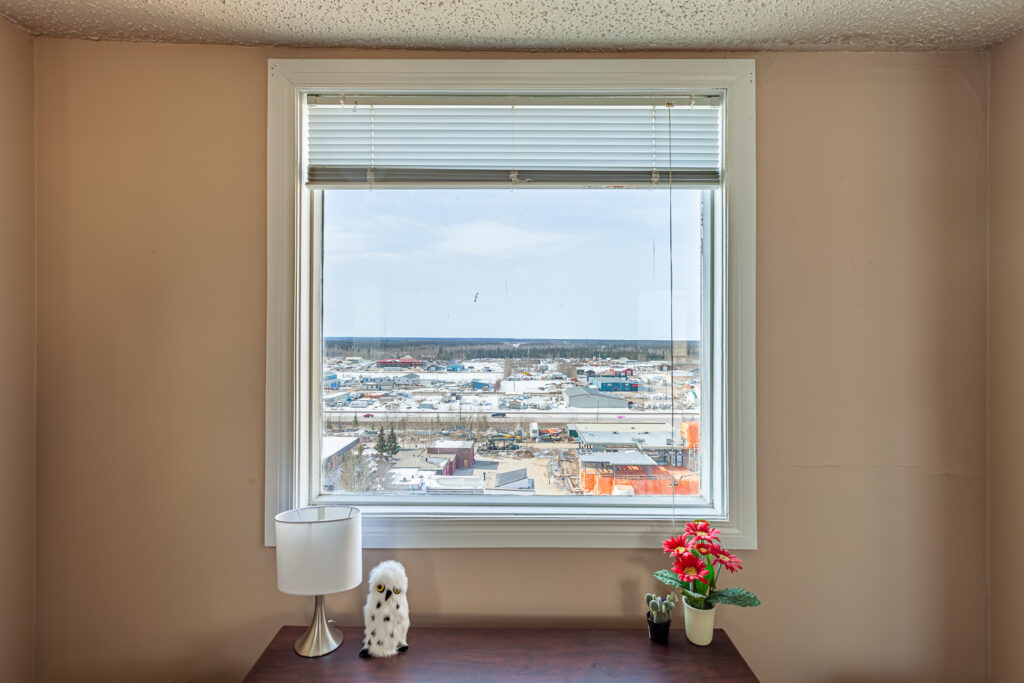
View out a west-facing window of Mackenzie Place. “2013_04_22-5D2-3476” from the series “Mackenzie Place 2013—2018.” Photo by Jesse Colin Jackson, 2023.
Critical observations of form from architectural history and urban planning help us understand how “architecture has been deeply embedded in the inextricable relationship between race and space… key to the colonial appropriation of resources, territorial control, and systems and patterns of inequality that still persist” (López-Durán and Rooney 2023, 167). These perspectives are useful starting points to think anthropologically with architecture. Architectural forms shape aspirations, disappointments, and exclusions in site-specific ways.
References
Bell, Lindsay A. 2017. “Soft Skills, Hard Rocks: Making Diamonds Ethical in Canada’s Northwest Territories.”FOCAAL: Journal of Global and Historical Anthropology 79: 74–88.
Bell, Lindsay A. 2023. Under Pressure: Diamond Mining and Everyday Life in Northern Canada. University of Toronto Press.
Carse, Ashley, and David Kneas. 2019. “Unbuilt and Unfinished: The Temporalities of Infrastructure.” Environment and Society 10 (1): 9–28.
Coulthard, Glen Sean, and Leanne Betasamosake Simpson. 2016. “Grounded Normativity/Place-Based Solidarity.” American Quarterly 68 (2): 249–55.
Desmarais, Carla. 2020. “Mackenzie Place Tenants Still Looking for Housing a Year After Fire.” CBC News, October 15, 2020.
Farish, Matthew, and P. Whitney Lackenbauer. 2009. “High Modernism in the Arctic: Planning Frobisher Bay and Inuvik.” Journal of Historical Geography 35 (3): 517–44.
Fraser, Crystal G., and Sara Komarnisky. 2026. Talk Treaty to Me: Understanding the Basics of Treaties and Land in Canada. Harper Collins Canada.
Hall, Rebecca. 2022. Refracted Economies: Diamond Mining and Social Reproduction in the North. University of Toronto Press.
Hall, Rebecca, and Hannah Ascough. 2023. “Care through Closure: Mine Transitions in the Mixed Economy of the Northwest Territories, Canada.” Gender, Place & Culture 30 (10): 1415–36.
Heathcott, Joseph. 2012. “The Strange Career of Public Housing: Policy, Planning, and the American Metropolis.” Journal of the American Planning Association 78 (4): 360–75.
Innis, Harold A. 1936. Settlement and the Mining Frontier. Macmillan.
Isard, Philip. 2010. “Northern Vision: Northern Development during the Diefenbaker Era.” MA thesis, University of Waterloo.
López-Durán, Fabiola, and Adrienne Rooney. 2023. “Caring to Act, Acting to Care: Unbuilding Whiteness in the Built Environment.” In Architectures of Care: From the Intimate to the Common, edited by Brittany Utting, 31–42. Routledge.
Piper, Liza. 2008. The Industrial Transformation of Subarctic Canada. University of British Columbia Press.
Purser, Gretchen. 2009. “The Dignity of Job-Seeking Men: Boundary Work Among Immigrant Day Laborers.” Journal of Contemporary Ethnography 38 (1): 117–39.
Purser, Gretchen. 2019. “Day Labor Agencies, ‘Backdoor’ Hires, and the Spread of Unfree Labor.” Anthropology of Work Review 40: 5–14.
Șalaru, Maria. 2025. An Anthropology of Architectural Transformation: The Changing Fabric of a Romanian Block of Flats. UCL Press.
Schwenkel, Christina. 2020. Building Socialism: The Afterlife of East German Architecture in Urban Vietnam. Duke University Press.
Todd, Zoe. 2017. “Fish, Kin and Hope: Tending to Water Violations in amiskwaciwâskahikan and Treaty Six Territory.” Afterall: A Journal of Art, Context and Enquiry 43 (1): 102–7.
van der Hoorn, Melanie. 2009. Indispensable Eyesores: An Anthropology of Undesired Buildings. Berghan Books.
Watkins, Mel. 1963. “A Staple Theory of Economic Growth.” Canadian Journal of Economics and Political Science 29 (2): 141–58.
Wolfe, Patrick. 1999. Settler Colonialism and the Transformation of Anthropology: The Politics and Poetics of an Ethnographic Event. Cassell.
Acknowledgments
The research for this work was funded in part by the Social Sciences and Humanities Research Council of Canada and Western University’s Faculty of Social Science. Comments from Christine Hegel-Canterella, Joeva Rock, and the special collection editors helped me set the right scale and focus for the article. Both David Kneas and Emily Yates-Doerr provided feedback on earlier drafts which greatly expedited and improved my thinking. Jesse Colin Jackson provided many of the photographs, but more importantly, he pushed me to place the High Rise in its broader architectural context.
Lindsay A. Bell is an associate professor of cultural and linguistic anthropology at Western University, Canada. She is interested in anthropological approaches to aspiration and how individual and collective hopes for the future are produced and experienced. Her book Under Pressure: Diamond Mining and Everyday Life in Northern Canada (University of Toronto Press 2023) won the 2024 Canadian Anthropology Society’s book prize.
Cite as: Bell, Lindsay A. 2026. “Building Future Disappointments: Architectures of Extraction in Sub-Arctic Canada.” In “Promised Futures,” edited by Ibrahim Ince and Erick Moreno Superlano, American Ethnologist website, 9 July. [https://americanethnologist.org/online-content/collections/promised-futures/building-future-disappointments-architectures-of-extraction-in-sub-arctic-canada-by-lindsay-a-bell/]
This piece was edited by American Ethnological Society Digital Content Editor Kathryn E. Goldfarb ([email protected]).