This piece is part of the “Anthropology that Breaks Your Heart” series, a project inspired by the work of Ruth Behar’s The Vulnerable Observer (1996).
Anthropology never broke my heart. Instead, the discipline opened it. Wide to new experiences, raw to unfiltered emotions, and full of thoughts that continue to shape me. It influences the way I move through the world, the way I encounter people, and perhaps most intimately, the way I see myself.
And yet, despite my love for the field, I often find myself questioning. Am I polite enough when conducting fieldwork? Am I sincere enough when meeting other professors? Am I generous enough with my colleagues? Am I good enough, to them, to myself?
These are the moments when I find no answer. Some might say the very act of questioning means I’m searching in the right places. But in reality, it’s because I’ve been told, over and over, that I am “too much.”
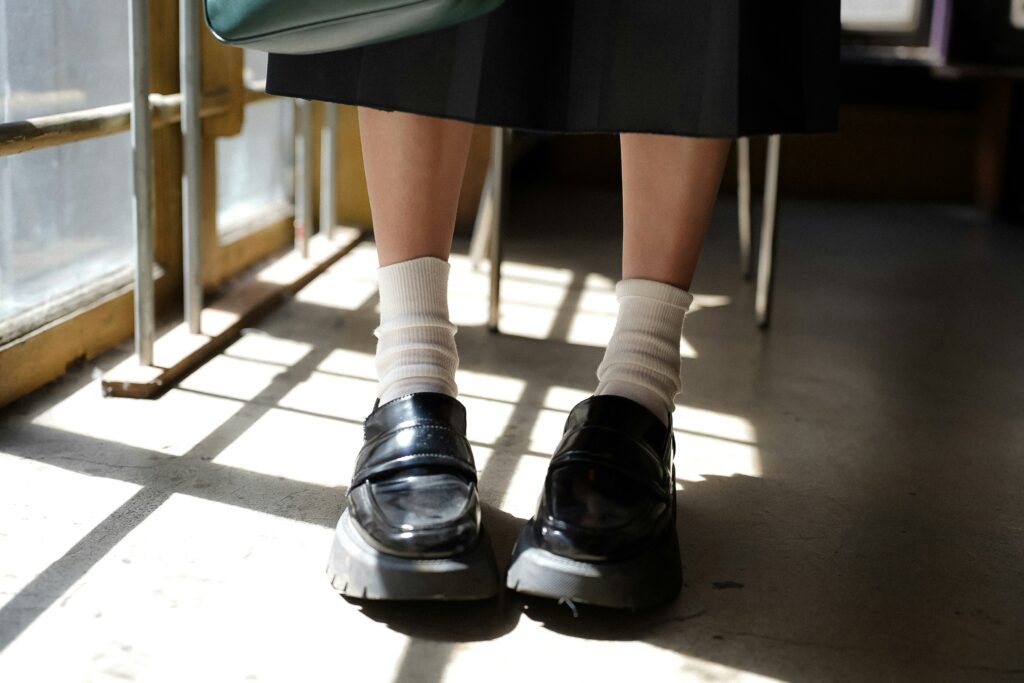
Academic outfit. Unsplash free license photo by Anastasiya Badun.
“You Don’t Look Like an Academic”
I remember the first time someone told me my clothes weren’t “academic enough.”
It was after a workshop, one where I had spoken with care, where I had shared something, I was proud of. I stepped off the stage, still caught in the rhythm of my own words, when a senior academic approached me.
“You know,” they said, smiling in that practiced way that softens the criticism but never quite hides it, “you should wear something more neutral, more serious. Maybe black or navy? You don’t want to look too girly.”
I looked down at myself. My colorful dress, the thick tights keeping me warm, my black leather shoes clicking softly as I shifted my weight. I had chosen this outfit because it had made me feel comfortable, like myself. Yet, in that moment, it was reduced to a distraction, something to be managed, corrected and neutralized.
Too girly. Too emotional. Too soft-spoken in one room, too assertive in another. Too kind to be taken seriously, too sensitive to survive in academia.
What I realize, though, is that my embodied experience speaks to a particular version of academia, one shaped by patriarchal, masculinist norms that quietly (or loudly!) regulate how scholars should look, speak, and carry themselves, often under the banner of “neutrality” or “professionalism.” Of course, this is not academia in its entirety, but a dominant mode of academic habitus that polices which bodies and affects are seen as credible, rendering some expressions “too much” and others “not enough.”
I am always too much of something and never enough of what is expected. My perfume lingers in seminar rooms where voices are meant to be neutral; it is my presence, carried in scent, that becomes “too loud.” My neatly braided hair, too polished to be effortless, too playful to be serious, announces me before I speak. And my outfits? Whether flowy or structured, patterned or plain, bright or dark, they send a message before I do, a silent challenge to the grayscale uniform of academic legitimacy. Before I am heard, I am seen. And yet that “seeing” is not recognition. It reduces then reveals, a gaze that prevents me from being seen on my own terms. Before my ideas are considered, my presence is judged. Too colorful. Too hippie. Too expressive. Too unserious. Too much.
And in those moments, echoes of earlier advice to look “neutral,” to appear more “serious,” I am reminded again of what this version of academia claims to be: a place for black blazers and buttoned-up restraint, for muted tones and practical shoes. Not, apparently, a space for color, for texture, for myself.
Clothes were not the only thing that made me “too much.”
I remember a conversation with a senior academic who, in what they thought was a moment of mentorship, told me I needed to “change” the way I speak.
“You should be more direct,” they said, leaning in as if offering me a secret to success. “You can’t be so shy. You need to argue, raise your concerns, push back. Speak louder. Be more.”
More?
I had spent years already feeling like I was too much. But now, suddenly, I wasn’t enough?
I like thinking before I speak. I like sitting in the moment, letting my words form with care. I like listening, absorbing, considering. English is not my first language. I need to think a bit longer, not because I lack confidence, but because I want my words to mean something. Yet in academia, silence is often mistaken for weakness, hesitation due to uncertainty. If I am not quick, if I do not jump in at the first gap in the conversation, I am overlooked.
So, I was told: Be more aggressive. Be more academic.
But what does that even mean? To strip away the way I think, the way I express myself? To replace it with sharp elbows and rehearsed certainties? To abandon the colors, the softness, the emotions that make me who I am?
What If I Refuse?
There is an unspoken rule in academia: to be taken seriously, you must dissociate. Dissociate from your emotions. From your softness. From anything that signals vulnerability.
Yet anthropology, at its core, is about connection. It is about understanding lived realities in all their messy, complex, emotional depth. Of all disciplines, shouldn’t anthropology be the one to resist this demand for dissociation, if not undo it altogether? Why, then, does academia still insist on sustaining this cold, detached, neutral posture?
When I conduct fieldwork, I do not hide behind the illusion of neutrality. I do not pretend to be unaffected. I do not wear the intellectual armor that keeps me separate from the people I engage with. I let myself “feel” the moments, trusting that feeling is not a failure of rigor but an embodied way of knowing. Because I know that feeling, being open, empathetic and willing to embrace the emotional weight of my work, is not a weakness. It is method.
I have seen the way people open up when they sense sincerity. I have seen the power of vulnerability in building trust. I have seen how my so-called “girly” qualities, my warmth, my attentiveness, my ability to sit in the in-between spaces of emotion and intellect, allow me to see things others might overlook.
What if my too much is exactly what academia needs?
What if there is power in embracing the softness, in rejecting the pressure to shrink? What if the way I move through the world, feeling, caring, dressing, existing, is not a limitation but an intervention of its own?
Maybe I am too much.
Maybe my voice is soft, my words careful, my clothes too bright, my presence too scented, my emotions too close to the surface. Because the qualities that read as “professional” were shaped around a narrow set of bodies, voices, and sensibilities, standards that were never neutral, but crafted to serve those who already resemble their image, and to quiet those of us whose ways of speaking, feeling, or appearing fall outside it.
So, maybe my way of being does not fit the rigid mold of academia.
Maybe that’s the point.
Christina Kefala is an Assistant Professor at the USC–SJTU Institute of Cultural and Creative Industry at Shanghai Jiao Tong University. She holds a PhD in Anthropology from the University of Amsterdam. Her research examines how identities are imagined, articulated, and performed at the intersection of creative industries, design, aesthetics, and digital media in contemporary China.
Cite as: Kefala, Christina. 2026. “Too Girly, Too Emotional, Too Much. Finding Myself in Academia.” In “Anthropology that Breaks your Heart: The Risk of Proximity,” edited by Alexandra Dantzer, Uyen Dang, and Emma Kahn. American Ethnologist website, 27 March. [https://americanethnologist.org/online-content/collections/anthropology-that-breaks-your-heart-the-risk-of-proximity/too-girly-too-emotional-too-much-finding-myself-in-academia-by-christina-kefala/]