This piece is part of the “Anthropology that Breaks Your Heart” series, a project inspired by the work of Ruth Behar’s The Vulnerable Observer (1996).
I woke up drenched. The flimsy blanket twisted around me, like the noose of the remaining year. I had done everything right that evening. Early dinner, a paracetamol, and cotton under wool, in the hopes that I might finally sleep through the night. The 2am awakenings were exhausting, and the year felt impossibly long when I was alone at night.
The thin mattress pushed against my back. Temperatures dropped below zero again. “I’m okay,” I said out loud. My inflamed tonsils mocked the affirmation, pulsing rapidly against each chilly breath. My throat was aggressively dry. My whole body was rioting against my resolve. “I am okay. This will not hurt,” I repeated, as I pushed a hand out of the blanket under which I had already been shivering. The glass of water near my bed would have been ideal if it were a June afternoon in Delhi, but right then, it stung. Numbing my fingers, burning my throat. When it bit at my gut, I prayed it would at least quench the panic.
I thought I had come prepared for the winter. While seeking permissions for conducting fieldwork in the High Himalaya, a senior government official had issued a memorable warning: “Your lower spine will never be warm there.” I had come prepared in other ways too, with heavy woolens and extensive notes. But nothing had prepared me for the panic that unfurled late at night.
Over the months after that first instance of suffocating panic, I devised several soothing rituals: a senior colleague’s methodology chapter turned into a tome from which I rehearsed incantations for approaching the unknown, an epigraph from Stoller’s book (1989, 1) inspired me in the dark, and dead anthropologists became dear friends with dull jokes that acted as salves.
But I hadn’t known at the outset what I would need. The grounding exercises I had learned in the city didn’t seem to work anymore, either. I already felt too close to the ground, the grass, and the wind. It didn’t do to listen to them any more closely. Besides, my queer-affirmative, London-educated, South Asian therapist, based in Delhi, was confused by my immersive research practice. During sessions, my panic had begun to sound too self-inflicted, almost indulgent. Yet that night, the panic fused with the chill in my spine. The icy water, the sting of the air, and my inflamed throat worked together to tie me down until the sun came up.
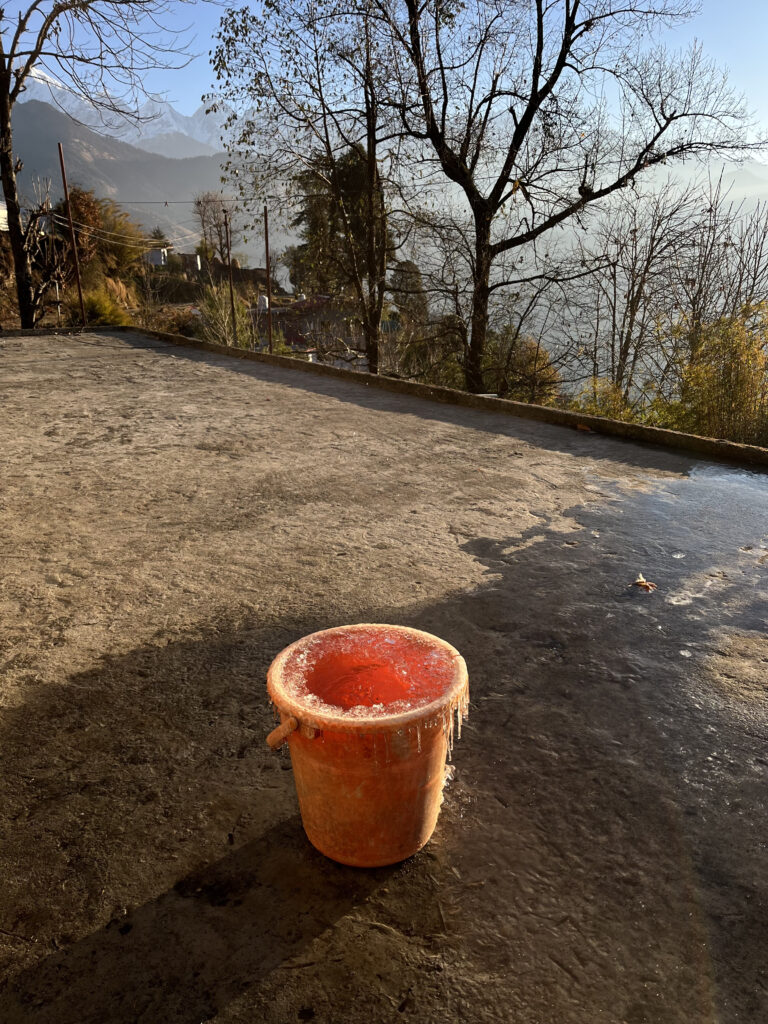
Winter 2023. View from Phooli’s veranda. Photo by Nishtha Tewari.
Each night of my first week was more difficult than the last, until the difficulty plateaued. My research on women’s health in high-altitude regions had turned immediately personal. I sprained my ankle the night I arrived, and some nights later a recurring fever began. I was living in an expensive village homestay organized by a women’s collective, approved for only three weeks through university funds. The room I was living in was built for tourists. It had a private bath with a European-style toilet—quite distinguished by ethnographic measure. So, I was in a hurry to find alternative living arrangements that would position me less obviously apart, from where my findings might be irreproachable. The task was trickier than I had anticipated; I had revealed my spending capacity and my preference for urban comforts too early. The arrangement prompted constant advice around the villages about how I should spend (or save) my money, pulling conversations away from nearly every other direction.
Towards the end of that first week, I bumped into a friendly taxi driver who took my number, confident that he could help. He knew a family with an extra room at the “local” rent. It sounded promising; I had read many narratives where ethnographers found homes in this fortuitous manner.
My phone rang at midnight. “What are you doing?” the taxi driver’s voice slurred at me. I reprimanded him and said it was too late to speak. He called again, making his intentions clear the second time that I answered. He rang incessantly for an hour and then for two more nights. I considered blocking his number but worried that I didn’t know his full name or village. How was I meant to stay away if I wasn’t sure where I might run into him? I turned off the ringer and put the phone face down, pushing it far away from me along with the memory of every other unwanted solicitation. “You really shouldn’t have shared your number with a strange man,” I reminded myself. I knew these rules. Why was I suddenly not following them?
The next morning, I woke up with a fever of 103 degrees. My body had reached its limits. There’s not much to say about forceful nighttime advances that hasn’t already been said. It was a tired, clichéd narrative, and I decided to defer it to another day. I wondered if other ethnographers had edited out this part of the script too.
My homestay was Phooli’s home. After a few sleepless nights, I approached her with the problem of the late-night caller. Enraged, she said, “That’s not okay for him to do, especially since you live here.” She took down his number, and the man was reprimanded thrice that day from different women. “Don’t dare call my daughter again,” Phooli screamed at him. Phooli and her friends from the collective shared his name and village with me. “Come to us if he bothers you again,” they told me. He never called again. Many months later, I saw him in the market. He turned onto a different lane and didn’t look my way.
Towards the third week at Phooli’s, I considered moving to a village a few kilometers away, hoping that I might also move away from the distinction which came with living in the women’s collective’s homestays. Glassy looks were exchanged when I discussed my plans with other households, and the panic loomed during daytime. I continued living at Phooli’s for the next few months, although at a substantially reduced rent, an arrangement I formalized with the women’s collective. I attributed my decision to the warmth I had felt when Phooli called me her daughter while reprimanding the late-night caller.
Only afterwards did the collective members mention: “We didn’t want it to look like we wanted your money, but it’s good that you didn’t proceed with the other village. Three people have been killed there in the last year. All domestic disputes, of course. Still, it wouldn’t have been safe for you. We thought we would tell you if you decided to move. After all, you have a good face.” My panic mingled with brief relief, but acknowledging these emotions posed ethical concerns with which I felt ill-equipped to grapple.
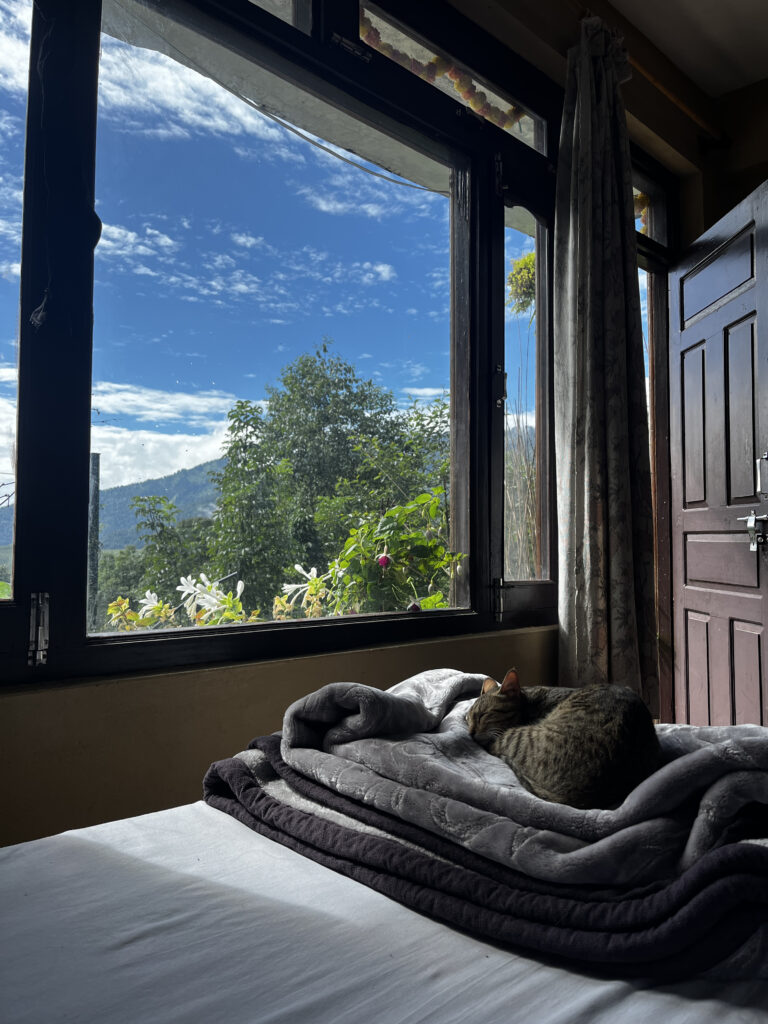
Monsoon 2023. View from my bed. Photo by Nishtha Tewari.
Over Zoom a few days later, my therapist, who had been an anchor for several years, told me, “You’re putting yourself through so much. You need to consider whether it’s worth it.” The next time I saw her was four months later, when I returned to the city for an urgent visit to the dentist. “You’ve been ill so frequently this year,” she remarked. The word “reckless” came up. My final session with her, after seven years, came as we discussed how my beliefs about marriage, family, and reciprocity were shifting, shaped in part by the relationships I had formed in the field. The conversation highlighted how my “personal” wellbeing was frequently at odds with my ethnographic commitments.
At the same time, relationships which I had found in the field—a place which others cautioned against thinking of as my “home,” but which, despite the initial panic, had increasingly begun to feel like one—grew in importance. Working through the panic felt “worth it” in order to hold onto these relationships. Could any therapeutic intervention hold these tensions? Maybe ethnographers needed to develop distinct therapeutic toolkits, I thought.
I spent the next few months creating an archive of phrases hidden in feminist ethnographies that hinted at this panic and distortion. Some whispered it by speaking about their position in the field, while others addressed it through their research conditions. I gradually grew more certain that I wasn’t as alone as I felt. It was only that—as the untethered threads in my own writing suggested—these experiences were too complex to write about very well.
***
In Melbourne, five of us sat at a fine dining restaurant. Red wine and medium-rare steaks. Three of us brown, two of them white… or was it three of them men, two of us women? Two of us private-school queers? One of them tenured, retired.
The conversation flowed, finally arriving at the topic of native anthropologists. Someone pointed out it’s possible to have an ethnographer’s eye even without an anthropological background. It was a perspective, after all, on everyday life.
The ethnographer’s eye can turn on her surroundings at any point.
“I did my fieldwork near my native town too,” I defended.
“Tell us more about your time in the village,” my tablemate nudged. “We were speaking earlier about how challenging it can be, even as a native.”
“Tell you more about what?”
“The murders,” he loudly whispered.
I regretted sharing this information. This is why most of the stories lived inside me, but I hadn’t been able to carry all of them alone.
“Oh,” I recoiled. “No, those were simply stories. Fieldwork was brilliant. But I do think about the stories that are shared with us by our interlocutors, at what moments, and which ones they might share a bit louder. Those stories can influence so much—things as definitive as the homes in which researchers, especially women, can choose to live. Those decisions influence our well-being the whole year.” While I had read narratives which explained how researchers organized their life in the field, fewer spoke about the genealogy of those decisions.
Then, softly, “I didn’t ask so many questions about the murders.”
This was a lie. I knew a lot more than I would have liked. That heaviness leaked into my work on occasion. But the more that I had learned, the less I liked to share.
Right on cue, someone at the table exclaimed, “Moral panic!”
I had come to expect this framing. I thought back to the fieldwork narratives, many offered by women, where the only panic that was acknowledged was in relation to the researcher’s presence in the field. Where personal discomfort was set aside to examine instead the fears that produced it. Each time I spoke about my choice, in staying with a family that had felt safe, I encountered the morality of my panic instead. It was a clear explanation, complicating my own positionality and power vis-a-vis my research participants.
But, during my late-night awakenings, those reflections had offered little relief. When the panic pins you down, how much can you endure, reflect, and predict? My physical panic, the all-too-real freeze responses, the burning aches, and the desire to flee were suppressed in those framings, turning away from the body. This intellectualization didn’t move me toward any possible action. The moral weight of my ethnographic choices remains, unresolved, within me.
***
The panic still rears its head. In off-hand remarks at dinner tables, in recollections of my own words spoken to others, and as I begin inscribing those words onto the page. The incidents which fed the panic—the sordid tales, the brutal cold, the half-open stories—still close in on me.
Not every vulnerability is productive. The physical panic marked the limits of what I knew. At the same time, analyzing what surrounded the panic obscured more than clarified the tensions within it: the edges of my own vulnerability, my efforts at individual well-being, and the attempts to situate and narrate the incomplete.
My account remains partial, exposed—shaped as much by what I cannot resolve as by what I reveal.
References
Stoller, Paul. 1989. The taste of ethnographic things: The senses in anthropology. University of Pennsylvania Press.
Nishtha Tewari is a PhD researcher at the University of Melbourne. She is currently working on her doctoral thesis, titled Joint-Pain: Women, Health and Households in the Indian High Himalaya. Her research interests include health inequalities, household economies, and state service-provisioning in South Asia. Her work is forthcoming in the Journal of the Royal Anthropological Institute.
Cite as: Tewari, Nishtha. 2026. “Panic! at the Fieldsite, or the Disingenuity of Clear Narratives.” In “Anthropology that Breaks your Heart: The Risk of Proximity,” edited by Alexandra Dantzer, Uyen Dang, and Emma Kahn. American Ethnologist website, 27 March. [https://americanethnologist.org/online-content/collections/anthropology-that-breaks-your-heart-the-risk-of-proximity/panic-at-the-fieldsite-or-the-disingenuity-of-clear-narratives-by-nishtha-tewari/]