This piece is part first instalment of the “Anthropology that Breaks Your Heart” series, a project inspired by the work of Ruth Behar’s The Vulnerable Observer (1996).
“Lo más seguro es que termines muriendo cubierto en sangre o en soledad”: “You’ll likely die bloody or alone.” My grandmother’s voice, low and certain, carried that prophecy through the halls of my childhood. She believed in curses, speaking of a curse attached to the men in our bloodline, one that flowed through them like a polluted current, condensing in their chests and submerging their minds, eventually dragging them towards violent or lonesome deaths.
Men’s bodies litter my family history, a shoreline strewn with washed-up generational grief that has swelled into decades of rage. Grief has been a coat, a shield, and at times a hammer, following me wherever I go. Grief has accompanied me as far as the southeastern Amazon Basin of Ecuador, where for the last eight years I have done fieldwork among Achuar communities.
The privilege of my education—only made possible due to the faintest stroke of luck and my mother’s will—afforded me the opportunity to leave the Southside of Chicago. My family members, immigrants and their first-generation children, tease me often, calling me the one who “made it out,” as though I ascended to a new class. But no distance or doctorate can save me from feeling the reach of loss or from my family inheritance of grief. The neoliberal university shows little patience for the messiness of mourning (Macdonald 2019). There, tears must be discreet. They must trickle down in the “secret zones of institutions” (de Certeau 1984, 191), behind sealed office doors, lest they be deemed a threat to productivity. Further: grieving in this particular body—one of Latinx heritage, of the diaspora, of Blackness, the result of settler-colonialism and the trans-Atlantic slave trade—brings its own unspoken expectations. My grief may never be so loud as to unsettle polite spaces, never so raw that it reads as aggression, never so honest that it frightens those around me. In the corridors of academia, the politics of civility demand a polished veneer.
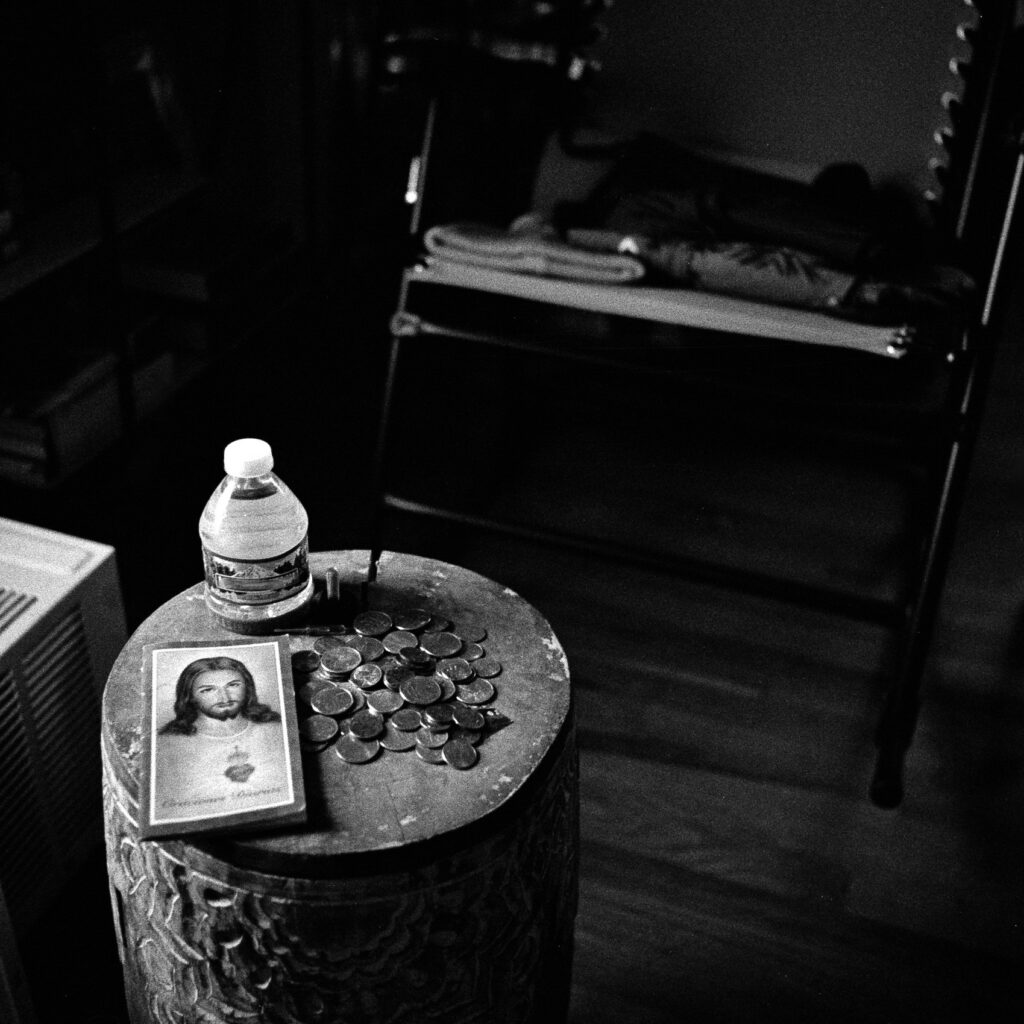
Inherited Bedside. Photo by Ulises J. Espinoza.
It was during a stint of fieldwork that my grandmother’s prophetic words resurfaced, further etching grief into my very being—and the future of my academic self. Sitting in a little café across from my hotel in Puyo, my phone vibrated as it lay on the table. The screen flashed “Tina”—my mom. We hadn’t spoken much since I had drawn boundaries between us, her hurt still fresh from the way she deemed my moving away from Chicago, a betrayal to the family.
I answered with a half-mumbled greeting and irritation in my voice. Then came the sniffles. My mother, crying? Tina doesn’t cry. It had been years since I’d heard her sound like this. The last time was when the house went silent after my oldest brother’s passing.
“Mijo, it’s Elijah. They killed him.”
Another one. Another of my brothers is dead.
I wanted to say something. But my mouth wouldn’t move. All I could manage were broken sounds that felt hollow and weightless. Nothing that could hold her grief, nothing that could reach her through that line. The silence between us stretched, punctuated by her sobs. I emptily reassured her that I’d come back after I finished my fieldwork. Always afterwards. Always work first. She hung up.
Alone in that café, I sat there staring at nothing for what felt like hours. The barista approached me, gently tapping my shoulder as though I might shatter at his touch, and told me that they were closing. What followed was a blur. “Dissociation,” my therapist would later call it. A fog that carried me through a night of losing myself in some bar in the Puyo square. No tears, at least none that I remember. Just a bruised eye, torn knuckles, and my pride scattered somewhere on the floor, waiting to be gathered in the wake of another bar fight, another moment of not deescalating, another way for the spilling of my blood to get me closer to living up to my grandmother’s prophecy.
A desolateness settled over me and did not lift. After my mother’s call, it moved with me for weeks—a deep, dull ache that comes when you understand you can’t change what’s already done.
For the Achuar, soul songs (anent) can be used to unbind the living from the dead, dissolving a loved one into a kind of anonymity where kin ties unravel and the decedent’s face becomes merely an abstract impression through the detailed imagining of their decomposition (Taylor 1993). In my own life, this same logic of putrescence took hold. I refused to invoke my brother’s name or imagine his likeness, until I could no longer recall the way he looked at the age of his passing.
Before this, grief, for me, once meant a loud, crowded homegoing, back when the matriarch of our family was still breathing. A call from her could pull us from whatever corner of the world we’d scattered to, as if showing up was the last duty we owed to each other. Old grudges called off for the day. The floor vibrating with the sounds of Anthony Acosta on the jukebox, the good-natured jabs about what small mercies the dead have found, never having to lie to Grandma again about her bad cooking. Her death ended that. Without her efforts we circled the same conversations about old hurts and failed familial expectations.
Truly feeling my brother’s loss felt like it would threaten the demands of my scholarly pursuits. So, I dove into fieldwork, into ethnography, into being a “vulnerable observer” (Behar 1996) of other people’s stories. I avoided the enactment of “withness” (Desjarlais 2016, 117) that arises in the space of mourning in my own life. What I would later see is that the grief threaded itself throughout my field notes, showing up in the margins, at the periphery of every conversation I had. There is no bargaining with grief. There is only learning to shape yourself to it. The way a poplar tree grows crooked under the weight of its strange fruit, its roots wandering far and blind beneath the soil, cracking pipes and foundations, ruining what it can’t see. I avoided it. I tried to walk past it, to let it sit unacknowledged while it rooted itself deep in my being.
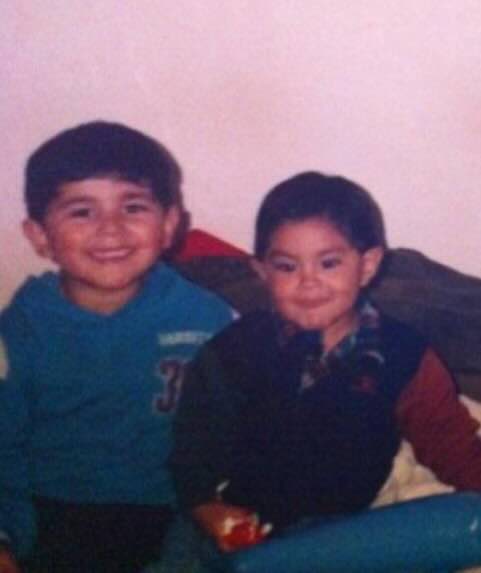
Childhood Snapshot of a Life Yet Lived. Photo from Ulises J. Espinoza’s personal archive.
It would be years before I would tell anyone about my brother’s passing, before I would even allow myself to realize that the grief was with me the whole time. My silence did not stem from a lack of community or professional support, but from a deep shame tied to the violent circumstances of his murder, from the shame of my failure as a brother to protect him. When you tell someone that a close relative was taken so brutally, they look at you with solemn disbelief. But when you look as I do and come from where I come from, there is an additional flood of questions. These questions cut into my own insecurities about how “loud,” “aggressive,” or “ghetto” I am perceived to be.
Other people’s queries land like self-imposed judgments, feeding into indictments I had internalized: that I left him behind to pursue anthropology, that I had failed to live up to my grandmothers’ instructions to be “el guardián de tu hermano.”
And that I could not prevent his death; that the rage he carried—a rage that played into his death—I carry too.
I think of Roland Barthes’s Mourning Diary and how grief spirals into questions of belonging, swirling around the unanswerable “why?” I find myself frustrated with trying to pin down the why of this loss, in the same ways that I find myself frustrated with descriptions of grief’s afterlife—the way its depictions can drift into misty, romantic metaphors or a catalogue of symptoms. Some framings of grief insist that it resists capitalism, that it compels a slowness out of sync with the market’s relentless tempo. Perhaps. But I think grief also simply abides.
Grief insists on being present, always waiting to spill out. It dulls, it sharpens, a rhythmic back and forth that leaves traces of use wear on the self. It does not simply break the heart; it reorients it, recalibrating what we can attune to, what we can let in, and how, as anthropologists, we make space for our interlocutors to speak of how their losses are lived in the everyday.
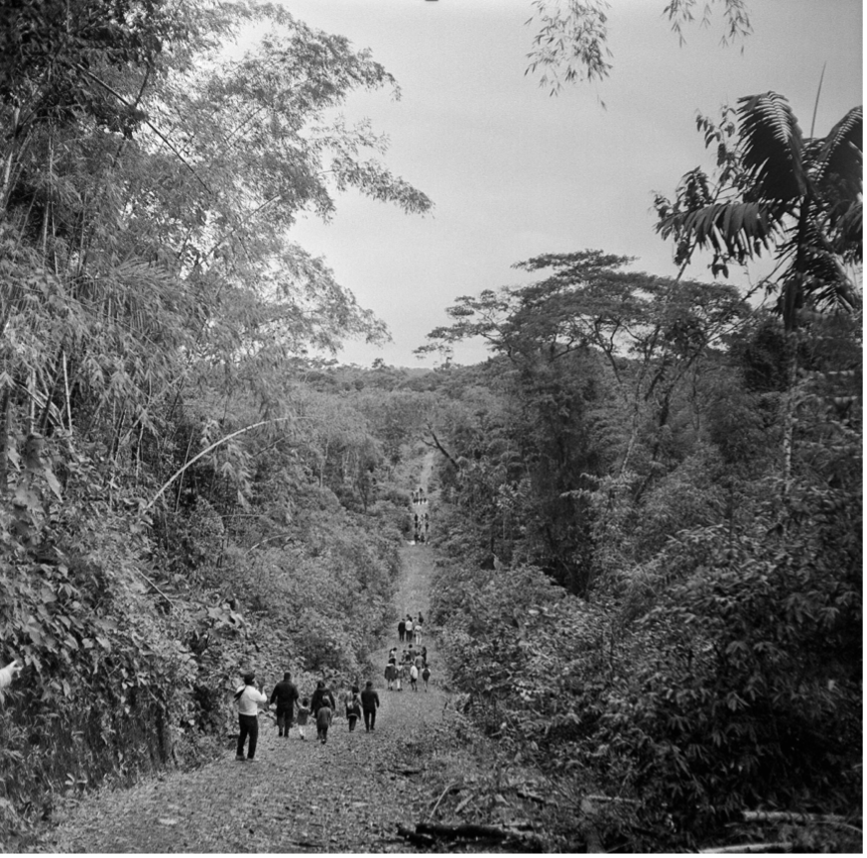
La carretera avanza. Photo by Ulises J. Espinoza.
I think of the communities I work with in Ecuador, living in the cross winds of ecological loss and social rupture (Grattan 2025). I think of interlocutors, such as Don Esteban, who have recounted to me a life before missionaries, before the road had advanced further into the forest. Over the years, he has spoken to me of change and of loss as it has gathered over time.
In one such instance, he mentioned brothers he lost, blood debts that took kin to be turned into tsantas. Anger tightened his voice. “In prior times,” he said, “I would have sought out to make a tsanta—headhunt—myself. Long gone are those days.”
That is when I shared about my brother.
He nodded once. “Ahh,” he uttered, “so you understand an anger that wants revenge… and the hope for them to show up in your arutam (visions).” In arutam, a loved one’s presence can be a sign that the dead have metamorphized, that their names are free for reuse.
I hesitated. “I think I do,” I said.
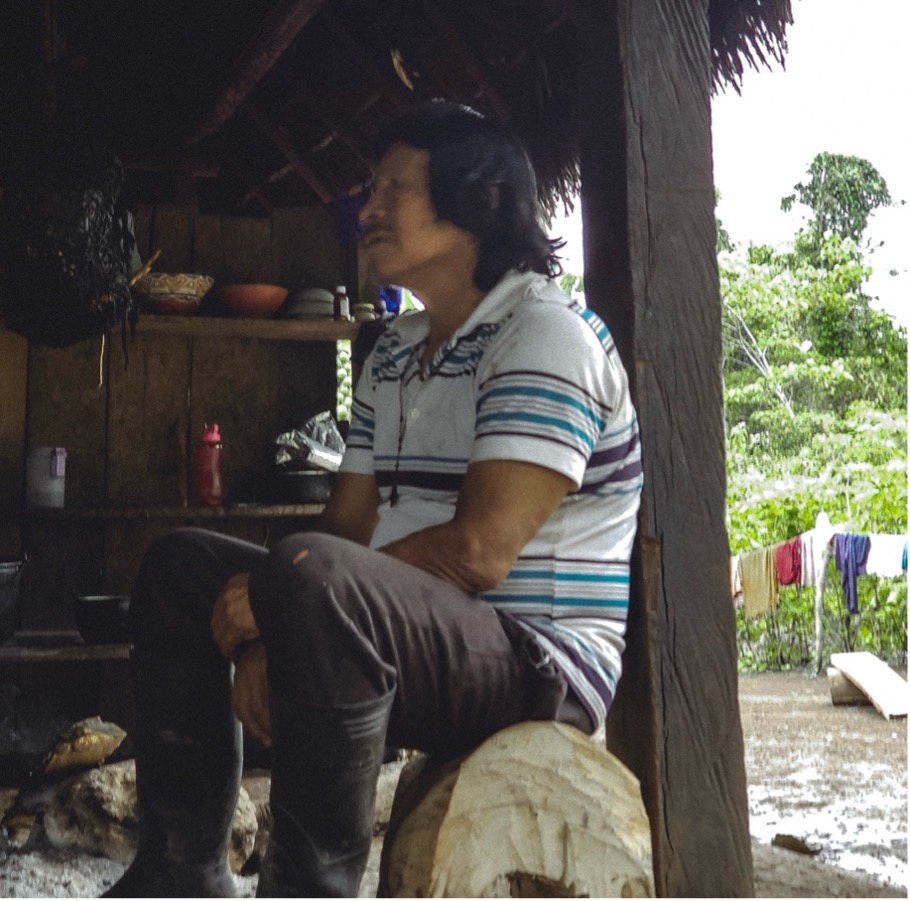
Desentrañando la rabia. Photo by Ulises J. Espinoza.
From here I wonder about the stakes of an anthropology of the broken-hearted, when taken up by individuals attuned to grief, who come from outside the expected trajectory of the academic identity. In my case, it was a search for a “rootedness elsewhere,” as Ruth Behar states (1996, 83), that led me to look for values and fears beyond my own. This effort began as avoidance but ended in points of contact shaped by ruptures. I wonder what it means to write an anthropology that begins in these points of contact, like those I shared with Don Esteban: not from a posture of distance, but from within the thick of conversations about loss—different in their reasons, perhaps, but bound by the shared work of staying with what grief makes of us. And I wonder, what might follow if we recommit ourselves to a collective understanding of grief, rejecting the presumption of its individuality (Ralph 2017).
This essay is a step towards searching for my “why.” It is an attempt, as someone oriented and reoriented by grief, to test the written possibilities of an anthropology of the broken-hearted. I do not wish to romanticize death or the grief that follows, nor cast myself as the hyper masculine wounded anthropologist. Rather, my effort is plainer and riskier: to stop hiding from myself, and to do so in public.
This, then, is my act of grieving publicly: admitting that I am not okay, and that I may never be.
Of writing against the way grief can be filed away as predictable. And writing against the violence which can make mourning feel disposable, reduced to collateral in a set of assumptions about race and class.
It is also an act of revisiting my grandmother’s words that are etched into my very bones. They sit there, lodged in the marrow, acting as both a warning and a promise I inherited:
“Lo más seguro es que termines muriendo cubierto en sangre o en soledad.”
Her words remind me that the men in my family, and many families like mine, have long been taught to swallow their pain, to remain silent and clench their jaws until all that remains is the metallic taste of suppression. In that silence, I can hear her voice reminding me that the “family curse” does not disappear.
Writing does not bring Elijah back. But I hope it can reorient the terms of my inheritance. On this page, I name the curse and refuse its inevitability. I take my grandmother’s words out of my body and place them in the open where they can be held up to the light.
Mourning, for my family, has never been tidy or solitary. And this grief, for all its weight, is a reminder that my brother Elijah mattered. To grieve together is to refuse the silence we inherited.
I write with my family behind me.
References
Behar, Ruth. 1996. The Vulnerable Observer: Anthropology That Breaks Your Heart. Beacon Press.
Certeau, Michel de. 1984. The Practice of Everyday Life. Translated by Steven Rendall. University of California Press.
Desjarlais, Robert. 2016. Subject to death: Life and loss in a Buddhist world. University of Chicago Press.
Grattan, Steven. 2025. “In Ecuador, environmentalists worry Noboa is unwinding nation’s green reputation.” Associated Press. August 4.
Macdonald, Mary Ellen. 2019. “The denial of grief: Reflections from a decade of anthropological research on parental bereavement and child death.” In Exploring Grief: Towards a Sociology of Sorrow, edited by Michael Hviid Jacobson and Anders Petersen. Routledge.
Ralph, Laurence. 2014. Renegade Dreams: Living Through Injury in Gangland Chicago. University of Chicago Press.
Taylor, Anne Christine. 1993. “Remembering to forget: identity, mourning and memory among the Jivaro.” Man 28 (4): 653-678. https://doi.org/10.2307/2803991.
Ulises J. Espinoza is an Assistant Professor of Anthropology at San José State University. He earned his PhD in Anthropology from UCLA in 2023. His current book project examines questions of rupture, hope, and grief tied to narratives of progress amidst Achuar and Shuar communities in Southeastern Ecuador in the backdrop of the infrastructural expansion of the road in the Amazon Basin. It attends to how people weigh the value of their traditions against the market’s pull by attuning closely to the grain of everyday decisions that play into what it costs to live a life they deem worth living.
Cite as: Espinoza, Ulises J. 2026. “Family Inheritance” In “Anthropology that Breaks your Heart: The Risk of Proximity,” edited by Alexandra Dantzer, Uyen Dang, and Emma Kahn. American Ethnologist website, 27 March. [https://americanethnologist.org/online-content/collections/anthropology-that-breaks-your-heart-the-risk-of-proximity/family-inheritance-by-ulises-j-espinoza/]