This piece is part of the “Anthropology that Breaks Your Heart” series, a project inspired by the work of Ruth Behar’s The Vulnerable Observer (1996).
We may write about violence embedded in research, but it’s difficult to openly discuss our own embodied experiences (Berry et al 2017; Heinze 2020; Walters 2020; Ahmann et al 2023). For researchers with an identity formed through marginalized experiences, the “objectivity” that haunts the dominant paradigms of social sciences, deeply rooted in the colonial apparatus, is “alive in aims and anxieties we develop for ourselves” (Johnson 2016). For me, being in the field at times felt like wearing an awkwardly fitting anthropology cloak. It is the work that makes one a stranger at home. As a diasporic Korean navigating the field, I felt both connected and out of place, neither fully an authentic insider nor what might be imagined as the archetypal researcher. Simultaneously, the heavy textures of fieldwork were constituted through navigating the frictions and the emotional residue of a long struggle: the peace movement in a small South Korean village where elderly community members placed their bodies on the line as they resisted the American military presence. In this space, I felt constantly in tension with my own vulnerability, belonging, and distance.

The village road at night. Photo by Clara Lee.
What happens if “the field” lingers long after you have left, like a dream you don’t wake from?
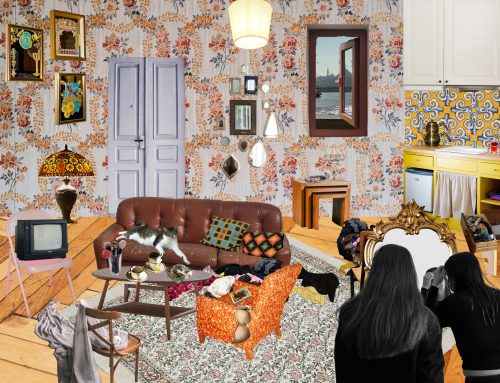
Post-field notes 1/25/2025: The grandmothers’ room looked different this time, less like a shared communal space and more like a personal bedroom in a country home, with wooden wardrobes, an old bulky television humming static, flickering across its screen, and a faux mink blanket adorned with flower prints spread on the floor. Everything felt analog, out of time. I told the group of older men whose faces and voices I did not recognize, “I need an apology.” One of them glared back, his expression heavy with disgruntled irritation. “You need to buy a plane ticket and go back.” They stormed out, slamming the door with a bang. I stood motionless, fixing my gaze at the buzzing TV screen as pixelated lines moved slow in waves. I reached for the doorknob, carefully peeking outside. The men were gone and I could see young students, perhaps even younger than I was, entering the room with surprised and unsettled face. I collapsed onto the yellow linoleum flooring, overwhelmed. My knees were weak, my heart pounding through my chest, my body trembling uncontrollably as I gasped for air. Through the haze of panic and pained breathing, I heard their words: “We believe you.” They gathered around me, removing the socks from my feet and massaging my bare feet and legs. “Breathe. Breathe. Breathe.” I tried to take a big breath.
Then I woke. Oh, it was a dream.
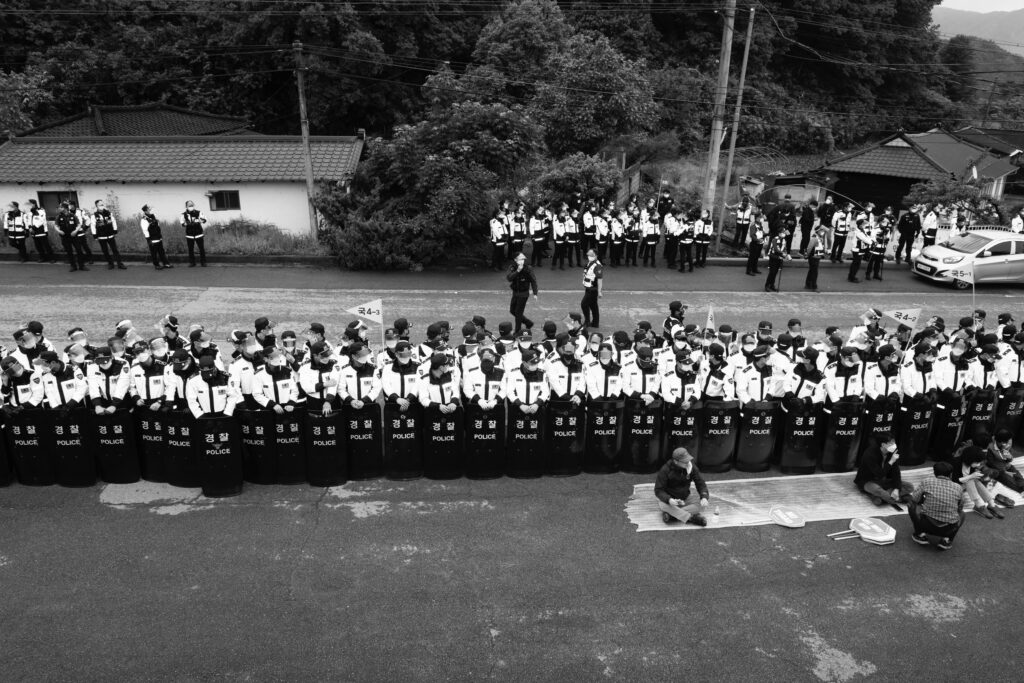
Village road occupied by state police. Photo by Jae Kak Lee.
My fieldnotes from 4/1/23 describe the lively rhythm of the anti-US base protestors preparing for a fundraising event: the county officials arriving in suits, photo opps, the dancing and laughter, the emotional reaction of the grandmothers—the heart of this community movement against American militarization in Korea—to a long-missed comrade. Missing from my notes, however, is the pervasiveness of the state surveillance, which had already become a background, a given. Perhaps I had stopped registering the specificities of its violence as notable “data.” Also missing is my own self, erased from the page. I had not written about the incident that had happened that day, how unsafe I had felt. A remarkable omission, since my notes were usually autobiographical—I was used to meticulously jotting down all observations and feelings.
It’s telling the way certain things are absent, while other things aren’t registered. It may be because we adapt. But adaptation isn’t a resolution. So, things linger in our bodies and in our dreams.
Dreams
Akmong (evil dreams) and sleepless nights were common in the stories the grandmothers shared. In English, I decided to call these experiences “mares,” evoking the older meaning embedded in “nightmare”: a malevolent presence that pressed down against the sleeper. In my observation, mares were not just evincements of unexplained happenings but were, rather, intricately tied to the lived reality of the community. Stories of mares were woven with life under the violence of the military empire and the nation-state that abandoned its aging and marginalized population. Many county residents most committed to the struggle had eventually receded from the village. Burdened with fractured solidarity, what remained was the lingering weight of ambivalence.
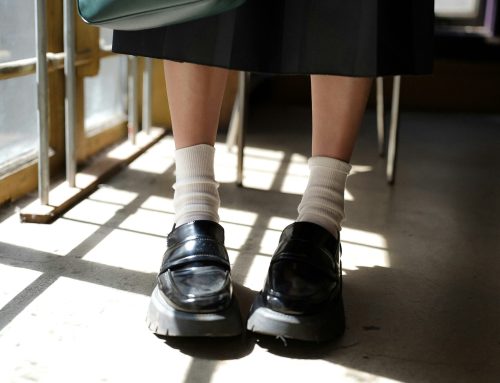
“I was lying down and sleeping, and I heard the siren in the middle of the night. I woke up and saw an enormous man with oversized feet kicking the chairs aside. The moonlight was really bright, but the road was empty. There was no one. I looked around, and that’s when I came to my senses. I had come out barefoot, without shoes or socks. I wasn’t wearing any shoes.”
The dreams were traces that I struggled to follow. I felt that they signaled the vulnerability of the grandmothers, who carried illness, anxiety, and stress in their bodies. If the Cartesian world casts dreams as an irrational singularity, these were afterlives of porous selves (Stewart 2017).
The distinction between fantasy and reality only mattered to those who did not have to carry the weight of violence, those whose “selves” were not at risk because it was happening “over there,” whose safety was not pushed aside as an “acceptable sacrifice” for the myth of national security. Trampled on by an oversized foot, across an empty road and isolated spaces, these dream states exceed the normative individualized framing of pathology. They were manifestations of collective trauma woven through historical, generational, and social experiences, refusing containment and neat narration.
At the same time, I hesitate to trace the dreams to specific causes and effects. Rather, thinking with dreams allows me to linger with the excesses: the ways violence occupies the senses, the body, day and night, how it operates as atmosphere rather than event, like a low hum or a static TV screen, continuing to live on beyond its punctuation.
What does it mean to encounter these dreamscapes as a researcher? Fieldwork is often framed as an endeavor to “know” the people represented in our writing, but I had not expected the intersubjective connection that unfolded through the intimacies of our bodies. As I listened to the grandmothers’ dreams, I sensed how the violence that haunted them affected my own body. It was not the same pain, but a kind of atmospheric inheritance, blurring the line between observer and participant. This dis-comfort shadowed my work.
Violence lingers in the body, leaving corporeal scars that etch in the aftermath. Singular events do not remain singular.
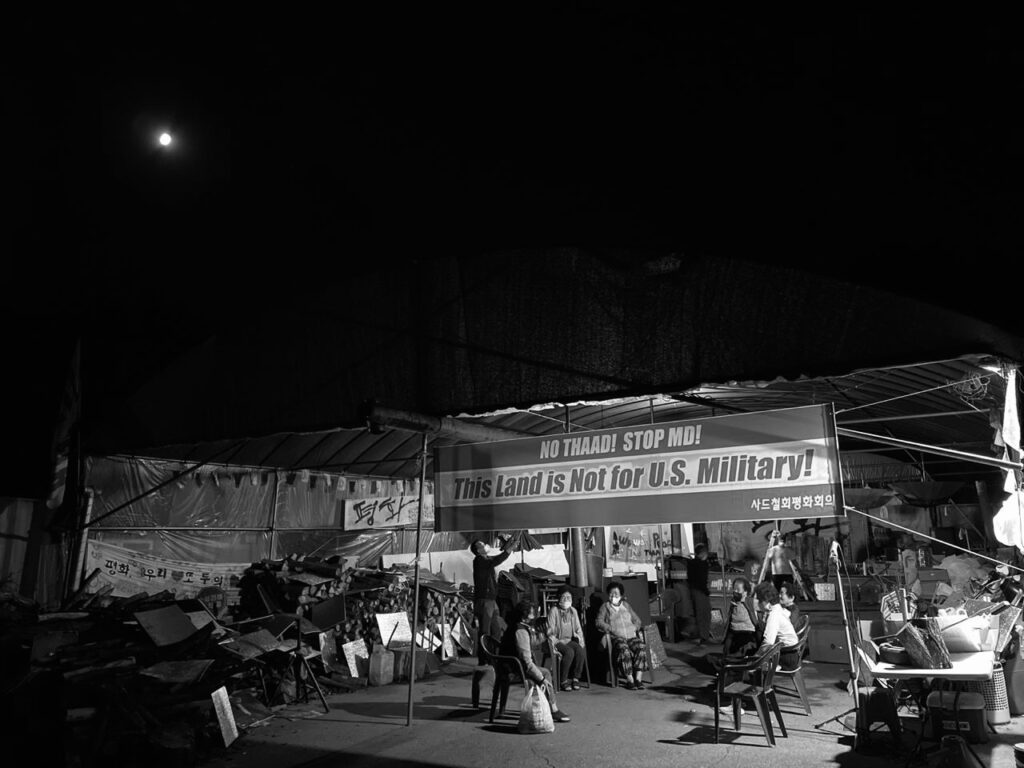
Nightly gathering in front of the village center. Photo by Clara Lee.
Vulnerability
There was an incident where a trusted interlocutor touched my body. He may have thought this gesture harmless, but I was left feeling violated and humiliated. Confronting him felt untenable. Not only was he a respected member of the peace movement, but there were also overlapping kinship and social relations. I was unable to weave the nuances of my experiences into writing, even in my own fieldnotes.
It took time to name what had happened and to allow myself the space to call it trauma. After all, the field was also a place of care, laughter, and transformation. So perhaps, I told myself, the good moments can outweigh the bad. For almost two years, I pushed down the “self” to the navel of my body, repeating that I had chosen this research. I convinced myself that silence protected the community and the relationships I had worked hard to foster. Disclosing what had happened felt like betrayal. So, I carried on in silence.
The vestiges of violence lived on as mares, isolation, estrangement. They settled into my body and shaped my relationships with the field. But from this dis-ease I came to recognize vulnerability as not a weakness but a shared condition. Looking back, I now see that taking communal bonds seriously and producing work that honors them could not be done by creating distance and essentializing my position as just an observer and a listener. It’s about returning to spaces of relation and about humanizing self and others.
Care
A year after completing fieldwork, I returned to the village. At first it felt like an obligation to keep the promises I made to myself and the grandmothers. The high-tech weapons systems of the US military’s remote warfare base, shielded behind armed forces and the gated road just past the village, still stood. It remained surrounded by a lifeworld of reciprocity nestled in the mountains. The villagers’ lives and dwellings remained inextricably linked to the land and to the people who quietly persisted.
I worried that my return would trigger the static hum I had tried to suppress. But from my conversations with the women a different kind of solidarity unfolded. I found that I wasn’t alone. I spoke aloud against the fear of burdening the movement and breaking hearts. Instead, they shared my tears and held my hands. “We stand by you, don’t forget that.” Certain community members continued to show up, checking in and listening as I began to speak out. Their embrace gave me space to breathe and courage to be vulnerable. When I eventually demanded an apology and tried to raise awareness about gendered violence in movement spaces, I was offered community support and acknowledgment. Their care made room for coming back and for my own unsteady and messy healing.
“Well-being” in anthropology means exiting the room with my and others’ dreams and returning with care.
I recognize the conditions that shape the grandmothers’ mares: violence and marginalization, the persistent weight of the state, the long durée of empire. But the story doesn’t end with mares. People gathered nightly around the fire, sitting in a circle, sometimes in silence and sometimes immersed in stories about the mundane rhythms of daily life. They often shared snacks. These were the moments where differences were aired, where the inevitable friction of a long-sustained movement could be felt and worked through, where we connected, imagined safety, and nurtured the everyday peace.
Dreams linger still, as I remember theirs and my own. But they give way to recognition for unwellness and the care that sustains new ways of being together. This is the kind of ethnography that I want to write.
References
Ahmann, Chloe, Ali Feser, Alix Johnson, Erin McFee, and Amy Leia McLachlan. 2023. “Fieldwork confessionals.” American Anthropologist 125: 623–628.
Berry, Maya J., Claudia Chávez Argüelles, Shanya Cordis, Sarah Ihmoud, and Elizabeth Velásquez Estrada. 2017. “Toward a Fugitive Anthropology: Gender, Race, and Violence in the Field.” Cultural Anthropology 32(4): 537–565.
Heinze, Jerika Loren. 2020. “Gauging the Toll: Auto-reflexivity, Sexual Violence, and Fieldwork.” Member Voices, Fieldsights, September 1.
Johnson, Alix. March 2016. ‘The Self at Stake: Thinking Fieldwork and Sexual Violence’. Savage Minds.
Stewart, Kathleen. 2017. “In The World That Affect Proposed.” Cultural Anthropology 32: 192-198.
Clara Lee is a PhD Candidate in Anthropology at the University of Colorado Boulder. Her ethnographic dissertation examines embodied, expressive, and often unseen forms of dissent within the Korean peace movement. Bringing together scholarship on global militarism, affect, and care, her research explores how US military policy in the Asia Pacific intimately shapes the lives of people in those regions whose daily lives are not considered central to large-scale political interventions and how these communities cultivate and sustain dissent through the persistent work of everyday care.
Cite as: Lee, Clara. 2026. “Things that Linger: Dreams, Vulnerability, and Care.” In “Anthropology that Breaks your Heart: The Risk of Proximity,” edited by Alexandra Dantzer, Uyen Dang, and Emma Kahn. American Ethnologist website, 27 March. [https://americanethnologist.org/online-content/collections/anthropology-that-breaks-your-heart-the-risk-of-proximity/things-that-linger-dreams-vulnerability-and-care-by-clara-lee/]