This piece is part of the “Anthropology that Breaks Your Heart” series, a project inspired by the work of Ruth Behar’s The Vulnerable Observer (1996).
When we met in Colombia, Gwen was six months pregnant with her son, Koa, and Juliana was a new mother; her son, Ammar, was four months old. Neither of us had any idea how we would feel navigating the competing demands of motherhood and ethnographic research.
We began working together on the project “Stories of Divided Politics: Polarisation and Bridgebuilding in Colombia and Britain,” which aims to study how individuals and organizations build bridges between politically divided sectors. But we frequently found ourselves experiencing a divide within our own selves, pulled in two seemingly opposing directions: motherhood and ethnography. Koa and Ammar are at the center of our lives. But so is our work as anthropologists.
Returning to work after having a baby is always difficult, but ethnographic fieldwork presents unique challenges. Ethnography as a profession is not a day job that you leave at the office, but an all-encompassing, holistic experience that requires your total, corporeal, emotional, experiencing self. It is an epistemology, a way of being in the world, even a political stance and identity (Shah 2017). Yet so is motherhood. How can we give ourselves completely to both? Can we have two centers without being torn in half?
As collaborators and friends, we continually express mutual admiration for the ways the other navigates being “mother-and-anthropologist,” this impossible new identity that sometimes feels as if it would tear us in half. We hold up a much-needed mirror to help the other appreciate the political potency of their actions. This piece is a product of our dialogues, which, in good feminist tradition, blur boundaries between the personal and professional. We use “we” to reflect the dialogic nature of our thoughts, and third person where we distinguish between our different experiences. Working together has convinced us of the need to put maternity on the public stage, including in anthropology, which we see as a work setting and an identity.
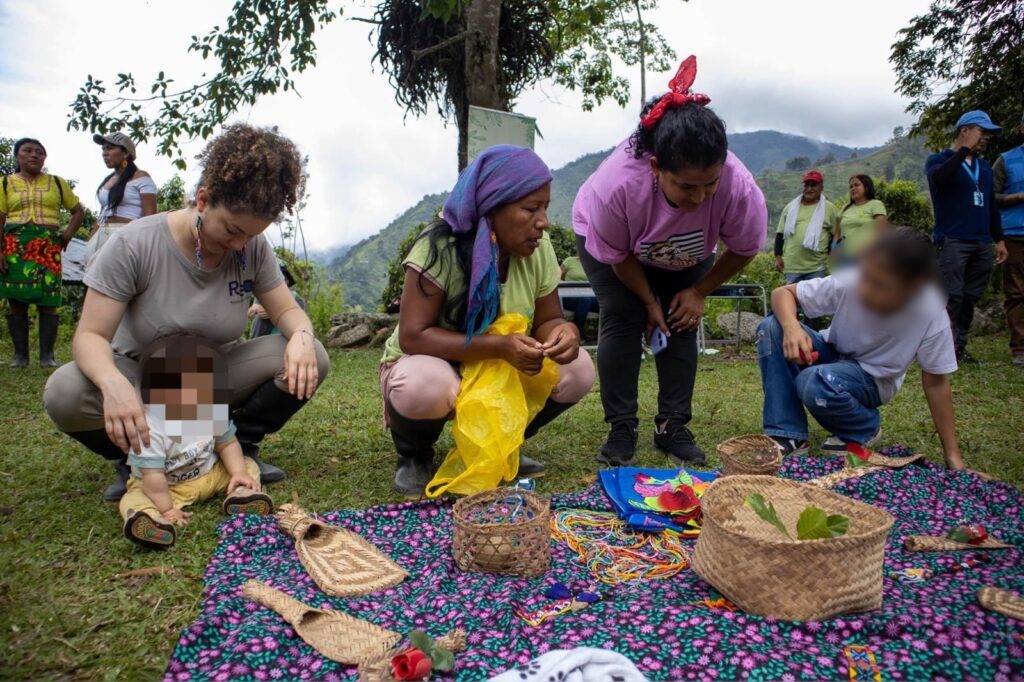
Juliana in the field with Ammar. Workshop on the Maleta Viajera of the Municipal Peace Council, Dabeiba, in Antadó-Llanogordo, with the participation of Indigenous authorities, traditional healers, and the Embera Eyábida community. Photo by Sergio Ríos Mena, 2025.
Fieldwork is an embodied experience. The body that goes to the field produces a different knowledge than could any other body; all ethnography is partly auto-ethnography. Maternity brings progressive and radical bodily change—first in pregnancy, then postpartum—from hormone cascades that take years to regulate, to metabolism shifts, skin and hair growth, and mood and energy swings.
Accompanying these physical changes is a broader process of identity change that lasts years, known as “matrescence” (Jones 2023). A mother in Gwen’s Scottish field site told her, “Motherhood breaks you into a thousand pieces, then you search around for those pieces to rebuild yourself, but the self you build is not the same.” We have revisited this quote together often. As new mothers, the process of rebuilding our broken pieces into new selves is continuous. Juliana summed it up in her field diary:
I struggle with wanting to be an anthropologist as if I wasn’t a mother, and be a mother as if I wasn’t an anthropologist. But I’m both. I’m not going to be the same Juliana as before. My ethnographic abilities and identity have changed. I’m being reborn.[1]
Ethnography is a relational method. While seeking to understand others, you reflect on your own being, beliefs, and perspectives. What does it mean, then, to do ethnography while reconstructing your identity? Being new mothers led us to take motherhood as a lens within our research. Some of the bridgebuilders we followed—people who convened and facilitated discussions on sensitive political topics across myriad dividing lines—were mothers themselves, and we reflected on how their mothering informed their bridgebuilding and vice versa. In other instances, we noticed the logic of care that informed the bridgebuilding activities we encountered, the same rationale that led philosopher Sara Ruddick (1989) to suggest that maternity, as a way of being in the world, had applications for peacebuilding. But we also brought these reflections into our daily lives, accompanying each other in the heartbreak of our rebirth, mourning our broken pieces, appreciating their generative power.
Juliana carried out ten months of fieldwork while Gwen gave birth in Edinburgh and gradually returned to writing and then fieldwork.[2] We communicated through WhatsApp calls and messages, our conversations frequently turning to maternity, reflecting together on motherhood. We developed a personal relationship anchored in solidarity and horizontality, contra traditional academic hierarchies, blurring boundaries between professional and personal selves. We were understanding when either of us had to postpone meetings or deadlines due to childcare; we shared tips about baby sleep, sickness, and “mum lit”; and above all, we simply listened to each other.
Rozsika Parker’s (2005) concept of “maternal ambivalence” highlights how mothers’ conflicting emotions toward their children are painful, but can also be productive. Similarly, as mothers-and-anthropologists we have experienced heartbreak both of the sad and unfair kind, and of the beautiful, joyous kind, which often go hand in hand. While our research participants build bridges between apparently opposing sectors, we have had to build bridges between our fieldwork and mothering roles. For example, Juliana’s diary describes feeling guilty for leaving Ammar with his father during her first day in the field:
I wept as I said goodbye. It was like leaving a piece of me. Ammar has separation anxiety. So do I. I looked at my son in Cristian’s arms with my heart broken and my stomach inside out. I couldn’t speak. This is my dilemma: I want to be with my son all the time, but also want to work, because I need money, and because I love fieldwork and feel best about myself in my professional life. How do I “build bridges” between these two Julianas?
This agonizing start was followed by an exciting day with bridgebuilding practitioners trying to facilitate dialogue between polarized groups. When Juliana got home, she wrote:
The fieldwork renovated me, particularly because it’s with people doing inspiring things, trying to change the world. Focusing on bridgebuilding means focusing on hope. I finished the day happy.
Gwen benefitted from Juliana’s insights when she started working again. She had the privilege of maternity leave but was still doing some work, reading Juliana’s reports between breastfeeding sessions, scheduling calls with Juliana around pram-walking naps, and working on drafts of this piece with Koa sleeping against her chest in a sling. Inspired by Juliana’s courage in taking Ammar to the field, she returned to practical work, including co-facilitating a peacebuilding workshop in London with Koa in her arms. She felt her attention divided between her baby and the participants—her two centers, active at once—but she also felt the political power of making her maternity public in this way, thanks to our exchanges.
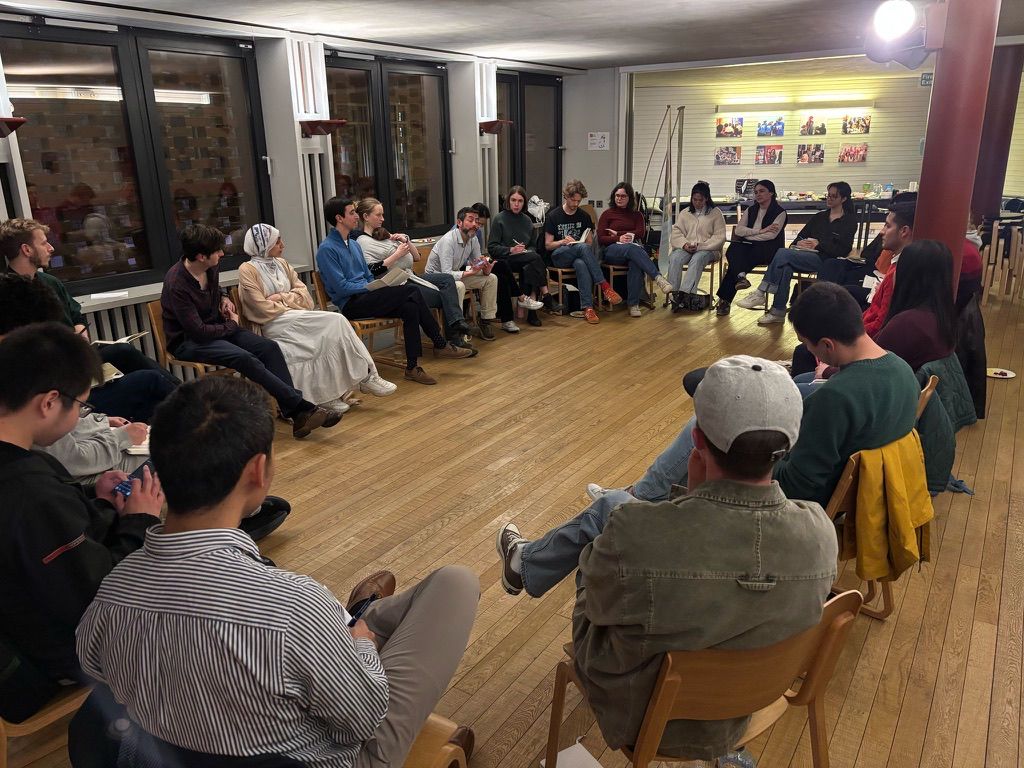
Gwen Burnyeat co-facilitating a peacebuilding workshop at the London School of Economics Faith Centre, with Koa asleep in a sling. Photo courtesy of Rodeemos el Diálogo, 2025.
A mother and baby, even after weaning, are corporeally co-dependent long after birth. Pregnancy and postpartum experts term the first nine months of a baby’s life “exterogestation” (versus uterogestation), because although the baby is out of the womb, they still depend on physical closeness with the mother’s body for emotional, hormonal and temperature regulation, and for physiological and neurological development. They also depend on the mother’s body for milk if they are breastfeeding.
While anthropologists have explored fieldwork experiences with children and families (Braukmann et al. 2020), we found little on fieldwork with babies as young as ours. We encountered several practical issues, which were also emotional. Firstly, travel logistics. Juliana’s fieldwork was multi-sited; she conducted short visits from her home in Bogotá to different locations in Colombia following various dialogue initiatives that seek to depolarize society. Ammar went with her. The project also funded travel for Ammar’s father, Cristian, to care for Ammar while Juliana worked. This was possible because her contract was with project partner and peacebuilding organization Rodeemos el Diálogo (ReD, ‘Embrace Dialogue’), so we could use our travel budget flexibly.
Juliana recalled how, as a solo ethnographer, she used to go straight to Departures with a small carry-on. Now she had to arrive early to the airport, check luggage, organize Ammar’s naps around trips, cart a pram through security, and manage Ammar’s discomfort with altitude changes. She learned to book accommodations with a separate living room and bedroom after her first trip saw her writing fieldnotes and eating dinner in the bathroom, to give Ammar darkness to sleep.Cristian’s job as a ceramicist meant he was flexible, though he had to relinquish time in his studio, so the project is indebted to his support.
Even fieldwork in Bogotá meant relying on Cristian or Ammar’s grandparents. Some bridgebuilding dialogues happened online, so Juliana could work from home. But that too required childcare, and it was often harder to concentrate, as Ammar’s cries from a nearby room compelled her attention, activating that feeling of being torn between two centers. Yet there is no perfect fieldwork. Just as psychoanalyst Winnicott (1988) famously talked of the “good enough” mother, we needed “good enough” fieldwork.
A second, related challenge was breastfeeding. On one occasion, Juliana decided to fly to another city and back the same day for a bridgebuilding dialogue. She pumped before the event and again at the airport, but her breasts became painfully engorged. She hoped to remedy the situation by getting home to Ammar, but it was too late. She fed Ammar several times that night but couldn’t sleep with the swelling and the pain of her clothes rubbing her nipples. Next day she had fever and terrible pain and realized she had mastitis, caused by not draining milk from the breast.
The third challenge was sleep. Babies have shorter sleep cycles than adults, feed regularly to maintain blood sugar, and are dependent on carers to fall asleep. Some sleep through the night after a few months, but others take longer. Ammar was still waking regularly at night to feed during the fieldwork, so Juliana lived with an extended sleep deficit. She often felt “zombie-like” in the mornings.
The demand for babies to sleep through the night masks an internalized capitalist need for the mother to be as or more productive than before pregnancy; in our case, to be anthropologists as if we were not mothers. But we are not the same as before and neither is our way of working. Often, discussions about maternal guilt or feeling “torn” between work and motherhood reflect cultural expectations about appropriate maternal behavior, being “intensive mothers” (Hays 1998) and productive citizens. As workers, anthropologists-and-mothers need family-conscious work policies and cultures to allow us the space and flexibility to “rebirth” ourselves and our fieldworker identities and capacities (c.f. Hodgkins and Thompson 2022).
Despite these challenges, motherhood also gave us new abilities as ethnographers. We have new sensitivities and may access spaces and conversations previously closed and unknown to us. Doing fieldwork with our babies is a political act. A man seeing Juliana in the field with Ammar said, “I want my future wife to be passionate about her job like you.” In Gwen’s peacebuilding workshop, people commented that seeing her rock Koa to sleep while facilitating a discussion about identity divides was inspiring; one young woman said, “peace begins with the family.”
Putting maternity on the public stage as anthropologists in this way, including our heartbreak and dilemmas, is political. We hope it can open the hearts of others and inspire new ways of working across the searing tension of mothering and ethnography.
Notes
[1] Joint translations from original Spanish.
[2] In Colombia, women have four months of maternity leave; Juliana applied for the job after this period. Gwen had a year’s maternity leave but continued supervising the project throughout and began a progressive return to writing and fieldwork from three months.
References
Braukmann, Fabienne, Michaela Haug, Katja Metzmacher, and Rosalie Stolz, eds. Being a Parent in the Field: Implications and Challenges of Accompanied Fieldwork. Transcript Publishing.
Burnyeat, Gwen. 2024. “Reverberations: Political Identity Boundaries after the Colombian Peace Referendum.” Journal of Language and Politics 23(5): 677-698.
Hays, Sharon. 1998. The Cultural Contradictions of Motherhood. Yale University Press.
Hodgkins, Jaime, and Jessica Thompson. 2022. “Impossible Choices at the Crossroads of Motherhood and Fieldwork” Sapiens, May 5.
Jones, Lucy. 2023. Matrescence: On the Metamorphosis of Pregnancy, Childbirth and Motherhood. Allen Lane.
Parker, Rozsika. 2005. Torn in Two: The Experience of Maternal Ambivalence. Virago.
Ruddick, Sara. 1989. Maternal Thinking: Toward a Politics of Peace. Ballantine Books.
Shah, Alpa. 2017. “Ethnography?: Participant Observation, a Potentially Revolutionary Praxis.” HAU: Journal of Ethnographic Theory 7 (1): 45–59.
Winnicott, Donald. 1988. Babies and Their Mothers. Free Association.
Gwen Burnyeat is Lecturer (Assistant Professor) in Social Anthropology at the University of Edinburgh and Principal Investigator of the project “Stories of Divided Politics: Polarisation and Bridgebuilding in Colombia and Britain.” Her latest book, The Face of Peace: Government Pedagogy amid Disinformation in Colombia (University of Chicago Press 2022, Spanish translation Editorial del Rosario 2024), won the 2023 Public Anthropologist Award. http://gwenburnyeat.com
Juliana Franco Calvo was Ethnographic Researcher of the project “Stories of Divided Politics: Polarisation and Bridgebuilding in Colombia and Britain.” She holds a Masters in Social Antropología from Centro de Investigaciones y Estudios Superiores en Antropología Social (CIESAS), Mexico, and is a Law graduate from the University of Rosario, Colombia. She is based in Bogotá.
Cite as: Burnyeat, Gwen and Juliana Franco Calvo. 2026. “Dilemmas of the Mother-Anthropologist.” In “Anthropology that Breaks your Heart: The Risk of Proximity,” edited by Alexandra Dantzer, Uyen Dang, and Emma Kahn. American Ethnologist website, 27 March. [https://americanethnologist.org/online-content/collections/anthropology-that-breaks-your-heart-the-risk-of-proximity/dilemmas-of-the-mother-anthropologist-by-gwen-burnyeat-and-juliana-franco-calvo/]