This is the Introduction to the second instalment of the “Anthropology that Breaks Your Heart” series, a project inspired by the work of Ruth Behar’s The Vulnerable Observer (1996). Please see the Introduction of the first instalment for direct discussion of Behar’s foundational text.
As researchers, teachers, and writers—professionals, in one word—we are often tasked with having it together. And yet what doesn’t always belong together is the personal and the professional. At the core of the anthropological endeavor lies a confrontation with difficulty, and still, our heartbreaks are often far removed from what we reveal to the world. As professionals, heartbreaks are better left where they belong—our chests and stomachs, diaries, intimate conversations, bedrooms, chats and support groups.
But what if heartbreak belongs at the center of what anthropologists do? Anthropologists in training are taught to stay close to what is painful, to closely observe the textures of the everyday and how they articulate with the macro and systemic. And that macro level is pain-inducing, harsh, steeped in injustice and differential access to privilege. Lauren Berlant (2011) teaches us that rather than being an event, pain is its own genre. It can have a beginning and an end, but more often than not, it turns into a mode of being, a structure that shapes what is sayable, thinkable, and knowable.
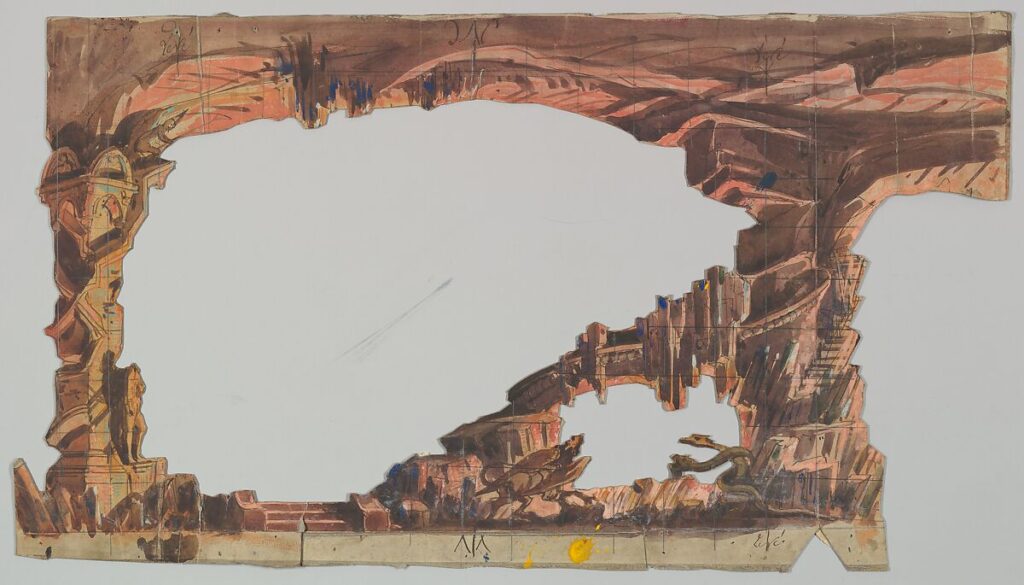
Eugène Cicéri, “Design for a Stage Set,” 1830-1890. Source: Metropolitan Museum of Modern Art.
Here, we are inviting you to understand heartbreak as Lauren Berlant understood pain—not as a deviation from scholarship, but as a mode of knowing that is too often discarded. We are asking you to stay with the trouble (Haraway 2016) of heartbreak and to commit to the entangled, messy, and sometimes uncomfortable merging of the personal and professional.
Our heartbreaks often end up invalidated by the extractivist logics of not only our discipline, but the institutional environments in which we are embedded. Still, we believe that they are an invaluable part of our knowledge production. Heartbreak is not a distraction from the work; it is the quiet force that shapes how we listen, what we notice, and what we write. It directs our attention towards the world and back to ourselves. And these selves, with all their wounds and joys, are the guides of our work. To echo bell hooks (1995, 281): “The function of art is to do more than tell it like it is—it’s to imagine what is possible.” In this installment, we are celebrating scholarship that makes space for our heartbreaks, not in spite of the pressure of professionalism, but because of it.
David Tutchener demonstrates how notions of heritage can emerge as much from personal registers as from formal regulations. The heartbreak Tutchener foregrounds resonates in the work of Gwen Burnyeat and Juliana Franco Calvo, who reflect on the powerful—if painful—sensibilities that arise from the professional marginalization of maternity. Their attention to the beauty and challenge of working anthropologically while bringing new life into the world is a poignant complement to the work of Lalaei Ameeriar, who writes from the throes of grief. Through a deeply ethnographic lens, Ameeriar recounts the excruciating and exquisite process of witnessing the end of her mother’s life. Maria Fernanda Olarte-Sierra precisely locates the heartbreak and grief in the body and gives it shape: her heartbreak is a flutter of butterflies turned bats.
Aika Sato explores the asymmetries from which her work emerges, reminding us that our scholarship emerges from various silences. She poetically explores the emotional textures of this condition. Binar (Mentari) Malahayati focuses on the violence of anthropology and ethnography, writing through the grief of anticipating that her scholarship will fail the people for whom she does the work. Staying with what hurts, Clara Lee reflects on how violence, vulnerability, and care linger beyond the temporal and spatial bounds of fieldwork, surfacing through dreams and bodily memory in ethnographic practice. Rather than resolution, the intuitive and difficult paths necessitate deeper reflection, as Nishtha Tewari’s “Panic! At the Fieldsite” reminds us. What makes “the field” difficult to narrate is that the ethnography arrives always and already laden with silence and heartbreaks.
Christina Kefala examines the heartbreak central to the self’s expression by asking what it means to meet or unsettle expectations of being “academic.” Blending personal narrative and photography, Camilo Leon Quijano explores how France’s Bienvenue en France initiative and migration policies more generally produce vulnerability, exclusion, and “deportability” for non-EU academics. In his essay he calls for a critical anthropology that confronts these structural shifts. Ulises Espinoza opens his essay with a family curse traversing generations “like a polluted current,” and invites us to explore the nexus between individual and collective grief, to orient ourselves towards an emotional landscape both foreign and familiar. But in following the tracks of loss and grief, we might also come upon an elusive yet encompassing kind of joy, as deniz atakan gürbüz explores in their piece. Fragile, atmospheric, and animate, such feeling embraces heartbreak as far-ranging agency, something to be attended to with the depth, curiosity, and vivid emotion that anthropology demands.
All of these essays provoke us to consider heartbreak as a genre of being, but also as a method that asks us to risk proximity, to write from within it rather than about it. In centering heartbreak in our scholarship, we want to believe that we don’t diminish our professionalism. Instead, we reimagine what rigorous, accountable, and transformative knowledge can and indeed should be.
Acknowledgments
This Introduction and installment were generously supported by the work of Emma Kahn and Uyen Dang. I’m grateful for their help. Thanks too to Kathryn Goldfarb for her patience and support with editing.
References
Berlant, Lauren. 2011. Cruel Optimism. Duke University Press.
Haraway, Donna J. 2016. Staying with the Trouble: Making Kin in the Chthulucene. Duke University Press.
hooks, bell. 1995. Art on My Mind: Visual Politics. The New Press.
Alexandra Dantzer is a 2025–27 Taft Postdoctoral Fellow at the Taft Research Center at the University of Cincinnati and a cultural anthropologist specializing in insomnia. Her work contributes to critical conversations in medical anthropology, disability studies, feminist and multimodal methodologies, temporality and urban life. Her manuscript Awake in the World: Insomnia and the Arts of Living in Belgrade merges ethnographic theory and historical contextualization with poetic and multimodal elements demonstrating how creative forms can deepen analytic insight. She is an author of a collaborative book Glossary of Insomnia and an award-winning filmmaker, and has published extensively on insomnia, tracking technology, ethics in anthropological research and existential experiences such as stuckness.
Cite as: Dantzer, Alexandra. 2026. “Anthropology that Breaks your Heart: The Risk of Proximity.” In “Anthropology that Breaks your Heart: The Risk of Proximity,” edited by Alexandra Dantzer, Uyen Dang, and Emma Kahn. American Ethnologist website, 27 March. [https://americanethnologist.org/online-content/anthropology-that-breaks-your-heart-the-risk-of-proximity-by-alex-dantzer/]