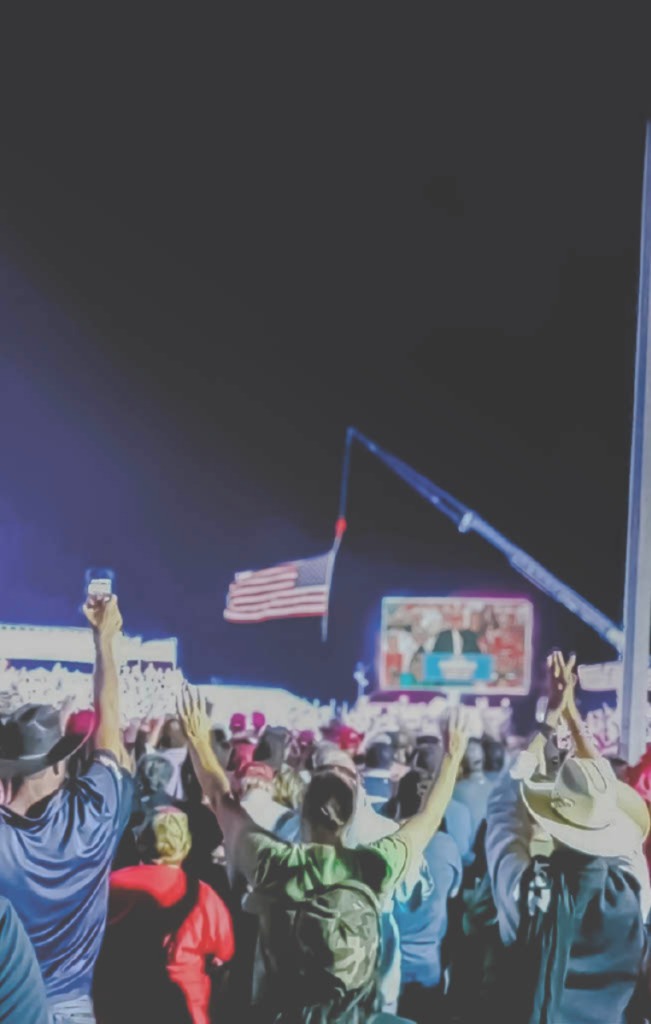
Trump rally in Robstown, Texas, U.S.A, October 22nd 2022. Photo by Thomas Long.
The caricature of the devout, “MAGA-republican” evangelical Christian is one that has dominated global media since Donald Trump’s first presidency in 2016. This is not without good reason. CNN exit polls from 2016, 2020 and 2024 show that 81%, 76% and 82% of white evangelicals voted for Trump in those elections. Yet, as I discovered while performing ethnographic research with Baptists—the largest Protestant and evangelical denomination in the US—the reality of this support was far more complicated than these figures alone might suggest.
What seemed to unite my interlocutors was not necessarily agreement over whether Trump was the right leader for the nation. It was, rather, a feeling that his politics were narrowing the space in which Baptists could disagree about that question, and about the wider set of “culture-war” issues mobilized in his rhetoric. In other words, they felt that the future Trump promised to deliver was one in which civil disagreement itself would be increasingly difficult to sustain.
I did my fieldwork in Austin, Texas, from September 2022 to October 2023, a time when Trump was beginning to reemerge as a prominent political voice following his 2020 electoral defeat. At the time, many of the Baptists I spoke to expressed their support, cemented in the belief that the “MAGA” movement was commissioned by God to save the nation. Others reacted with complete abhorrence, articulating uncompromising critiques of an individual they saw as profoundly un-Christian. Most fell somewhere in the middle. They understood that in a two-party system, Trump was a means justified by the ends that his administration would bring, even if they found him grotesque and (at times) politically extreme. As one of my interlocutors commented, shrugging, “God uses imperfect people for his perfect plans.”
Popular discourse often frames Trump’s appeal to evangelicals as unprecedented in the modern political era (see, for example, Doran 2026). Yet this was not how my interlocutors viewed him at all. Far from seeing Trump as a new or unprecedented “rupture” from the past (see Robbins, 2007), the Baptists I spoke to ubiquitously described him and his rhetoric as deeply familiar. Trump was, they told me, a figure who had simply “gotten in through an already open door” and capitalized on “religious wars [Baptists] have been having for the last 50 years.” The divisions he mobilized were the latest iteration of long-standing ideological, theological, and political fault lines already present in Baptist and American life: they were nothing new.
What had shifted, they said, was how those divisions were being received and managed. Baptists, while known for their deep history and the continuity of traditions in the US, are also famous for their capacity to disagree, split, and reconstitute over theological, cultural and political conflicts: “He is a Baptist, but not my kind of Baptist,” I would often hear my interlocutors say. I have termed this kind of relationship—stable division without full rupture—“fracture” (see Long n.d.), and argue that this is central to the organization and cohesion of the Baptist faith. What my interlocutors seemed to be describing was the difficulty of maintaining fractured relationships in the post-Trump climate: there was an increasing tendency toward rupture instead. As one such interlocutor, a pastor at an Austin-based church, put it:
Pre-2016… there were complexities and differences, yes, but there was also a lot more consensus. Complexity would be honored… These days you think evangelical—even me as a Baptist preacher—and you think “God, Guns and Oil”… or “Our Lord isn’t Woke, so why should you be.” It’s so divisive. If a pastor doesn’t have the political leaning, if he isn’t speaking to the right kind of politics, then he can’t know you in Christ, he can’t know you at all. And I am not fine with that.
For the Baptists I worked with in Texas, the greatest casualty of Trump’s rhetoric was not unity. There had always been disunity, they told me. Trump’s effect instead was to transform how that disunity was understood. The Baptist capacity for fracture—to understand that a person could be a Baptist, just not your kind of Baptist—is what his rhetoric eroded: a shift from negotiating difference to enforcing disparity, and from living with disagreement to imagining a singular political future in which disagreement no longer has any place at all. For my interlocutors, there was a tangible sense that under Trump, the fractures of the past were becoming the ruptures of the present and, more troubling still, the fixed conditions of the future.
In her recent book, Living Right (2024), Agnieszka Pasieka sets out to understand the ways that European youth become involved in far-right political movements, arguing that this is to do with how far-right imaginaries of the nation are lived as “a future project, which draws on the past,” recoding nostalgia as “a concern with the future” (202-3). This seems to me to be exactly what Trump’s MAGA rhetoric does. Nationalist projections of the future, writes Pasieka, foster “an increasingly common view among activists that they have less in common with liberal compatriots than with other [f]ar-right activists or even with ‘cultural others’ who value their own traditions” (216). They only accommodate a particular kind of person with a specific set of values, and thus actively reward exclusion over inclusion. These are not political futures that allow for division and disagreement, because these are not futures for everyone.
It is this temporal orientation of Trump’s rhetoric, I suggest, that has produced the aforementioned transformation—from fracture to rupture—for my Baptist interlocutors. The projection of a “MAGA” future in which division is foreclosed rather than negotiated or lived-with, is what makes fractures between Baptists no longer tenable.
Allow me to give a concrete example of what I mean. Early into my fieldwork, I attended a Trump rally one evening in southern Texas. It was around the time of the 2022 midterm elections, and Trump had begun holding rallies to endorse candidates and tease a third presidential run. Slipping into his recognizable stream-of-consciousness-style narrative, he recounted a similarly recognizable story: the radical left had eroded America’s strength to a dire extent, and “Making America Great Again” was the single, inevitable solution.
The Texas way of life is under siege. Biden and the far-left lunatics are waging war on Texas… They’re against oil, God and guns. They say, “We will stop MAGA.” I said… How do you do that? Even if you want to stop it, you just don’t say you want to stop Making America Great Again.
As Trump spoke, whoops and cheers abounded. His followers were electric, applauding and shouting their support, save for the few that remained still, standing motionless with eyes shut and arms aloft, a telltale bodily performance of evangelical prayer. Not long into the address, Trump invited the incumbent Texas Attorney General, Ken Paxton, onto the stage. After a brief endorsement from Trump, Paxton followed in kind, ending his brief cameo in a significant and striking manner:
[Donald Trump] has done more for the American people than any president in our lifetime… However, I have one suggestion because it sounds like there might be a possibility that he’s running for president again… He’s got a great slogan, a great theme, Make America Great Again. But if he’s going to run again, maybe a little tweak could be, instead of Make America Great Again… Make America Texas!
Paxton’s remark was delivered as humor, but it landed—I argue—as something more revealing: a spatial contraction of the nation in which Texas was offered as a template for the whole of America’s future.
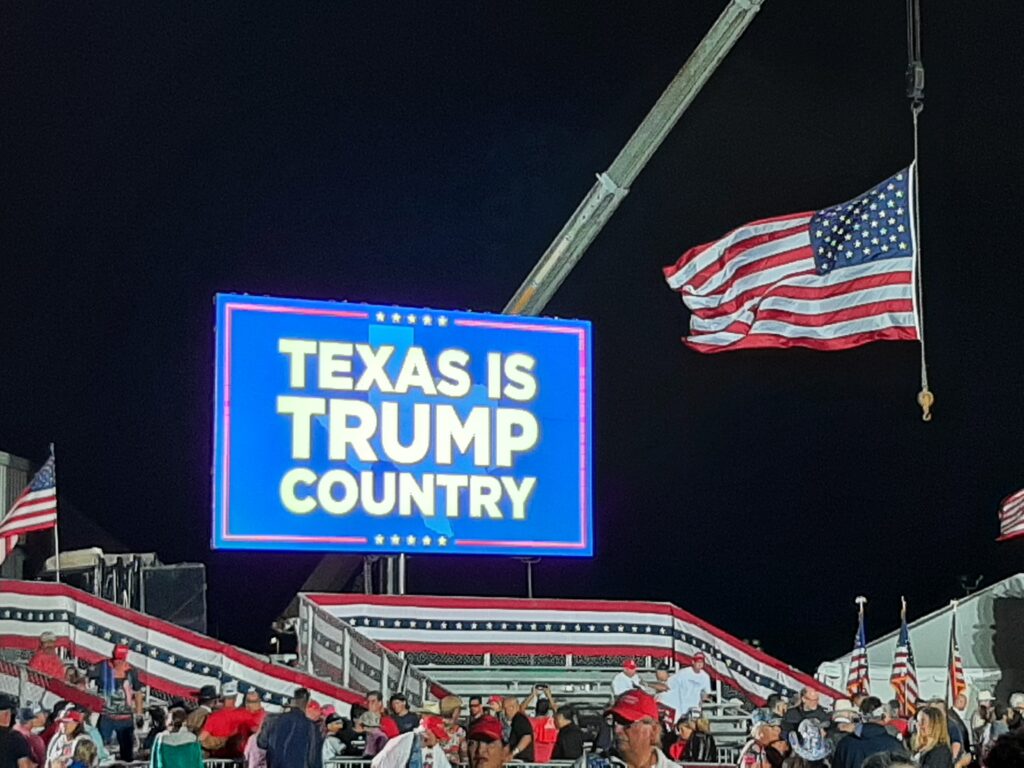
“Texas is Trump Country,” Robstown, Texas, U.S.A, October 22nd 2022. Photo by Thomas Long.
Among Baptists, this move mirrored a growing religious logic in which one form of faith—of “God, Guns and Oil”—was no longer situated as a Baptist position, but as the Baptist position. What was being eroded, here as elsewhere, was the space for fracture itself. Trump’s politics altered not the existence of division, but the spatio-temporal horizon upon which division could be lived without becoming rupture: the horizon upon which America could exist without becoming Texas.
The “MAGA” promise does not simply situate old conflicts as restorative nostalgia (Boym 2001). It reorders them by projecting a singular future in which those conflicts themselves become illegible. They are no longer sites of amicable disagreement, but signs of moral failure or civic (and spiritual) betrayal. By recoding the past as a particular form of conservative American heritage and the future as its rightful and natural continuation (Paseika 2024, 202), “MAGA” transforms fractures into ruptures by delimiting the kinds of beliefs and values that Americans must have in order to claim legitimate belonging within that future.
Trump’s promise, crystallized in sentiments like “Make America Texas,” is a future narrowed in advance, a nation imagined not as a plural space of contested difference but as “a powerful panacea for current malaise and the only true source of social cohesion” (Paseika 2024, 203).
For Baptists, this promised future is not abstract. It is lived as a moral and theological reckoning over who can still be recognized as a Baptist, and as the diminishment of dialogue across fracture in a nation that no longer makes space for it. This is not a nation that invites negotiation or difference. It is a predetermined destination, a promised future that rewards exclusion. I argue that it is this promise—not only policy or personality—that has made Trump’s politics so profoundly divisive for Americans and American Baptists alike.
References
Boym, Svetlana. 2001. The Future of Nostalgia. Basic Books.
Doran, Michael. 2026. “Why the Trump Coalition Is Cracking Up.” Hudson Institute, January 5, 2026. Accessed January 14, 2026.
Long, Thomas. n.d. “Divided We Stand: Conceptualising Divisions in Baptist Religion as ‘Fractures.’” Revise and resubmit at the Journal of the Royal Anthropological Institute.
Pasieka, Agnieszka. 2024. Living Right: Far-Right Youth Movements in Contemporary Europe. Princeton University Press.
Pew Research Center. 2025. “Most Americans Don’t Believe God Played a Role in Recent Presidential Election Outcomes.” Pew Research Study, September 10, 2025. Accessed November 21, 2025.
Robbins, Joel. 2007. “Continuity Thinking and the Problem of Christian Culture: Belief, Time, and the Anthropology of Christianity.” Current Anthropology 48(1): 5–38.
Thomas Long is an anthropologist and lecturer at the University of Manchester. His research concerns evangelical Christians in the US and the moral, theological and ideological “fractures” that form between them over contested cultural and political issues. His interests include the anthropology of religion, the anthropology of Christianity, US politics and religion, populism, political polarization, and ideology. Follow his research explorer page here.
Cite as: Long, Thomas. 2026. “‘Make America Texas’: Baptists, Fracture, and the Foreclosed ‘MAGA’ Future.” In “Promised Futures,” edited by Ibrahim Ince and Erick Moreno Superlano, American Ethnologist website, 9 July. [https://americanethnologist.org/online-content/collections/promised-futures/make-america-texas-baptists-fracture-and-the-foreclosed-maga-future-by-thomas-long/]
This piece was edited by American Ethnological Society Digital Content Editor Kathryn E. Goldfarb ([email protected]).