Cholet “Monumental Cafeflor,” El Alto. Photo by VelascoMamani (Wikimedia Commons).
Jutting from the streets of Bolivia’s highest and youngest city El Alto, playful facades of cholets bear witness to—and anticipate—a new modernity. The cholet, a play on “chalet,” is a novel type of mixed-use building in Bolivia, iconic for its elaborate interior and exterior decoration. Rendering western sci-fi heroes in hand-molded polystyrene against plasticized glass (Andreoli 2015), these aesthetically plastic buildings manifest an abundant future.
Cholets are social hubs for, and monuments to, an emerging indigenous urbanite bourgeoise: Aymara and Quechua traders made wealthy in recent decades by importing consumer goods, mainly from China. The abundant future they anticipate is neither westernized nor strictly indigenous, and not an emulsion of the two—but rather one straddling their contradictions. El Alto’s commerce and fiestas are also abundant, utilizing synthetic materials’ high quantity and low cost to out-maneuver socioeconomic exclusions born from a colonial history of discrimination.
This abundance has a shadow. Plastic is dispersed everywhere in the world but especially concentrated in the Global South, where international wastelanding frameworks enact colonialism by another name: pollution (Liboiron 2021). Mounting evidence of the havoc this capricious material is causing to ecosystems is met by indecision at the highest levels, attested by recent failures at the United Nations to produce a Global Plastics Treaty.
Understanding the entwined unfolding of Bolivia’s rising middle class, global plastics, and the neocolonial processes that entangle them means embracing contradiction. Theorizing Bolivian modernity, indigenous scholar Silvia Rivera Cusicanqui (2018, 98) introduces ch’ixi: an Aymara word denoting a composite color, like granite, which appears grey from a distance but is really myriad distinct black and white dots. For Cusicanqui, ch’ixi points to the irreducibility at the base of intertwined things—particularly different contemporary cultures. Much like ch’ixi, the aspirations of people practicing neoliberalism from below coexist and conflict with hegemonic visions of the future. Their experiences reveal many contrasting answers to the question of living well in an increasingly plasticky world.

Cholet “Titanic,” El Alto. Photo by ValBellC (Wikimedia Commons).
The evolving cholet
On the corner of Avenida Adrian Castillo and the busy main road Avenida Tupac Katari rises cholet “Titanic,” whose top floors are a replica modern ship. Designed by pioneering Aymara architect Freddy Mamani, it is the city’s tallest building. In an interview (AFP 2025), its owner Victor Choque reported, “It’s a bit like us”: rooted in the past but “looking towards the future.” The ship motif signaled a pending Hague ruling on sovereign access to the sea in 2017, when “Titanic” began construction (Calle Quispe 2025, 44).
One mile south, Av. Tupac Katari joins Ruta Nacional 1 outside El Alto’s vast international airport—Bolivia’s dry dock. It is via these logistical arteries that inflows of plastic-heavy goods and building materials arrive from China to propel Alteño commerce toward a prosperous future. A cholet might cost more than USD $1M, for which prospective owners are resorting more frequently to loans from banks and investors (Calle Quispe 2025, 41, 46).
This outward and upward turn is inscribed in the evolution of cholet facades. Over 100 neo-Andean buildings have been constructed by Mamani. His vernacular attempts to resurrect the ancient ruins of Tiwanaku from which the Aymara are said to descend (Andreoli 2015). In addition, “tipo Alteño” (Alteño style) now includes many copycat cholets which increasingly incorporate futuristic pop-cultural elements from the Global North in their design. Informed by growing international attention, cholets such as “Iron Man” and “Bumblebee” (from the Transformers franchise) exemplify this techno-futurism. The controversial appetite for “future projection,” viewed by some as becoming distanced from local Aymara identity, is spawning specialized construction companies and training courses for the (re)production of choletarchitecture (Calle Quispe 2025, 45).
The heart of most cholets is the salón de eventos (event hall), a richly decorated space complete with mezzanine. Fiestasare crucial to Andean cultural and socioeconomic arrangements. They materialize movimiento (movement) through dance and generous financial expenditure on celebration (Andreoli 2015). Movimiento is synonymous with holistic wealth that is cultural as well as financial. “Profit must be worn, inhabited and physically incorporated into society,” saturating El Alto in an aesthetic of abundance (Tassi 2010, 200). These displays are also for the benefit of the spiritual world, manifesting abundance in the hopes it is reflected back into people’s own lives—forging futures that promise dividends from social, economic and affective investment (Müller 2020, 243).
Unlike capitalism’s usual logic of scarcity demanding thriftiness, Andean cosmologies situate scarcity and abundance in constant negotiation with spiritual and material forces (Tassi 2010, 200). Abundance reigns presently due to the recent affluence of Alteños (residents of El Alto), and the widening flood of imported plastics that make it easier to multiply colorful, detailed objects. These include formerly hand-crafted but now plastic ritual miniatures of future desires (from cars to university degrees) dedicated to the Ekeko (God of Plenty), and even scale cholet souvenirs (Giroto 2023, 23).
In two decades, the cholet has evolved from Mamani’s neo-Andean portfolio to a widespread phenomenon that anchors a culture in transnational transition. With their virality and pastiche style, cholets promise an abundant future—one which invokes an exponential, omnivorous disposition towards modernity’s materials, icons and imaginations regardless of their incommensurability.
Ch’ixi economics
This unbridled sense of abundance parallels Bolivia’s uniquely structured economy. The International Finance Corporation characterizes it as “highly informal,” with 84 percent of Bolivia’s workforce holding informal jobs (IFC 2021, x, 9). In El Alto, this means the majority of businesses are sole- or family-operated and concentrated in commerce (Lazar 2008, 181). Bolivia’s hugely informal economy is ch’ixi—heterogeneously composed like myriad dots of color, and incongruous with international norms that compel market formalization. Deep-rooted institutional failings, monopolies and interventions have engendered this “improvised… resilient” adaptation from below (Sanchez 2025), where inventive pathways to prosperity open despite—and because of—their nonconformity.
The successes of Alteño merchants in this decentralized, shifting marketplace are reflected in their investments in fiestaslike the annual Fiesta del Gran Poder. Celebrated around Trinity Sunday, Gran Poder syncretizes Catholic and Andean devotion in an exuberant parade involving more than 40,000 dancers (Müller 2020, 245). Such is Gran Poder’s magnitude and demand for the forward reaching movimiento—including wearing brand-new formalwear—that plastic fiestaparaphernalia, synthetic clothes and fabrics sourced inexpensively from China are “the very precondition” for the fiestacycle and its associated Alteño livelihoods (Müller 2020, 249).
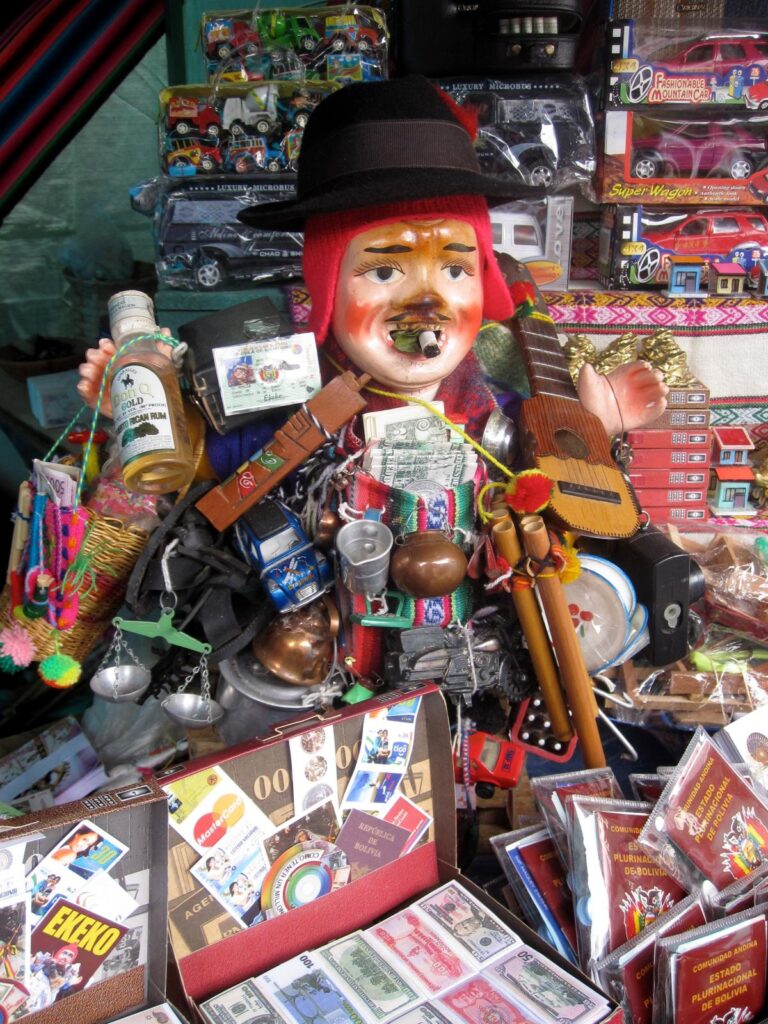
Plastic Ekeko statuette carrying wished-for objects. Photo by juhauski72 (Wikimedia Commons).
The “China-centeredness” of Andean grassroots commerce (Müller 2020), which in 2024 placed China as Bolivia’s biggest importer and exporter (OEC 2025), is both economically structuring and culturally productive. As well as cultivating a principle of buying brand new rather than second-hand, to create movimiento towards prosperity, the “high-quantity, low margin business” of trading products manufactured just-in-time (Müller 2020, 250) capitalizes on the informal economy’s fluidity.
Interpersonal skills in building networks and negotiating contracts that facilitate the flux of China-Bolivia trade help indigenous merchants circumvent persistent “marginalization from mainstream capitalist channels” (Andreoli 2020, 240), implicated in a long history of racial discrimination (Tassi 2010, 203). The popular label for urban indigenous traders, cholo, still carries pejorative racial and political connotations. It has been used since colonial times to designate urbanized indigenous people, who are perceived to occupy an in-betweenness of “Indian” and “mestizo.” The cholo stereotype, a market woman or man who transports goods, is “indelibly” associated with commerce (Lazar 2008, 17).
Alteño traders inhabit this deeply contradictory terrain of racialized, colonially rooted global capitalism. Betwixt rural pasts and urban futures, upwardly mobile at the economic margins; these experiences highlight the ch’ixi nature of Aymaran modernity. It calls forth a future that promises abundance and in the same stroke entails “the irruption of pasts undigested and indigestible” (Cusicanqui 2018, 41; translation mine).
Contemporary commerce in very cheap, environmentally indigestible plastics reflects ch’ixi: plastic enhances traders’ adaptations to this peripheral economic landscape; simultaneously, it drives an ecological future hostile to the divine Pachamama (Mother Earth).
Abundant plastics
In popular discourse, indigenous modernities are often juxtaposed against developmentalism. At many climate conferences, “indigenous” certifies authenticity, purity and earth stewardship. So too have Aymara and Quechua people long been romanticized as quintessentially rural figures (Lazar 2008, 18). Upwardly mobile Alteños challenge this purist doxa with strong developmentalist visions, manifested in displays of abundance and the year-on year increases in the number of cholets, scale of fiestas like Gran Poder and trade with China. Ch’ixi therefore describes both cholet aesthetics, exuberantly interrupting El Alto’s motley brick streets, and visions of development they embody.
But this “politics of excess” (Andreoli 2020), enabled by the influx of ultra-cheap synthetic goods from Chinese factories, leaves a difficult residue. Four hundred miles southwest of El Alto sits Iquique, a coastal city at the edge of Chile’s Atacama Desert and vital free trade zone for transnational Bolivian merchants. Beyond being a hub for Bolivian-Chinese commerce, Iquique is one of the world’s largest destinations for imports of used clothes—and in the desert just outside the city lies a vast graveyard of unwanted synthetic textiles (Bartlett 2024).
Unlike its petrochemical brother Big Oil, the global plastics industry is highly disaggregated; it comprises thousands of companies operating in different scales, jurisdictions and states of (in)formality or (il)legality (De Groot and MacNeil 2025). Iquique’s plastic wastelands and Gran Poder’s sparkling new formalwear are conjoined by the threads of this labyrinthine, proliferating web: informal, transnational relationships at the international order’s peripheries.
Plastic is inherently ch’ixi, and Bolivia’s entanglement with the global plastics web reveals a shared unpredictable rhythm. Both contain multitudes, taking shape from myriad small-scale stories that contradict and yet coexist. Understanding plastic accumulation and its associated modernities from below makes them intelligible where top-down perspectives cannot. In the Global North, visions of a not-ecologically-disastrous future rely on notions of reuse, de-consumption (especially of plastics and petrochemicals), de-growth and frugal living. The abundant future promised for Alteño traders comes up against these lofty principles, perhaps irreconcilably; global capitalism’s discriminatory processes shape plastic’s necessity for Aymaran future-building.
Ch’ixi encourages us to walk with these indissoluble contradictions on modernity’s volatile terrain, where radical possibilities for some becomings-with emerge just as other lives are simultaneously foreclosed. A popular Aymara aphorism, qhipnayr uñtasis sarnaqapxañani, concerns continuing to walk through the present with “a future on the back and a past in sight” (Cusicanqui 2018, 103; translation mine). “The future… is a kind of q’ipi, a burden of worries, which is better carried on one’s back (qhipa),” whereas the past, called in Aymara nayrapacha—where nayra means eyes—“is ahead… the only thing we know because we can see it, feel it, and remember it” (Cusicanqui 2018, 103).
A ch’ixi acceptance of our connected nayrapacha, from which plastic cannot be removed, might temper future-anxiety and climate despair. Just as accumulating wastelanding closes avenues, others are opened by the resilient creativity of Alteños—for whom the proliferating cholet signals a future abundant, syncopated, radically alive.
References
Agence France-Presse. 2025. “‘Never Again’: Indigenous Bolivians Sour on Socialism.” AFP, August 19.
Andreoli, Elisabetta. 2015. “‘We Have Money and Can Build in a Way That Represents Us.’” The Architectural Review, July 13. https://www.architecturalreview.com/today/we-have-money-and-can-build-in-a-way-that-represents-us.
Andreoli, Elisabetta. 2020. “Architecture in El Alto: The Politics of Excess.” In Architecture and Ugliness: Anti-Aesthetics and the Ugly in Postmodern Architecture, edited by Wouter van Acker and Thomas Mical. Bloomsbury USA.
Bartlett, John. 2024. “Fast Fashion Goes to Die in the World’s Largest Fog Desert. The Scale Is Breathtaking.” National Geographic, March 5.
Calle Quispe, Susana Vania. 2025. “Multilocal Hyperstitions in the Urbatecture of the City of El Alto—Bolivia.” Malaysia Architectural Journal 7 (1): 33–50.
Cusicanqui, Silvia Rivera. 2018. Un mundo ch’ixi es posible: Ensayos desde un presente en crisis. Tinta Limón.
De Groot, Babet, and Robert MacNeil. 2025. “Towards a Theory of ‘Big Plastic.’” Review of International Political Economy 32 (5): 1712–30.
Giroto, Ivo Renato. 2023. “The New Mestiza? Architecture and Identity on the Border.” Dearq 36: 16–25.
International Finance Corporation. 2021. “The Plurinational State of Bolivia: Unlocking Private Sector Potential to Achieve a Sustainable and Inclusive Recovery.” IFC. https://www.ifc.org/content/dam/ifc/doc/mgrt/cpsd-bolivia.pdf.
Lazar, Sian. 2008. El Alto, Rebel City: Self and Citizenship in Andean Bolivia. Duke University Press.
Liboiron, Max. 2021. Pollution Is Colonialism. Duke University Press.
Müller, Juliane. 2020. “Webs of Fiesta-Related Trade: Chinese Imports, Investment and Reciprocity in La Paz, Bolivia.” Critique of Anthropology 40 (2): 238–63.
Observatory of Economic Complexity. 2025. “Bolivia.” OEC, November 6.
Sanchez, Elias. 2025. “Quantum Adaptation and the Informal Market: A Political Economic Analysis of Bolivia.” The Cobden Centre, November 13.
Tassi, Nico. 2010. “The ‘Postulate of Abundance’: Cholo Market and Religion in La Paz, Bolivia.” Social Anthropology/Anthropologie Sociale 18 (2): 191–209.
Isaac Silver is a graduate of social sciences from the University of Sheffield (BSc Politics and International Relations) and the University of Oxford (MSc Social Anthropology), with an interdisciplinary interest in climate change. His master’s dissertation reviewed the nascent anthropology of plastics.
Cite as: Silver, Isaac. 2026. “Abundance, Plastics and Ch’ixi on the Bolivian Altiplano.” in “Promised Futures,” edited by Ibrahim Ince and Erick Moreno Superlano, American Ethnologist website, 9 July. [https://americanethnologist.org/online-content/collections/promised-futures/abundance-plastics-and-chixi-on-the-bolivian-altiplano-by-isaac-silver/]
This piece was edited by American Ethnological Society Digital Content Editor Kathryn E. Goldfarb ([email protected]).