We inherit all the collapses of past dreams, and we are subject to the prediction, on the horizon, of collapses to come.
Camille de Toledo, Les potentiels du temps
During a meeting in Berlin, we sat in an office at the Humboldt University and talked about the anthropological archives from the time of the German Democratic Republic (GDR). These archives are relics of a past utopia. Utopia, that oft-imagined “good place,” that “no place.” Jonas suggested a day trip to Eisenhüttenstadt—Ironworks City—deep in former East Germany, with its Museum of Utopia and Everyday Life.
Eisenhüttenstadt was founded as a model socialist city in 1950 to house workers of the vast state-owned steel mill to which it owes its name. It was the first city to be built according to the “Sixteen Principles of Urban Design” adopted that same year by the Council of Ministers of the GDR. Eliminating the “deficiencies” of unplanned urban environments, as well as imperial and religious traces in spatial organization, the planned socialist city would give expression to “the political life and national consciousness of the people,” while promising “the harmonious satisfaction of human needs for work, housing, culture and recreation” (Ministerial Bulletin 1950, 153f.).
We visited Eisenhüttenstadt on a warm but rainy day in July, driving from Berlin towards the Polish border through deep forest along the so-called “Highway of Freedom,” named to commemorate the fall of the Iron Curtain. Arriving, we found a void at the city’s heart: a makeshift, puddle-strewn parking lot, where we left the car and began our walk. According to the “Sixteen Principles” cited above, this central square was intended to be the “defining core” of the city, “the political focal point for the life of its population” (Ministerial Bulletin 1950, 153f.). A Palace of Culture, planned to tower above the square to survey the city’s orderly layout, had never been built. Its absent presence lingers as an architectural specter of the utopia that Eisenhüttenstadt once stood for.
In this essay, we reflect on our day trip in this spectral utopia, offering a meandering walk through the city by way of a condensed set of observations on the architecture, urban planning, and displays in the exhibition of the Museum Utopia and Everyday Life. Michel de Certeau’s essay “Walking in the City” (1984) offered us a theoretical companion through the tensions between authoritarian planning and everyday resistance through walking. Martin Maleschka’s Architekturfürhrer Eisenhüttenstadt (2023) provided a more literal guidebook to our wandering.
A model city
Eisenhüttenstadt exemplifies de Certeau’s notion of the “concept city:” the materialization of a utopia that was first visualized theoretically, in this case on the drawing boards of the urban planning department of the GDR’s Ministry of Reconstruction. If the towering viewpoint of the Palace of Culture went unrealized, the scopic and gnostic drive to “see the whole” described by de Certeau was satisfied in what is now the city hall, originally the House of Parties and Mass Organizations, the only grand building of Zentraler Platz to be completed. This was the first pause in our ethnographic dérive, our Debordian drift through the “varied ambiences” of this idea-of-a-city made concrete (Debord 1958).
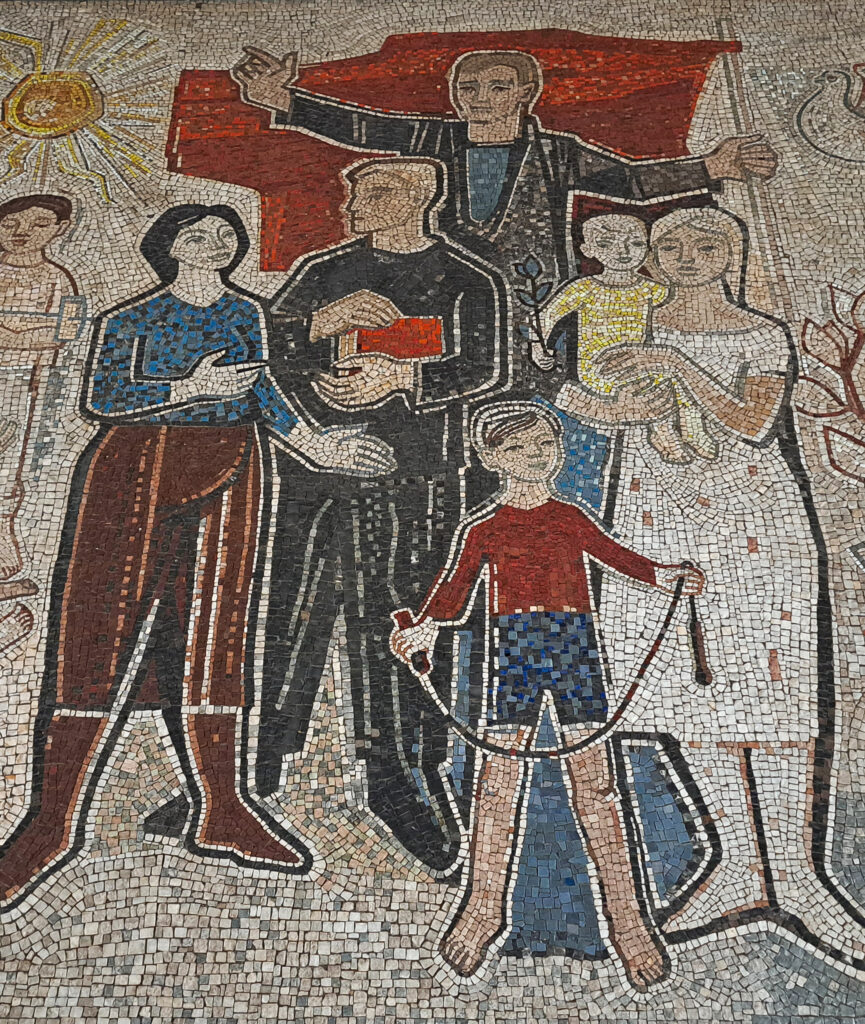
Detail of Walter Womacka’s “Unser neues Leben” (“Our New Life”) wall mosaic at the city hall. Photo by Paul Basu.
In the foyer, we paused before a stained-glass window installation that had been relocated from the student dormitory of the now demolished “School VII” complex. In bold colors, it depicts model students industriously engaged in a model curriculum. Passing beneath Walter Womacka’s remarkable wall mosaic, “Our New Life,” we entered a large room almost entirely occupied by a vast scale model of the model city itself. Here, then, was our Icarian view of Eisenhüttenstadt: an “optical artefact” in de Certeau’s terms, protected under plexiglass, providing us with a perspective of a city that never was. The model granted us the ability to look down “like a god,” making “the complexity of the city readable” (de Certeau 1984, 92.). Was the model a scaled-down facsimile of the city, or the city a scaled-up facsimile of the model?
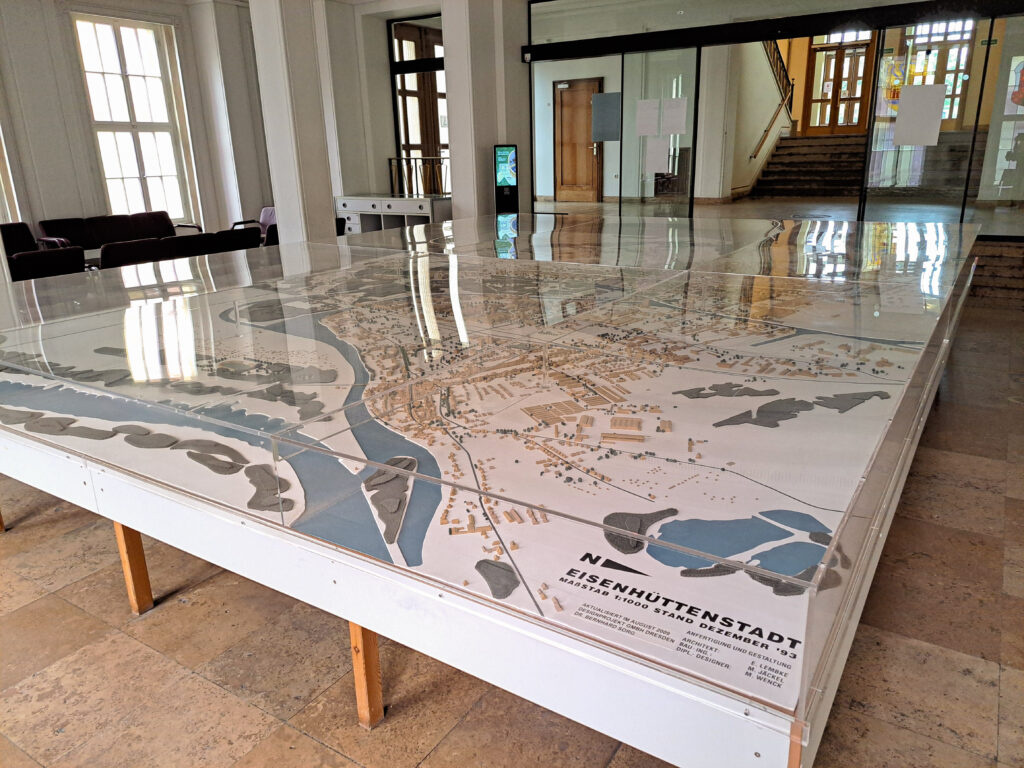
Scale model of Eisenhüttenstadt in the city hall. Photo by Paul Basu.
Another spatiality
As we returned to the open vistas of Eisenhüttenstadt’s avenues, the clean lines of its low-rise apartment blocks, we did not sense escape from the “visual, panoptic, or theoretical constructions” (de Certeau 1984, 93) produced by the socialist town planners. There was no air of the opaque everyday practices of city dwellers or “another spatiality,” in which “ordinary practitioners of the city live … below the thresholds at which visibility begins” (de Certeau 1984, 93). It was rather as if we were walking in that over-sized model in the city hall, vulnerable to the same gaze through which we ourselves had just surveilled the city. And while there was a seductive beauty to this green urban environment, unpolluted by the presence of the heavy industry for which it was constructed, we were mindful of the “all-seeing power” of the surveillance state that conceived it. It is perhaps no coincidence that the Stasi—the notorious East German state security service—was established in the same year as Eisenhüttenstadt. At the same time, as de Certeau argues, the production of a rational organization of space, which must “repress all the physical, mental and political pollutions that would compromise it,” is an “operational concept” of all cities “founded by utopian and urbanistic discourse” (de Certeau 1984, 94).
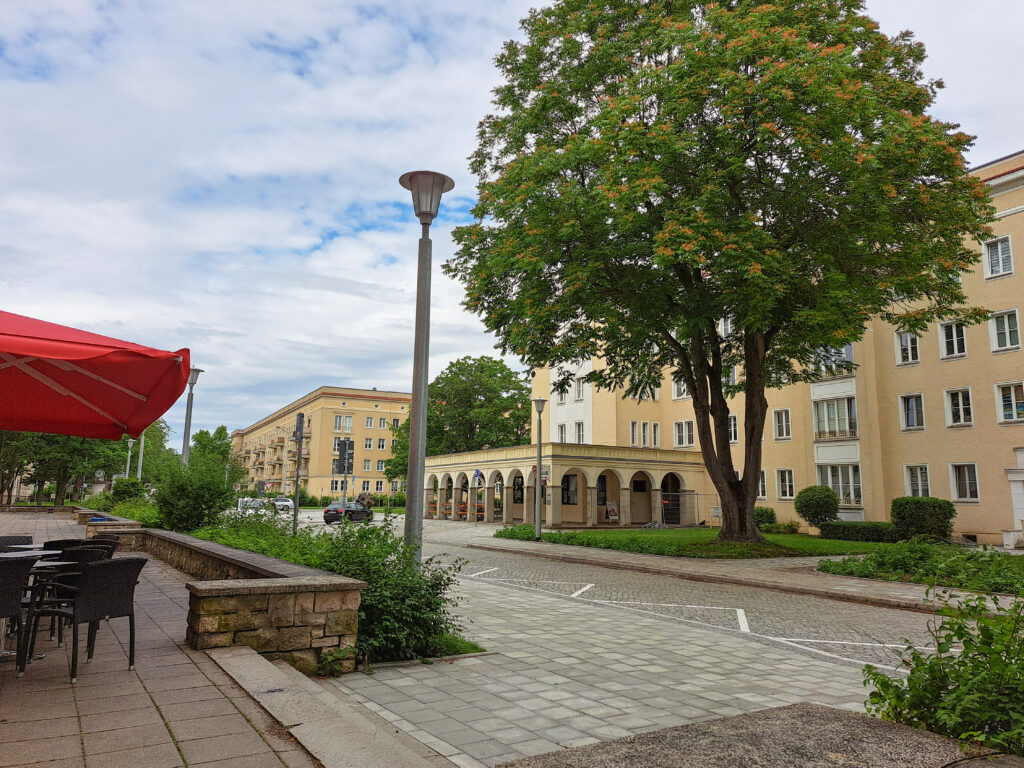
Straße des Komsomol, renamed Saarlouiser Straße in 1986, Wohnkomplex II. Photo by Paul Basu.
Utopian traces
The cleansing of such pollutants, including the traces of past promises that have failed to materialize, is not always apparent to the eye. Some, such as street renamings that rewrite the “city-text,” are invisible, or have been rendered so. Until 1961, the city itself was known as Stalinstadt, only becoming Eisenhüttenstadt during the Khrushchev-era “de-Stalinization” reforms. This act of cleansing required the removal of a huge wall mural that covered the side of a four-storey building on present-day Lindenallee (then Leninallee) and its replacement by another. The name “Stalinstadt” was emblazoned across the top of the original mural above a gigantic figure of an iron foundry worker. Perhaps wisely, the equally vast replacement, by the same artist—Walter Womacka—who created the mural at the city hall, does not include a placename. Completed in 1965 and entitled “Production in Peace,” the mosaic work depicts a huge dove being released by a bionic hand. Revealed within the arm we see the muscularity of industrial cooperation that powers it. As Martin Maleschka explains (2023, 159), the upper arm depicts the mining of Soviet iron ore and Polish coal, while the forearm portrays operatives in the iron works’ control room. Here, then, is a shared peace, brought about through the cooperation of socialist nations and their resources—nations, we should not forget, that had been at war only a few years earlier.
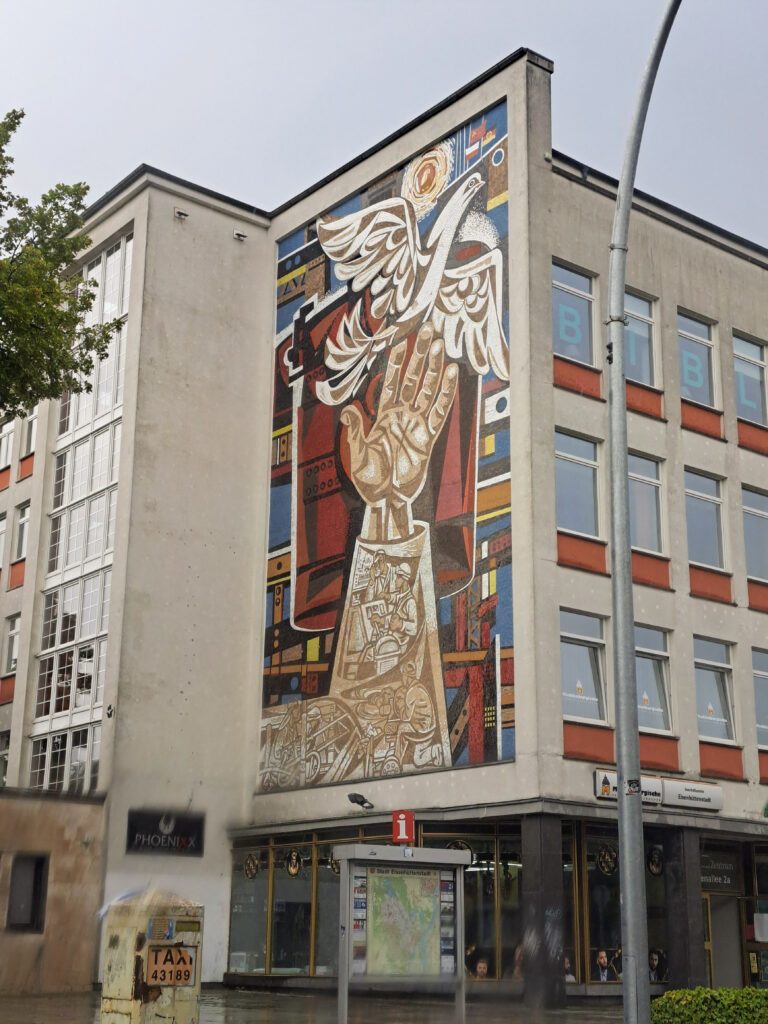
“Produktion im Frieden” (“Production in Peace”) mural, Linenallee. Photo by Paul Basu.
The didacticism as well as the sheer scale of Eisenhüttenstadt’s public art is breathtaking. As we gazed at Womacka’s vast mural, we were reminded of Peter Guth’s (1995) encyclopedic study of socialist realist art in East Germany, and the poignancy of its title, Wände der Verheissung (“Walls of Promise”). While Eisenhüttenstadt’s city center is now protected as a national monument and many of the buildings have been renovated and restored, to walk in this city is to walk among the ruins of promises that were soon broken.
A beautiful trace of this promise fills the stairwell of the Museum of Utopia and Everyday Life. The museum is housed in what had been the kindergarten of Residential Complex II. A few features recall the original purpose of the building, but none so striking as the stained-glass window that illuminates its main staircase: another work by Walter Womacka completed in 1955. The state’s provision of free childcare for all, allowing parents to return to productive labor soon after childbirth, ensured gender equality in the socialist utopia. But what struck us most was the multi-racial world evoked in the window’s design, with children of all colors playing in harmony together. While this representation of GDR history is not uncontested, such a cosmopolitan projection of future normalcy is a far cry from the anti-immigrant narrative of the Alternative für Deutschland (AfD), an increasingly dominant right-wing political force in the region today.
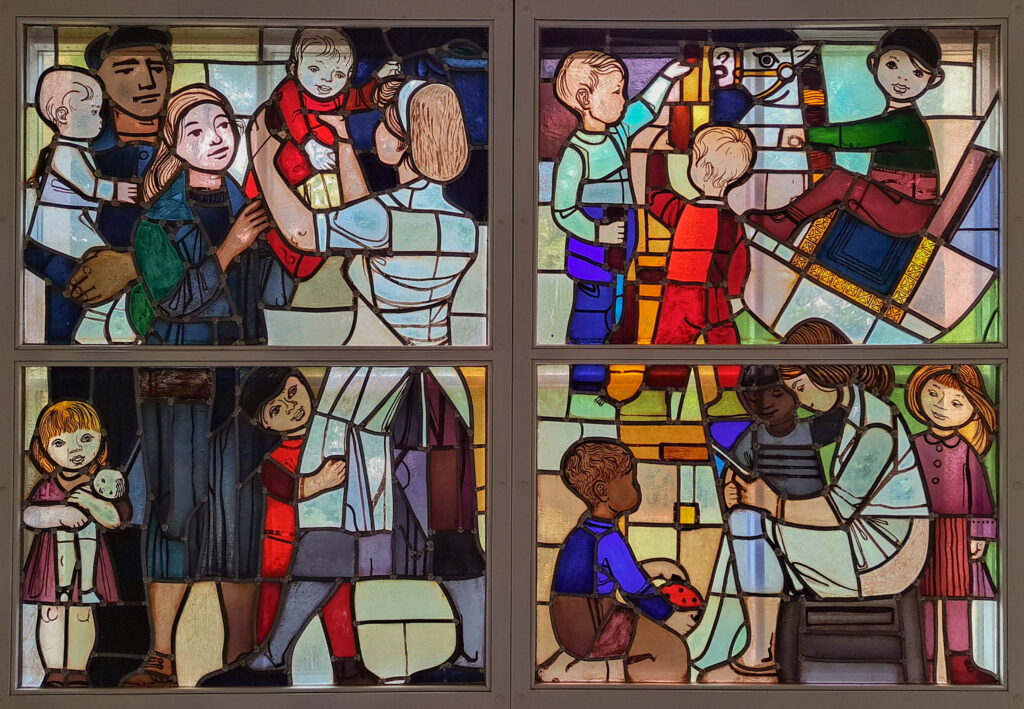
Central panel of “Die Welt der Kinder” stained-glass window, Museum Utopie und Alltag. Photo by Paul Basu.
Exhibiting socialist utopia and the everyday
The chronologically organized displays of the museum document life in East Germany between 1945 and 1989 through everyday objects and artworks. We each made our own path through the convoluted galleries, but we agreed that the arc of the exhibition’s narrative could be summed up in three printed works on display.
The first was an illustrated songbook of the “Young Pioneers,” a subdivision of the Free German Youth movement for schoolchildren aged between six and 13. The booklet was opened to a page displaying the lyrics of Unsere Heimat (“Our Homeland”), a popular song of the youth organization, reproduced beneath a colored woodcut print. The folksy illustration depicts a utopian vision of the socialist German Heimat in which the city, with its concrete slab buildings and heavy industry, nestles within a storybook landscape of wheatfields and forested mountains, framed by German oaks, under a blazing German sun.
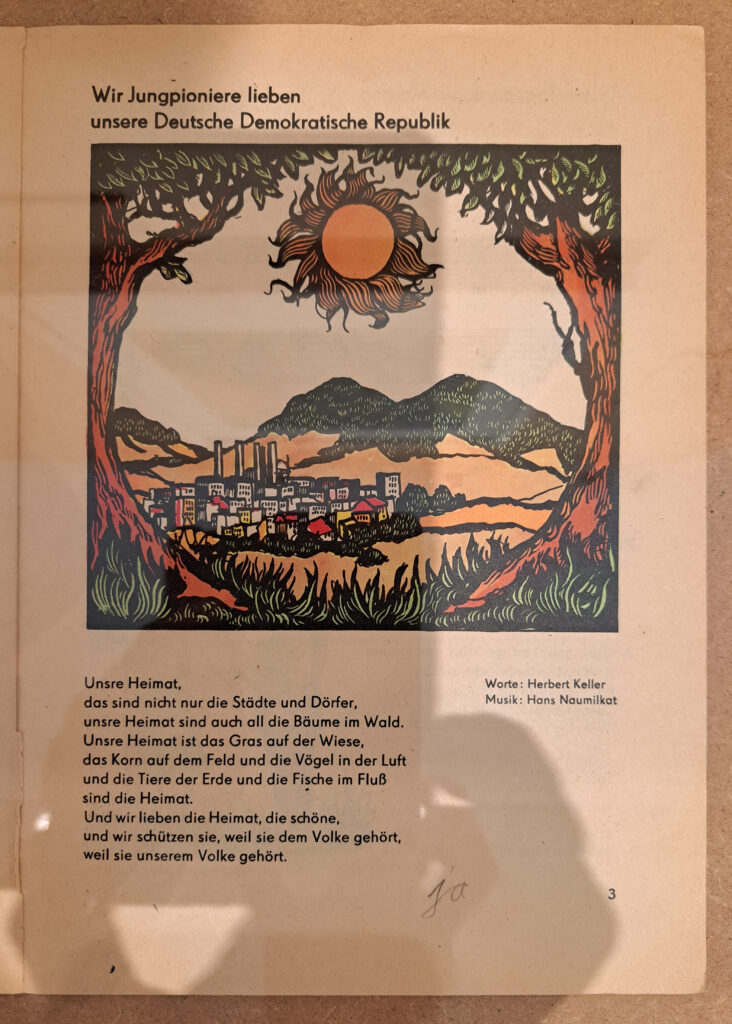
Unsere Heimat, Jungpioniere song book. Photo by Paul Basu.
Written in 1951, the lyrics of Unsere Heimat evoke a utopian homeland in which country and city, agriculture and industry, coexist in bounteous harmony. Indeed, the provision of “healthy and peaceful living conditions” was among the GDR’s principles of urban design, but so too was an acknowledgement that “transforming the city into a garden is impossible.” The seeming continuities with Nazi ideologies of Heimat are, however, conspicuous. Recalling the cosmopolitanism of the kindergarten window, while “our people” (unserem Volke) are redefined in the song inclusively through proletarian solidarity rather than by ethnonationalist associations of Blut und Boden, still we are reminded that every utopia is built on—and, in some senses, from—the ruins of another. The national socialist German utopia of the 1930s emerged from the collapse of the Kaiserreich, the socialist utopia of the GDR emerged from the collapse of the Third Reich, and each imagined future was grounded not only on an imagined country, but also on an imagined past.
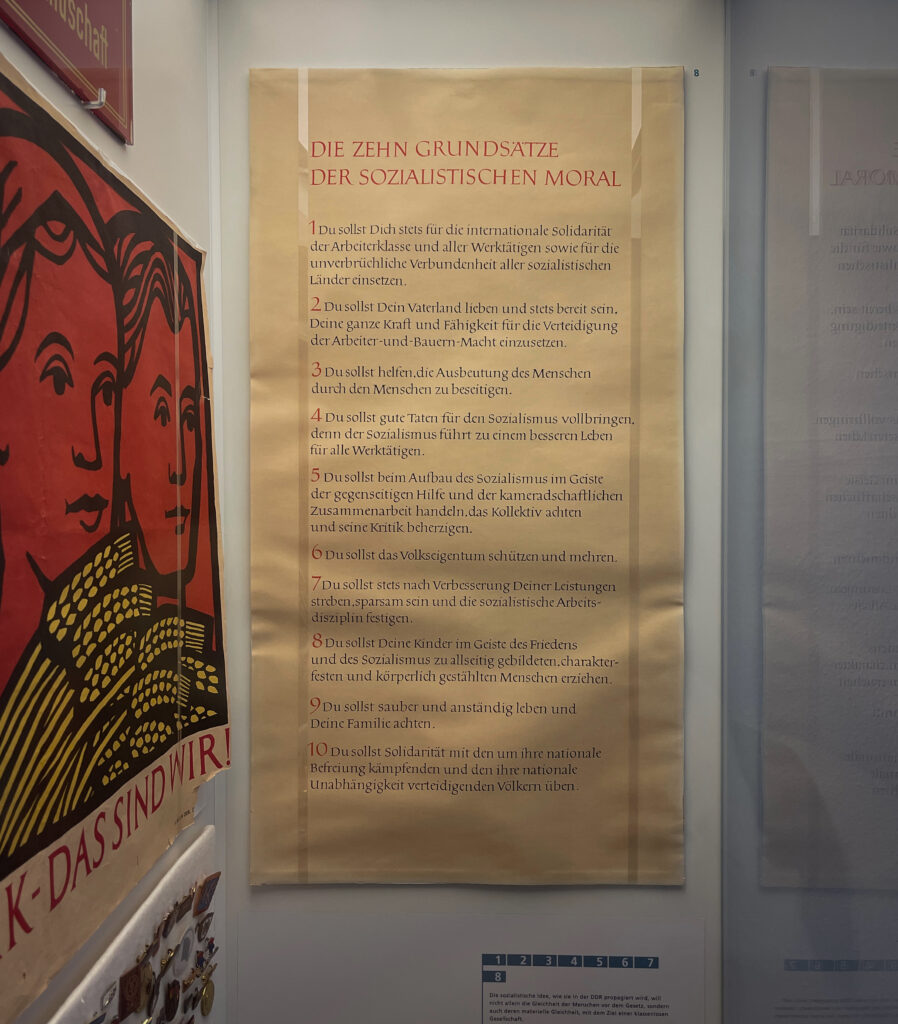
“Die Zehn Grundsätze der sozialistischen Moral.” Photo by Jonas Tinius.
A shift was apparent in the second exhibit that caused us to pause in our drift through the museum. This was a poster which reproduced “The Ten Commandments of Socialist Morality” proclaimed by Walter Ulbricht, General Secretary of the Socialist Unity Party of the GDR, in July 1958. The patriarchal authoritarianism of East Germany’s ruling party is expressed in the order “You shall…” (“Du sollst…”) with which each commandment commences:
You shall always strive for the international solidarity of the working class and all working people, as well as for the unbreakable unity of all socialist countries.
You shall love your fatherland and always be ready to use all your strength and ability to defend the power of the workers and peasants.
You shall always strive to improve your performance, be thrifty, and strengthen socialist work discipline.
How quickly, we thought, was the promise of a shared socialist utopia transformed into the dystopic reality of a police state, in which morality, too, was determined by edicts of the Party.
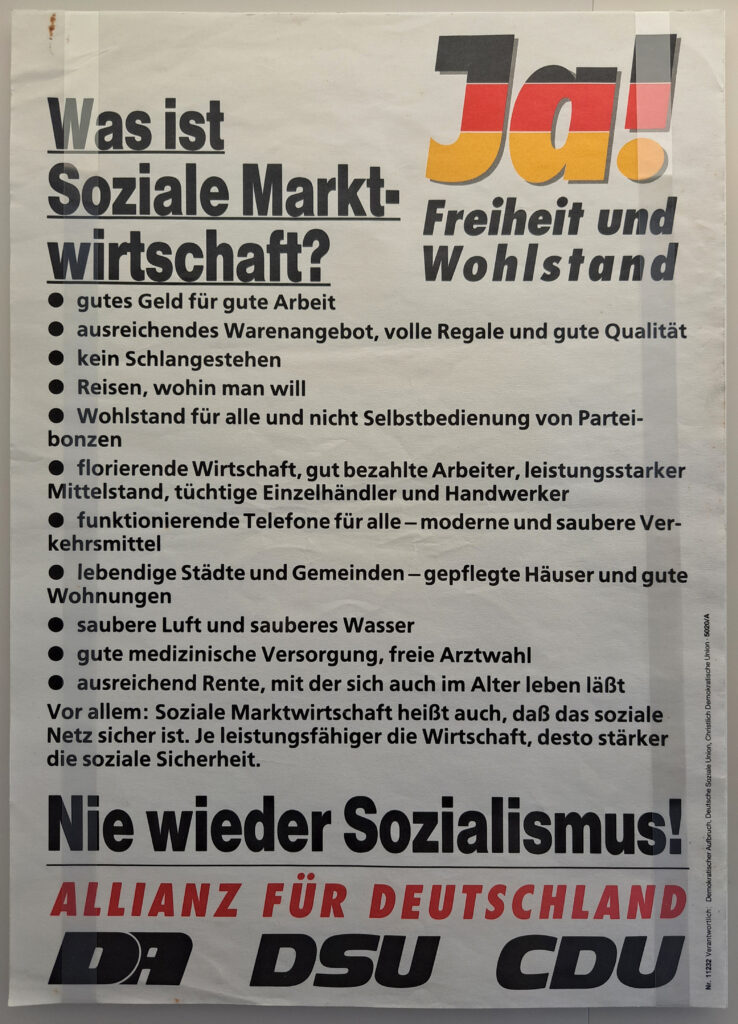
“Nie wieder Sozialismus!” Allianz für Deutschland campaign poster. Photo by Paul Basu.
The arc of the GDR’s utopian trajectory was completed in a display of campaign posters from the East German general election held in 1990, the first democratic elections in the region for nearly 60 years. “Freedom and Prosperity” was heralded on the poster of Allianz für Deutschland (“Alliance for Germany”), the coalition that would go on to win the election. Under the slogan “Never Again Socialism,” the Allianz delineated the neoliberal utopia that would be brought about by a shift to a market economy. In this brave new world, there would be fully stocked shelves of quality goods, no queuing, freedom to travel, and prosperity for all. Reminding us of the everyday nature of such utopias, the Allianz even promised “working telephones for all.” The poster makes no mention of one of the main pledges of the Allianz: the swift reunification of East and West Germany, in which the GDR itself would be dissolved and the socialist utopia consigned to “no place.”
What remains
The rain over Eisenhüttenstadt had intensified by the time we left the museum. Behind a kebab kiosk on a street corner, we stumbled upon a butcher’s shop, Fleischerei Grahl. With its meagre palette of colors and flavors, as we stepped inside, we had the sensation of stepping back into old Stalinstadt. Indeed, the business had been run by the same family for decades. A wave of “Ostalgie”—nostalgia for the East—overcame us as we ate our Schinkenbrötchen and Krautsalat, which surely had been served here since the 1950s. It is, as Jonathan Bach (2017) writes, often the casual, everyday encounter with what remains that brings a feeling for a past moment’s intensity most acutely into the present.
Our drive back to Berlin was infused with a sense of melancholia. The realization of utopia seems more remote than ever. In our unbelieving times, there is not even the promise to sustain us. Eisenhüttenstadt at least had that.
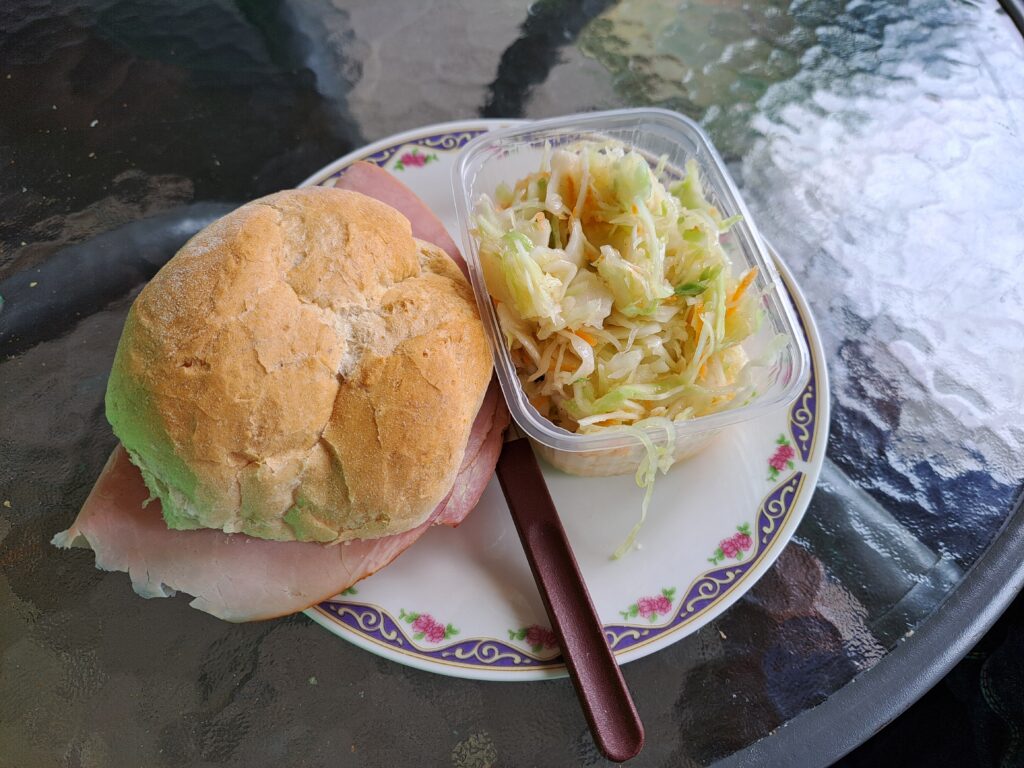
Schinkenbrötchen und Krautsalat. Photo by Paul Basu.
References
Bach, Jonathan. 2017. What Remains: Everyday Encounters with the Socialist Past in Germany. Columbia University Press.
De Certeau, Michel. 1984. The Practice of Everyday Life. Translated by Steven Rendall. University of California Press.
Debord, Guy-Ernest. 1958. “Théorie de la dérive.” Internationale Situationniste 2: 19–23.
Guth, Peter. 1995. Wände der Verheissung: Zur Geschichte der architekturbezogenen Kunst in der DDR. Thom.
Maleschka, Martin. 2023. Architekturführer Eisenhüttenstadt. DOM Publishers.
Ministerialblatt der Deutschen Demokratischen Republik, Nr. 25 of September 16, 1950, 153f.
Paul Basu is Professor of Anthropology at the University of Oxford and a Curator at the Pitt Rivers Museum.
Jonas Tinius directs the Berlin-Brandenburg Office for Everyday Culture and the archives of the Institute for European Ethnology at the Humboldt-Universität zu Berlin. He studied social anthropology at the University of Cambridge.
Cite as: Basu, Paul and Jonas Tinius. 2026. “Day Trip in Utopia.” In “Promised Futures,” edited by Ibrahim Ince and Erick Moreno Superlano, American Ethnologist website, 9 July. [https://americanethnologist.org/online-content/collections/promised-futures/day-trip-in-utopia-by-paul-basu-and-jonas-tinius/]
This piece was edited by American Ethnological Society Digital Content Editor Kathryn E. Goldfarb ([email protected]).