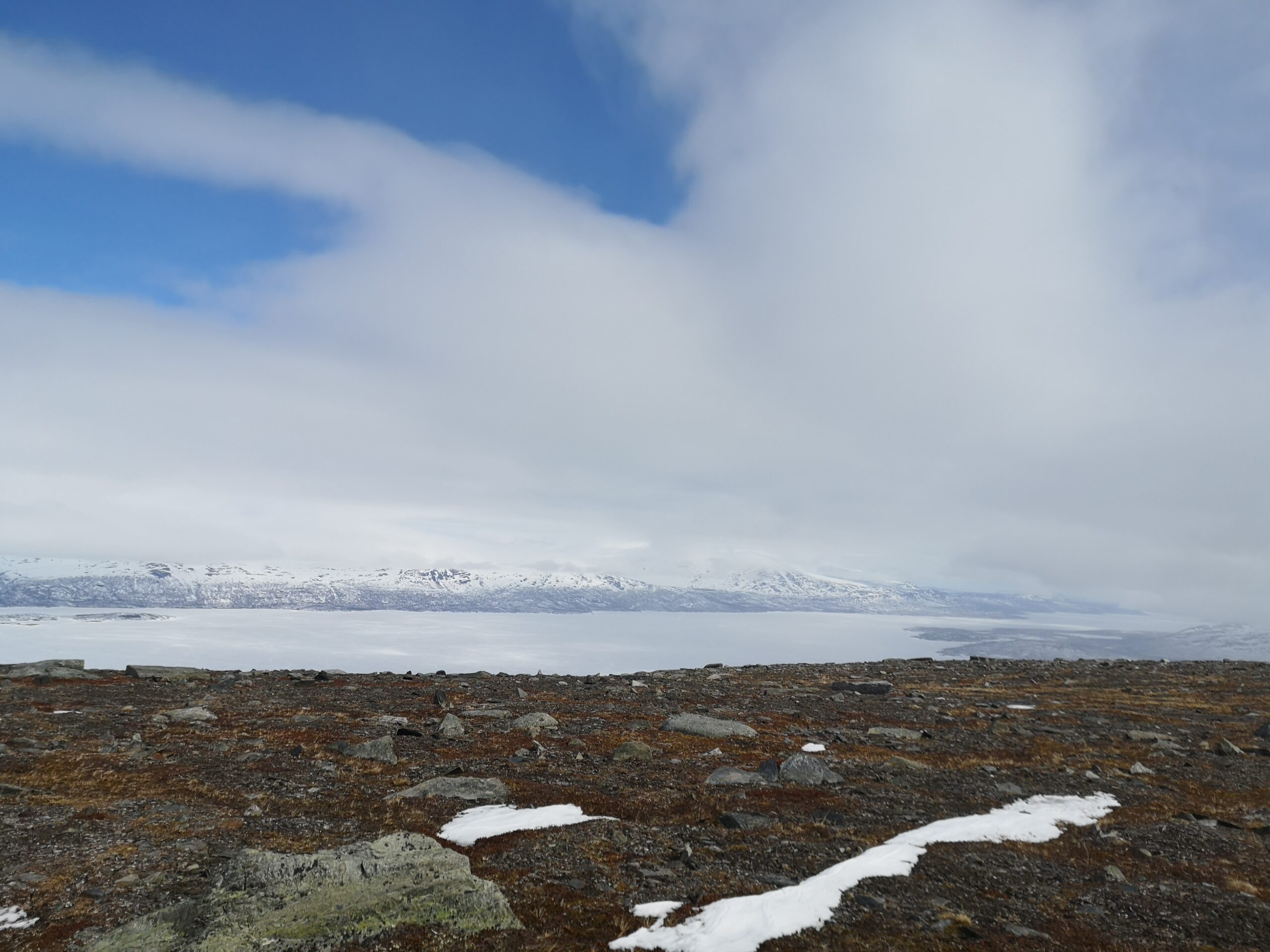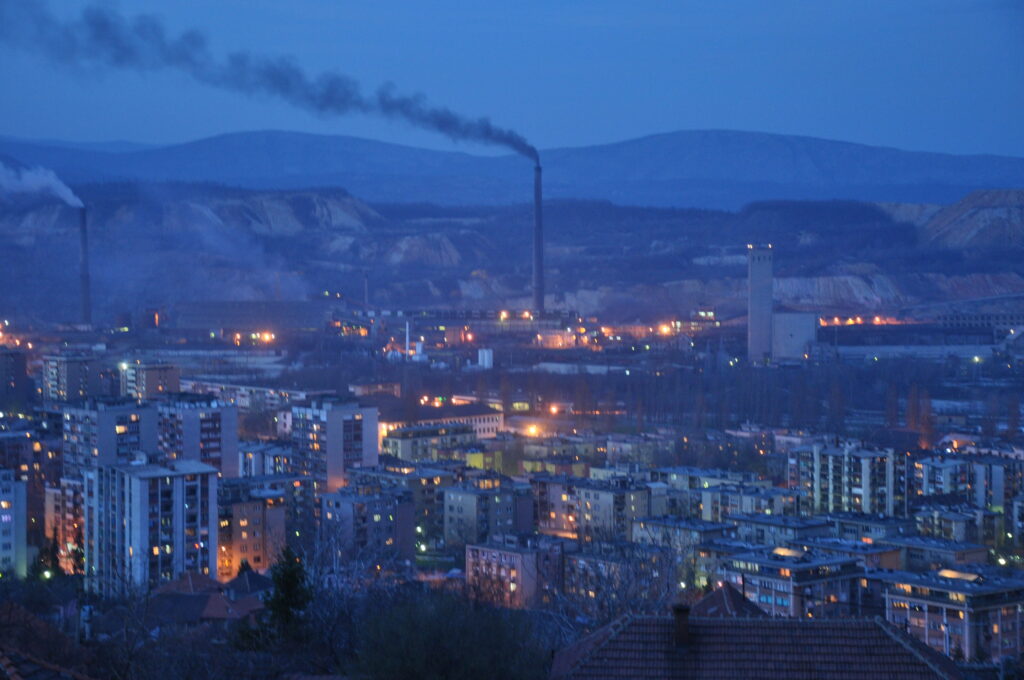
Panoramic view of the industrial town of Bor, Serbia. Photo by Marija Jocić Jeremijić and Miloš Jocić, 2013.
“The golden age of America begins right now,” the President of the United States, Donald Trump, declared in his inaugural speech in January 2025. “From this day forward, our country will flourish and be respected again all over the world.” Trump vowed to end betrayal and return power to the people, while promising to restore faith, democracy, and freedom. This is a familiar script of a populist staging: something has been lost, the state lies in ruin, and only a theatrical savior can bring a revival. Such staging today is the essence of modern illiberal or populist power, risen as a reaction to “reconfigurations of power, wealth, and identity that are endemic to global neoliberalism” (Gusterson 2017, 209). It operates not just through bureaucratic control, but also through continual theatrical performance in which the citizens become both the audience and actors.
Going beyond global rhetoric and the accompanying performative staging, in my work I ask what staged promises and their “chronopolitics” do to our present, and how individuals orient futures while engaging with them. As populism thrives on a sense of crisis, urgency, and prompt mobilization (Taş 2022), I show in this essay that its temporal effects are crucial to address.
Performances of revived and coveted futures have a specific resonance in peripheral and derelict sites, especially in places systematically excluded from the circuits of global capital where industrial closings alienated a postindustrial working class (Evans 2020) contributing to their “double devaluation” (Kalb 2023). Consider Bor, a Serbian copper-processing and mining town which used to be an industrial Yugoslav “giant,” hollowed out by deindustrialization and the protracted post-socialist crises. In this town, collective and individual horizons have been profoundly constricted for decades. Futures were experienced as both radically uncertain and confined. It is within this context, conditioned by industrial and extractive possibilities, that newly arrived performative promises of the sudden revival were enacted by the political and industrial elites of the then state-managed company. The promise of resurrecting the down-at-heel industrial company and the derelict and polluted town acquired a compelling force. The promises of revival spoke to a reality defined by environmental and economic devastation, and pervasive precarity.
Drawing upon more than a decade of my past and present ethnographic engagement in this town, especially in the period of promissory staging from 2011 until 2018, I contend that the performative dimension of the promises in this town was fundamental to their powerful uptake and impact (Jovanović 2025). Many residents saw through the enacted staging of revival of industrial, infrastructural, environmental or urban futures, but still found these aspirational projects and promises crucial in their efforts to reorient and rearrange a troubled present.
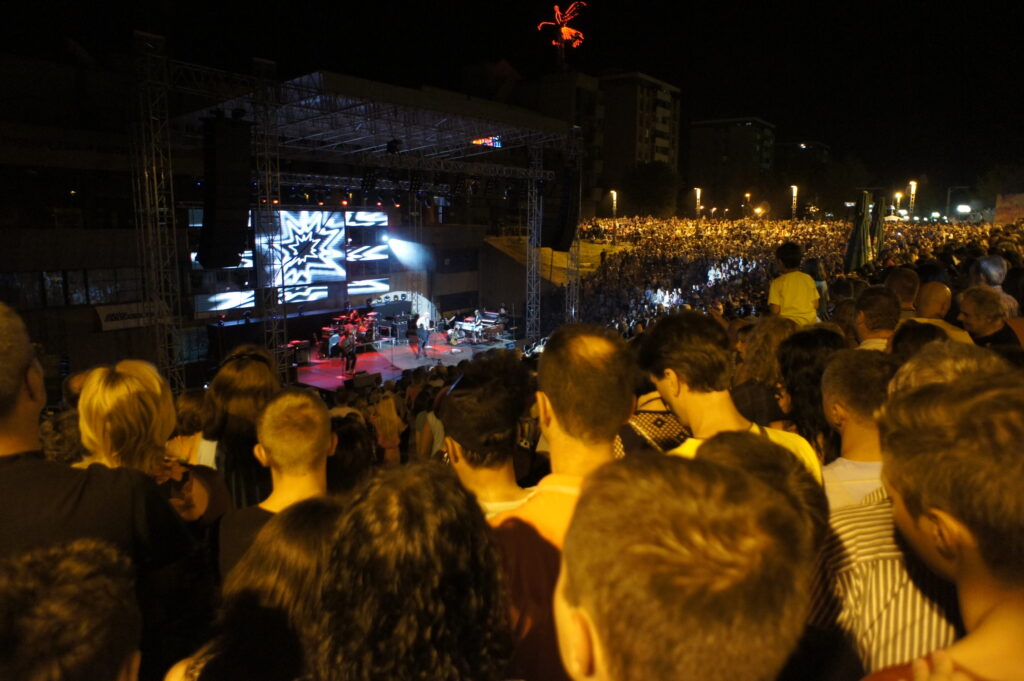
A concert organized every year by the industrial company for the Miner’s Day. In the background is a statue of a phoenix. Placed on the rooftop of the House of Culture by the management of the industrial company, it symbolized the revival of both the town and the company. Photo by Deana Jovanović, 2013.
Temporal effects: Fake it till you make it
My research in spring 2013 introduced me to Pavle (a pseudonym), then a twenty-eight-year-old who had just started working at the industrial company. When discussing his job and future, he pointed to the urban transformations throughout the town. Pavle was nearing the completion of a management degree. His strategy, shared by many of his peers, was to capitalize on personal networks. He was relying on his father’s assistance to gain employment as soon as possible, a move made particularly urgent by the inflated salaries available at that time.
As I described our conversation in an earlier publication (Jovanović 2025, 8), Pavle commented: “Yup, this story with Bor is quite interesting. Now it’s like it’s changing …” In Pavle’s view, the industrial company—according to its own marketing—was driving the revitalization of the town. “In fact, they are trying to change the image [of the town]. It’s changed for the better, in my eyes. They are trying to induce optimism, you know, like it is going to get better. Optimism for a better life … Marketing is a real miracle.” He laughed. “You simply start believing in some stories.”
I asked him if he believed in it: “Do you think life in Bor will get better?”
Pavle contended that prior to the staged revival, it used to be really bad in Bor. He thought the revival of the company and the town was “absolutely great” and that the town would not return to the “bad days.” “At least I hope it will remain like this,” he added.
Pavle engaged in an “as if” performance, while embodying the promised revival. In Bor, this practice of “faking it till you make it” became a form of self-fulfilling prophecy, a logic through which many anticipated futures were actively constructed. In Pavle’s case, for example, his primary focus was on inserting himself into this collective performance. First, to secure a position at the company, and second, to experience the promise’s rewards in the present for as long as the performance lasted. With assistance from his father, who was himself involved in the performances of the revival, Pavle successfully obtained the job, while simultaneously being ironic about it.
Although the staged promises were dismissed by many as mere illusory simulations, their performative nature was precisely what made them effective. As Yaron Ezrahi (2012) suggested, political action often involves blurring the lines between fact and fiction, reality and theatre, to produce tangible “reality effects.” In a town constrained by ruin, such performances became necessary. Through staging, desired futures felt closer at hand, charging the now with immediate demand. For individuals like Pavle, the capacity to act with immediacy became a vital skill which was differentially distributed according to age and gender: a means to feel, however fleetingly, the effects of one’s agency (as soon as possible) within a foreshortened horizon of possibility. The imminent present and near futures became the temporal orientation in which many citizens embedded their everyday lives.
Lethality and discontent
Bor’s example compels us to think about encounters with staged promises and their temporal effects on a global scale. Moreover, it indicates the material conditions that make hope a possibility and urgency an imperative. In the context of the widespread global investments in infrastructures (Pan et al. 2026), infrastructures, as particular stages, may also serve as objects in the crafting of populist discourses (colonial or otherwise, cf. Mrázek 2018). This is especially visible in relation to the (re)building of mega-infrastructures, such as mines in Bor, but also railroads, stations, airports, and so on, grandiose in their scale (Hirsh and Mostowlansky 2024) that awaken fascination and sometimes resistance (Ullberg et al. 2025).
On November 1, 2024, a roof canopy in front of the main railways in the town of Novi Sad in Serbia collapsed. The station, constructed in the 1960s, had recently undergone a celebratory renovation as a project within a broader Serbian-Chinese railway infrastructure initiative north of the capital (Neuman Stanivuković 2025). Touted by government and local officials as a promise of modernizing progress, its staged reopening (that even occurred twice) was hurried to meet a deadline for maximum “quick effect.” The collapse of a 300-ton concrete roof canopy at the railway station was more than a tragic infrastructural failure. It became a metaphor for the populist political system built on promissory rushed spectacle over substance, and highlighted both the fragility of the freshly renovated infrastructural stage and systemic issues of the corrupt government (Danas 2024).
This rush, corruption, and neglect, united together, came at a catastrophic cost. Investigations revealed human error and negligent execution in the canopy’s reconstruction, compounded by a blatant disregard for formal oversight due to corruption (Danas 2024). Its collapse ended the lives of sixteen individuals standing beneath it that November day. Their futures were seized not by random chance, but by a systemic preference for performative achievement over material integrity and accountable governance.
This tragedy became a catalyst for the largest student protests in Serbia since 1968, channeling widespread anger over endemic corruption and the hollowing-out of institutional accountability. The protests were fueled by a demand for a fundamental “change of the system,” a demand to revitalize the actual work of institutions like the judiciary, police, and education from their weakened, party-politicized and corrupt Serbian state. The slogans such as “Serbia is under a canopy. We are all under the canopy” (Srbija je pod nadstrešnicom. Svi smo mi pod nadstrešnicom) capture the collective sense of perilous existence beneath unstable material stages that shape everyday lives.
My argument here moves beyond attributing systemic and infrastructural failure purely to populism. Instead, I point to material conditions in “the age of the trickster” (Armburst 2019) that produce deep temporal effects. While staged promises may render some distant futures visible, individuals mostly act upon their near futures. Although staged promises generate hope, they may become a force of insurgence, and, in extreme cases, may even become lethal.
In a January 2026 speech at the World Economic Forum in Davos, Canadian Prime Minister Mark Carney invoked the legacy of Czech dissident and later president Václav Havel, quoting his seminal 1978 essay, The Power of the Powerless. Carney referenced the question: “How did the communist system sustain itself?” (Havel 1985) By doing so, Carney acknowledged the compliance of ordinary citizens in communist Czechoslovakia, who, as Havel argued, sustained the regime by “living within a lie,” who publicly acted “as if” they supported the official ideology while privately dissenting. Similarly, Alexei Yurchak (2005) (sparsely quoting Havel) showed how the forms of hegemonic discourse in late socialism in the Soviet Union were produced, without necessarily subscribing to proclaimed meanings. Carney suggested that the same mechanism, where citizens actively participate in systemic falsehoods, underpins the dissolving world order.
In times of promissory staged global momentum, new critical questions emerge for anthropological explorations. When governance is often seen by our interlocutors as a mere performance, renovations as scenography, and “the fake” as “at least something,” we can ask: in what ways might our interlocutors begin to write their own screenplays? How can we facilitate prefigurative politics together with those who “see through”? As anthropologists, our task is to critically inquire into our own complicities in staged promises. We must work to ethnographically understand not only how distant and long-term futures disappear from the horizon of our interlocutors, but also how these futures might be reconquered.
References
Armbrust, Walter. 2019. Martyrs and Tricksters: An Ethnography of the Egyptian Revolution. Princeton University Press.
Danas. 2024. “Građevinski inženjer objasnio kako je došlo do rušenja nadstrešnice u Novom Sadu [The Civil Engineer Explained How the Canopy Collapsed in Novi Sad].” Danas, November 11.
Evans, Gillian, ed. 2020. Post-Industrial Precarity: New Ethnographies of Urban Lives in Uncertain Times. Vernon Press.
Ezrahi, Yaron. 2012. Imagined Democracies: Necessary Political Fictions. Cambridge University Press.
Gusterson, Hugh. 2017. “From Brexit to Trump: Anthropology and the Rise of Nationalist Populism.” American Ethnologist 44 (2): 209–14.
Havel, Václav. 1985. The Power of the Powerless: Citizens Against the State in Central-Eastern Europe. Edited by John Keane. Hutchinson.
Hirsh, Max, and Till Mostowlansky. 2024. “Introduction.” In Infrastructure and the Remaking of Asia, edited by Max Hirsh and Till Mostowlansky. University of Hawaii Press.
Jovanović, Deana. 2025. Staging the Promises: Everyday Future-Making in an Industrial Town in Serbia. Cornell University Press.
Kalb, Don. 2023. “Double Devaluations: Class, Value and the Rise of the Right in the Global North.” Journal of Agrarian Change 23 (1): 204–19.
Mrázek, Rudolf. 2018. Engineers of Happy Land: Technology and Nationalism in a Colony. Princeton University Press.
Neuman Stanivuković, Senka. 2025. “Rhythms of Growth: Unpacking Infrastructure and Geopolitics in the Balkans.” Economy and Society 54 (4): 695–715.
Pan, Lulu, Eddie Chi-Man Hui, and Jianfu Shen. 2026. “Populism and Global Infrastructure Investment.” World Development 200 (April): 107282.
Stanojević, J. 2011. “Nova Životna Energija Grada [New Life Energy of the City].” Kolektiv 2217, September 30: 22–21.
Taş, Hakkı. 2022. “The Chronopolitics of National Populism.” Identities 29 (2): 127–45.
Ullberg, Susann Baez, Gabriella Körling, and Cristiana Strava. 2025. “Making Megaprojects: The Practices and Politics of Scale-Making.” Ethnos 90 (2): 175–84.
Yurchak, Alexei. 2005. Everything Was Forever, Until It Was No More: The Last Soviet Generation. Princeton University Press.
Deana Jovanović is an Assistant Professor of Cultural Anthropology at Utrecht University. Deana obtained her PhD in Social Anthropology from the University of Manchester and has been conducting long-term ethnographic research of industrial urban environments in the Yugoslav region. Her first book Staging the Promises: Everyday Future-Making in a Serbian Industrial Town was published in 2025 by Cornell University Press.
Cite as: Jovanović, Deana. 2026. “Staging the Revival in Populist Times: Can the Long-term Future Be Reconquered?” In “Promised Futures,” edited by Ibrahim Ince and Erick Moreno Superlano, American Ethnologist website, 9 July. [https://americanethnologist.org/online-content/collections/promised-futures/staging-the-revival-in-populist-times-can-the-long-term-future-be-reconquered-by-deana-jovanovic/]
This piece was edited by American Ethnological Society Digital Content Editor Kathryn E. Goldfarb ([email protected]).