Alleys littered with flyers, cardboard boxes, topped-over beer bottles, and empty sardine cans—the refuse of the streets accessorize Hong Kong’s cityscape in Wong Kar-wai’s Chungking Express. Its intertwining storyline of lovelorn characters has received ample analysis as a political allegory for the impending end of British colonial rule in Hong Kong, but I intend to focus on the wholly unexamined materiality of waste across Wong’s avant-garde film. The profusion of waste indeed draws out the conventional readings of the film, redoubling on the metaphoricity of Hong Kong’s changing status through the imminent disposability of waste. However, I also seek to illustrate how waste addresses itself to viewers beyond the film by gesturing to other temporal vectors through the durability of things.
A reading of Chungking Express could not begin without addressing the geopolitical context looming over the screen. The 1984 signing of the Sino-British Joint Declaration marked a projected end date of Britain’s colonial rule over Hong Kong. It announced the transference of sovereignty back to China by July 1, 1997. A collective anxiety gripped Hong Kong in the twilight of its colonial era and against its unprecedented return to a Communist state. Filmed in 1994, Chungking Express grapples with Hong Kong in a liminal space—straddling the border between the colonial present and the post-colonial-to-come.
Embedded within this colonial history is also the occluded politics of waste. Zsuzsa Gille and Josh Lepawsky remind us that “waste is always situated” (2021, 4). The politics of waste in Hong Kong cannot be divorced from the continuous land reclamations demanded by the territory’s geographical limits. Characterized by mountainous terrains, with lowlands concentrated in its narrow coastal strips, Hong Kong’s terrain is rendered largely unsuitable for industrial development. The British colonists in the mid-nineteenth century directed alterations to Hong Kong’s land and waterfront space for urban infrastructure. Colonial Hong Kong in the mid-twentieth century saw the necessity to accommodate the upsurge in industrial and residential demands, and hence to acquire new land by expanding its flat terrains (Xue and Sun 2022, 295).
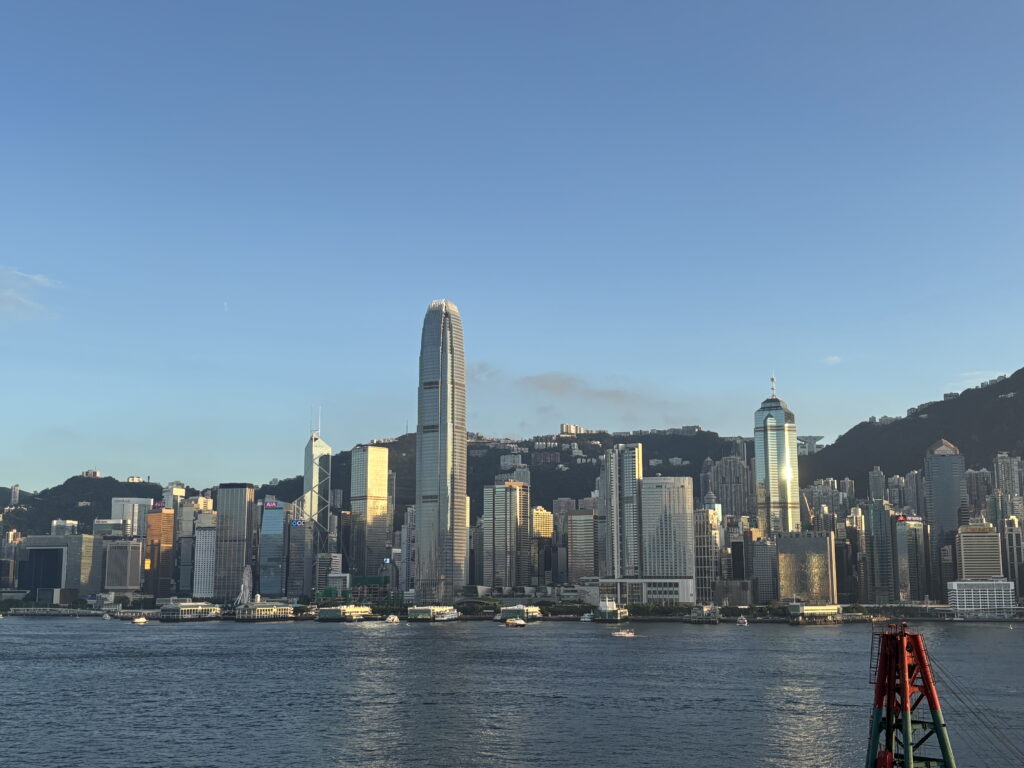
Victoria Harbour. Photo by Jo Gao.
A major source of infill for reclamation sites came from household and construction waste (Fabian and Lou 2019, 2). The bordering sea virtually became a dumping ground for vegetal matter, road sweepings, rags, and building debris. These buried mounds were drained until they became contiguous with the coast—and new land emerged. The local production of waste conveniently supplied an infinite stock of infill to continue reclaiming land from the sea. Through the patch-by-patch remolding of Hong Kong’s geographic boundaries, the colonial government fashioned for itself a variant kind of terra nullius constructed from rubble and detritus. The island’s economic flourishing thus rests upon a lengthy drama of water and land transformations. The iconic skyline along Hong Kong’s harbor, which has become a visual metonym for the metropolis itself, is built on thick layers of quotidian waste. In other words, trash literally makes Hong Kong possible.
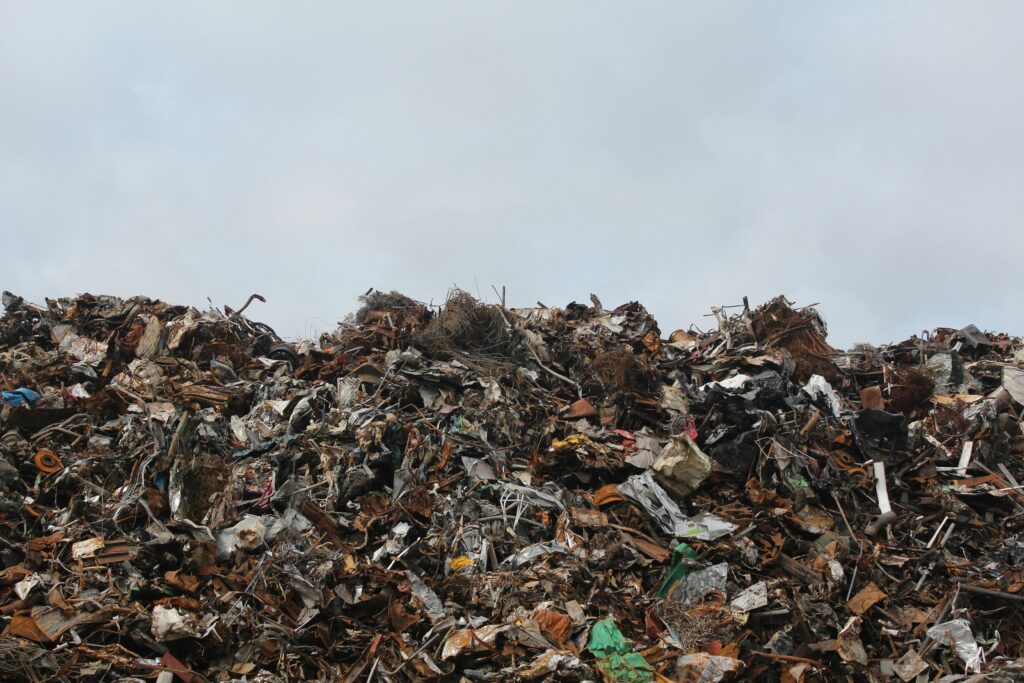
Dumpsite. Stock Image by Emmet from Pexel.
Now returning to Chungking Express. In my reading, the film depicts objects as always on the path to becoming waste, articulating Hong Kong’s imminent change of status, as Britain’s colonial rule was coming to an end. Chungking Express is categorized as a romance-cum-crime dramedy, featuring two lovelorn policemen, Cop no. 223 (named He Zhiwu) and Cop no. 663 (nameless), who struggle to recover from romantic loss. Aside from these characters, located in this time-space conjuncture of waste-as-land, Chungking Express is populated with mass-produced, disposable items. After being jilted by his former lover Ah-May, He Zhiwu develops an odd compulsion as a mechanism for mourning: he purchases a can of pineapples every day, marked with the same expiration of May 1. He explains, “Canned pineapples are Ah-May’s favorite food, and my birthday is on May 1st. If she has not returned by the thirtieth can, this relationship, too, will expire” (Wong 1994, 00:13:23-52) (translations of the dialogue from Mandarin and Cantonese to English are my own). He attempts to mitigate his sexual frustration through a product imagined as a symbolic union of Ah-May and himself. Psychoanalytic theory denominates the allocation of emotional energy in any object as the process of “cathexis”; objects are cathected when an individual attaches a fantasy, person, or the self to them (APA 2018). The emphasis on expiration suggests that canned pineapples operate as more than a mere cathected object for his love. Conspicuously, the expiration date also gestures allegorically to the termination of Hong Kong as a British colony. However, I want to veer in the opposite direction by taking up the very thingness of the tin can.
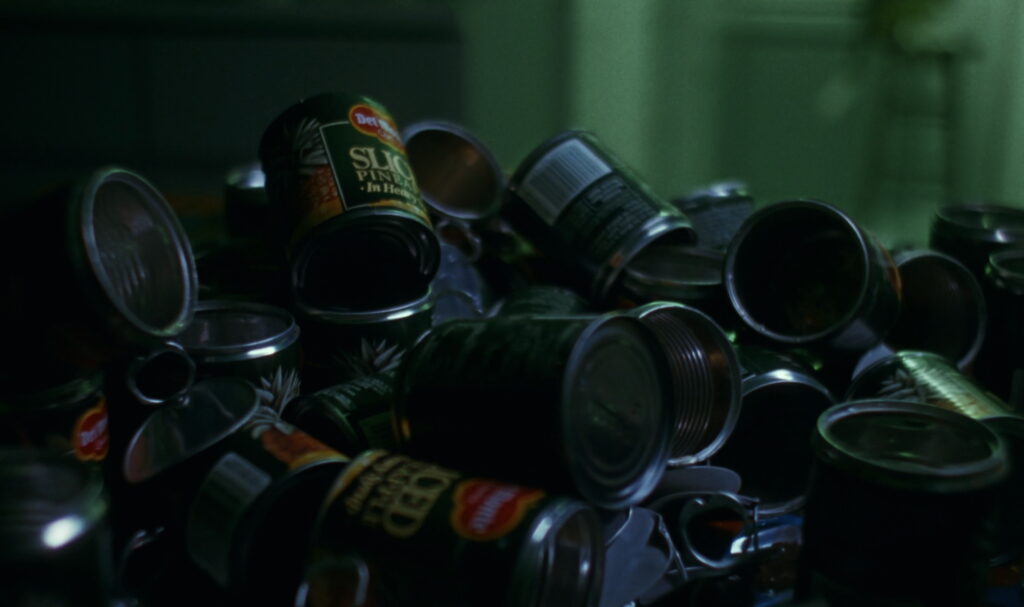
Empty pineapple cans as remnants of a dejected feast. Screenshot taken from Kar-wai Wong’s film Chungking Express (1994).
In allegory’s stead, the materiality of the objects occupies the front and center of the film. In another instance, He protests: “I don’t know when it began. Everything started to get stamped with an expiration date. Mackerels expire, meat pâtés expire, even plastic wraps expire. Is there anything in this world that doesn’t expire?” (Wong 1994, 00:19:10-28) His remarks are laden with caustic overtones about the fated obsolescence of consumer products. As Amago (2021) states, “the logic of consumer capitalism is… ruled by a temporality that is always prepared to send objects into oblivion, with its ‘sell-by’ dates and planned deaths of objects” (43). Thus, while He’s critique points to an anxiety over the metaphorical disposability of the colonial state, the film notably spotlights the commodity’s relationship to a non-sequential temporality, one that does not end once the object becomes obsolete but endures beyond its functional utility. It is this material durability of trash that organizes the infrastructure of the film and constitutes the reality of Hong Kong as we know it.
In an outburst of frustration, He berates the convenience store cashier: “Do you know how much labor goes into the making of canned pineapples? They need to be grown and harvested and sliced. You think you can just throw them out?” (Wong 1994, 00:18:03-48). His litany of questions imply that objects are carriers of relationality, in line with Marco Armiero’s (2021) proposition of the “Wasteocene” as an alternative to the Anthropocene, framing waste as “not a thing to be placed somewhere but a set of wasting relationships” (2). Apprehended thus, commodities are nodal for all kinds of relations: the can holds within it labor relations, the relation between cultivators and the dirt upon which pineapples are grown, romantic relationships, etc. In a revision of Marx’s commodity fetish, all the historical and living relations embodied by the object become grossly transparent on the temporal trajectory of waste, at the junction between the object’s life and its afterlife as trash.
Once discarded and reincarnated as trash, these relations do not disappear so much as become overridden by others. In Chungking Express, as He sits by the curbside, a waste-picker quietly scavenges for recyclable items on the street. Depicted as only a shadow of a man, the waste-picker represents much of the invisible and unofficial labor carried out in the aftercare for waste. In Heike Weber’s (2021) words, the “reverse logistics of the waste business” relies on a motley of collecting agents, often poor urbanites, who form relations with the discarded (93). In the afterlife of things, relations are recomposed. The temporality of waste, consisting of its use and an afterlife during which the object is transformed, carries some resonance with the temporality of geopolitics in Hong Kong in this anticipatory postcolonial moment. The colonial subject at the cusp of the handover is thrust into an afterlife that must grapple with a new set of relations both to China and to Britain. Comparably, waste always carries future relations in the present, but the future outcome of these relationalities remains unknown.
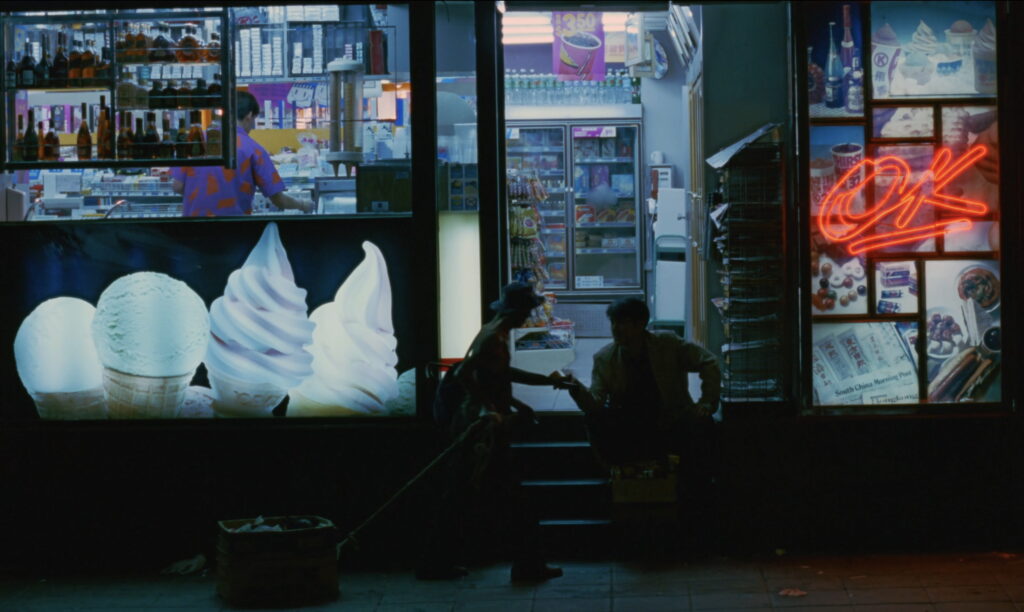
Waste-picker. Screenshot taken from Kar-wai Wong’s film Chungking Express (1994).
The temporalities of waste in Chungking Express and geopolitical Hong Kong are governed by a disorienting quality that maintains the past, present, future in stratified and interwoven disorders. For the political state, the future perfect tense of an anticipatory postcolonial-to-come is held alongside the wistful backwards-looking gaze of an unstable present. He’s pineapple can sketch is as much a gesture of nostalgic longing as it is a fear of an unknowable future. In addition to indexing Hong Kong’s changing status, this temporal dissonance turns our attention towards the stubborn durability of things beyond their shelf lives. Perhaps the most prominent factor demonstrating this quality in the film is the incessant reappearance of the same objects. Chungking Express is rife with intra-textual references, doubling motifs that reincarnate from one story to the next and one character to another: pineapple and sardine cans, airplanes, fishtanks, recurring musical phrases, the nominal resemblance between Ah-May and Faye (Cop no. 663’s love interest), Cop no. 223 and no. 663, and more. Waste is the spectral evidence of a past that we seek to be free from, yet that is always projecting itself into the present (Amago 2021, 43). In the era of mass production, waste is also the inbuilt futurity cast upon the present of any product. The same stands true for the compacted platforms of garbage and debris extending Hong Kong’s shoreline; its very materiality holds together the paradoxical simultaneity of past, present and future.
Scholars of waste theory have noted the capacity to both produce and eliminate commodities as an identifiable marker for modernization. The enduring legacy of trash, particularly plastics, will serve as a gross testimony to human activity on this planet. Carys E. Bennett et al. (2018) foresee the disruption of organic timescales by the anaerobic conditions of landfill sites, in which the osteo-pathological bones of broiler chickens will be mummified as a “biostratigraphic marker species of the Anthropocene” (9). Yet, the apparent permanence of waste contradicts the ephemerality underpinning commodity culture, with its “constant serial replacement” of goods (Hawkins 2007, 60). Thus, any discourse engaging waste necessitates a reckoning with its multiple, warped temporalities.
Through the hodgepodge of cut frames—scenes at once in slow motion, fast-forwarding, frozen and protracted—Chungking Express’s temporal machinery corresponds to what Fiona Allon et al. (2020) articulate as the “post-linear time of waste disposal” (3). Weber (2021) maintains that to consign an object to the wastebasket is hardly the conclusion of its lifecycle; in fact, a product’s obsolescence ushers in an “afterlife of waste,” its recycle, reuse, or “more or less eternal need for care” (88, 100). The circular, fragmented, and dis/continuous temporal motifs of Wong’s film translate the complex temporalities of waste onto a visual surface. Wong approaches trash as a symbol and aesthetic strategy in confronting a moment of rupture in Hong Kong’s contemporary history, but his representation of waste also directs us towards engaging with the intertwining political and material structures at large in the Wasteocene. Our imagination and recognition of waste’s durability is essential for a re-orientation of environmental action.
Acknowledgements
I thank Naveeda Khan for her brilliance and patient guidance. For sharing in the love of film and generously offering her store of knowledge, I am grateful to my friend, Christina Zhou.
References
Allon, Fiona, Ruth Barcan, and Karma Eddison-Cogan, eds. 2020. The Temporalities of Waste: Out of Sight, Out of Time. Routledge.
Amago, Samuel. 2021. Basura: Cultures of Waste in Contemporary Spain. University of Virginia Press.
APA Dictionary of Psychology. “cathexis.” Last updated April 19, 2018.
Armiero, Marco. 2021. Wasteocene: Stories from the Global Dump. Cambridge University Press.
Bennett, Carys E., Richard Thomas, Mark Williams, et al. 2018. “The Broiler Chicken as a Signal of a Human Reconfigured Biosphere.” Royal Society Open Science 5 (12).
Fabian, Nele, and Loretta Ieng Tak Lou. 2019. “The Struggle for Sustainable Waste Management in Hong Kong: 1950s–2010s.” Worldwide Waste 2 (1): 10.
Gille, Zsuzsa, and Josh Lepawsky. 2021. “Introduction: Waste Studies as a Field.” In The Routledge Handbook of Waste Studies, edited by Zsuzsa Gille and Josh Lepawsky. Routledge.
Hawkins, Gay. 2007. “Sad Chairs.” In Trash, edited by John Knechtel. MIT Press.
Weber, Heike. 2021. “Unmaking the Made: The Troubled Temporalities of Waste.” In The Routledge Handbook of Waste Studies, edited by by Zsuzsa Gille and Josh Lepawsky. Routledge.
Wong, Kar-wai, dir. 1994. Chungking Express. Jet Tone Films.
Xue, Charlie Qiuli, and Cong Sun. 2022. “Land Reclamation in the Making of Hong Kong.” In The Routledge Handbook of Infrastructure Design, edited by Joseph Heathcott. Routledge.
Jo Gao is a PhD student in the English department at the University of Virginia. She holds a bachelor’s degree from Barnard College of Columbia University in Neuroscience and English. Her academic interests lie in the nineteenth-century British novel, feminist theory, the history of science and Environmental Humanities.
Cite as: Gao, Jo. 2026. “Waste & Hong Kong Post/Coloniality in Chungking Express”. In “An Aesthetics for the End”, edited by Naveeda Khan, American Ethnologist website, 18 January. [https://americanethnologist.org/online-content/waste-hong-kong-post-coloniality-in-chungking-express-by-jo-gao/]
This piece was edited by American Ethnological Society Digital Content Editor Kathryn E. Goldfarb (kathryn.goldfarb@colorado.edu).