In Río de Niebla, Río de Adobe, Río de Sangre (2023–2024), an exhibition by Tania Ximena (Mexico, 1986), the artist invites viewers to inhabit a shifting territory, moving from passive spectatorship toward an ethics of witnessing. The exhibition emerges from collaborative, place-based practices grounded in long-term engagement with people, land, and more-than-human worlds, and unfolds across video, photography, painting, and sculpture.
At the core of the exhibition is a three-channel, 2K video triptych that bears the same title, unfolding across three thirteen-minute narratives situated in mountain, river, and coastal environments. Operating simultaneously yet asymmetrically, the three screens refuse a single, stable point of view. Instead, they articulate distinct but entangled ecological registers, forming a network of interconnected visual and sonic environments that envelop viewers in shifting perceptual modes of sight and sound.
The middle screen of the triptych, Río de Niebla (River of Mist), follows the intertwined presences of the Jamapa Glacier and a glaciologist. Aerial views dissolve into glacial white sands; the horizon fractures into water drops, craters, and porous rock; a solitary human figure stands surrounded by snowy terrain, with no visible shelter—images that evoke time, duress, recollection, endurance, solitude, and thaw.
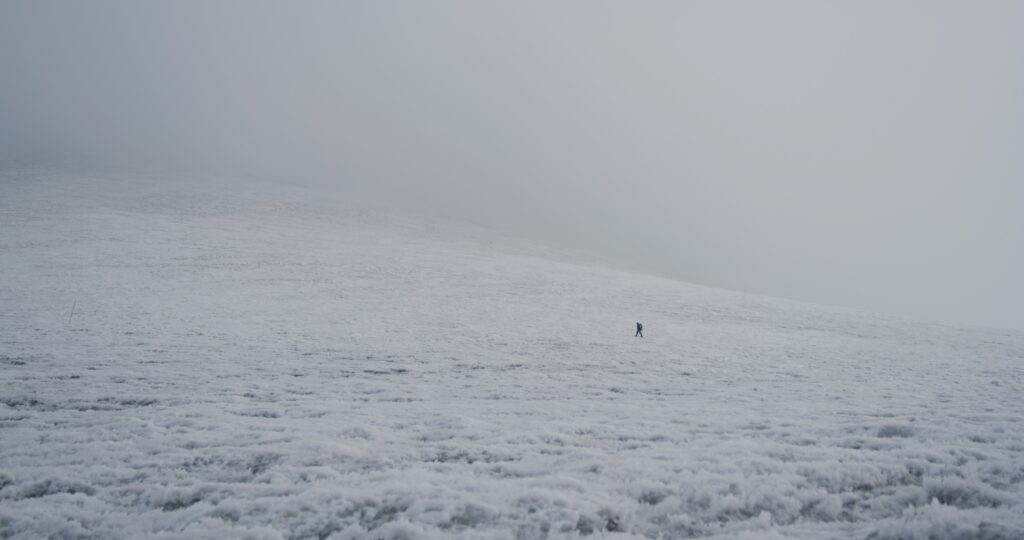
Screen shot from Río de Niebla, Río de Adobe, Río de Sangre, by Tania Ximena (2023).
On Mexico’s Citlaltépetl—a dormant stratovolcano rising to 5,636 meters (18,491 feet) above sea level and the country’s highest peak, more commonly known as Pico de Orizaba—the last tropical glacier recedes with growing speed. Its disappearance signals more than environmental loss. It exposes the fragile boundaries between human and more-than-human worlds, reminding us that endings are neither distant nor abstract; they unfold around and within us. The perception of such loss is often framed through human experience, yet it is articulated in profoundly different ways, as the complementary perspectives of artist Tania Ximena and glaciologist Guillermo “Memo” Ontiveros reveal.
Since 2015, Ximena has accompanied scientists on Pico de Orizaba, forging sustained relationships at more than 5,000 meters (16404 feet) above sea level. This essay centers on her collaboration with Memo, a glaciologist at the National Autonomous University of Mexico who has studied the Jamapa Glacier’s retreat to predict its disappearance and trace its ties to humanity’s carbon footprint. I focus on how their ongoing exchange navigates the terrain where art and science meet, revealing how knowledge, practice, and care can converge, and how each discipline can expand the other’s ways of sensing a changing world.
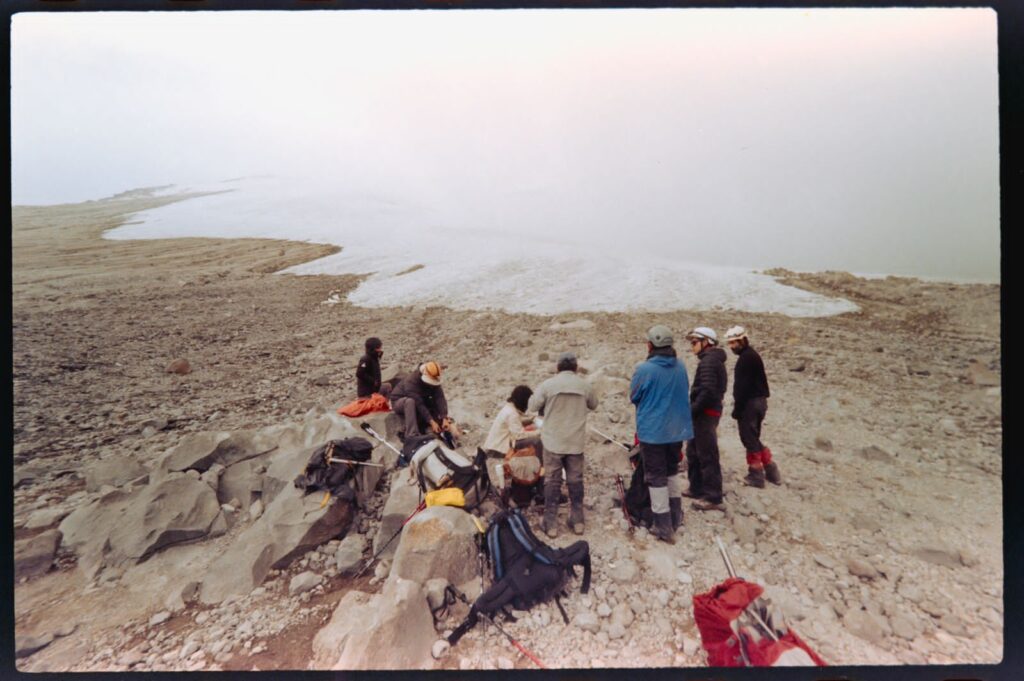
Lower end of Jamapa Glacier. Photograph by Alejandro Villanueva Alcocer, 2019.
Ximena grew up in Xalapa (from Nahuatl, “spring of water in the sand”), the capital city of Veracruz, a region ringed by volcanoes and cloud forest, from which the glacier was visible on clear days. Years later, as an artist, she began mountaineering and experienced what she calls “landscape sickness”—a state in which terrain reshapes perception, breath, and thought.
Memo’s own path began years earlier on El Tetlapan (from Nahuatl, “in the river of stones”), a volcano in the State of Mexico, where he first became a mountaineer and later a scientist. Reflecting on those early encounters, he recalled, “These things, both, made me feel uncertain, intimidated, and sometimes afraid,” as Ximena recounts in the exhibition publication (Ruiz 2025, 89). Those feelings persist, though they are now shaped by decades of high-altitude research and sustained proximity to a vanishing glacier.
For both Ximena and Memo, the glacier became more than a subject of attention: it was a long-term companion, shaping their methods, sensitivities, and commitments at the heart of their collaboration. While they share this bond, they approach it differently, Memo’s through measurement and scientific observation, Ximena’s through sensory translation and embodied presence. Together, their experiences echo Naveeda Khan’s reflection on “the conjoining of the human and the non-human, subjectivity and its dissolution, frailty and gigantism, that works precisely because it makes feeling its object” (2019, 340). Together, their experiences make palpable how relation is forged not through coherence or mastery, but through sustained exposure to uncertainty—an intimacy shaped by duration, vulnerability, and the slow work of staying with what exceeds human control.
For Memo, years of glacier monitoring condense into data—ice thickness, flow, cores, mass balance—tools for predicting the glacier’s disappearance and situating it within climate models. For Ximena, those same phenomena become raw sonic and visual material: meltwater against rock, muted fractures of shifting ice, the low-frequency hum of wind across its surface. Memo’s scientific labor, like Ximena’s artistic engagement, is shaped by care and an acute awareness of loss. Reflecting on glaciers, he writes, “I think I felt a certain identification between the certainty of eternal snows and the rigorously deductive structure of science” (Ontiveros 2025, 89)—a certainty now shaken. Ximena notes how his work carries the weight of mourning, a quiet acknowledgment of an ending unfolding in real time.
“Memo spoke of the glacier as if it were a living being resisting death,” Ximena recalls. “His animistic and emotive way of speaking motivated me to begin a long-term process of accompaniment that became Río de Niebla” (Ruiz 2025, 26). From this point, their work together moved beyond the parameters of scientific inquiry, documenting disappearance through methods that register not only measurable change but also affective, sensory, and relational dimensions.
Through this convergence, their collaboration reframes responsibility—not as mastery over land, but as entanglement with vanishing environments that requires response-ability: a relational, situated capacity to act within conditions of ecological urgency, where culpability is diffuse and no single agent can resolve the crisis (Haraway 2008, 2016; Barad 2007; Tsing 2015). Their collaboration reflects a mutual recognition of the limits of their epistemic realms and a willingness to yield to one another’s methods in order to relate more fully to the glacier. In doing so, their practice unsettles boundaries between human and more-than-human worlds, challenging Western visual regimes and foregrounding sound as a medium for attuning differently—to glaciers, territories, and the ruptures of time they carry. Rather than resolving ecological crisis through knowledge or control, their collaboration insists on response-ability as a practice of accompaniment grounded in proximity, patience, and the willingness to remain implicated in conditions that cannot be repaired.
In Río de Niebla, “landscape” becomes “territory”: not a passive backdrop but a lived, relational field shaped by intertwined histories, practices, and forces. As Arturo Escobar writes, “Territory is our genuine historical text, which keeps the tradition of those of us who inhabit it alive. It represents and describes the principles and practices of our culture. It means effective authority over the physical and spiritual space” (2020, 42). Read through this lens, Ximena’s work figures territory as an ongoing negotiation of responsibility one shaped by cultural memory, ecological relations, and more-than-human presence rather than by extractive logics of control.
Ximena’s approach moves beyond aestheticizing landscape to approach territory as a contested, living space. Her process becomes a form of embodied witnessing, implicating her own body alongside those she encounters. Figures like Memo remind us that scientific labor, too, is shaped by care, grief, and the desire to hold space for what is vanishing. Against this unavoidable loss, Memo has cultivated a sustained photographic practice, documenting the glacier’s transformations from the summit of the mountain; these images were included in the larger exhibition at Ex Teresa Arte Actual.
In this sense, Río de Niebla not only documents a disappearing glacier but stages an encounter between disciplines and temporalities, opening a relational field where knowledge is co-created in the face of irreversible loss.
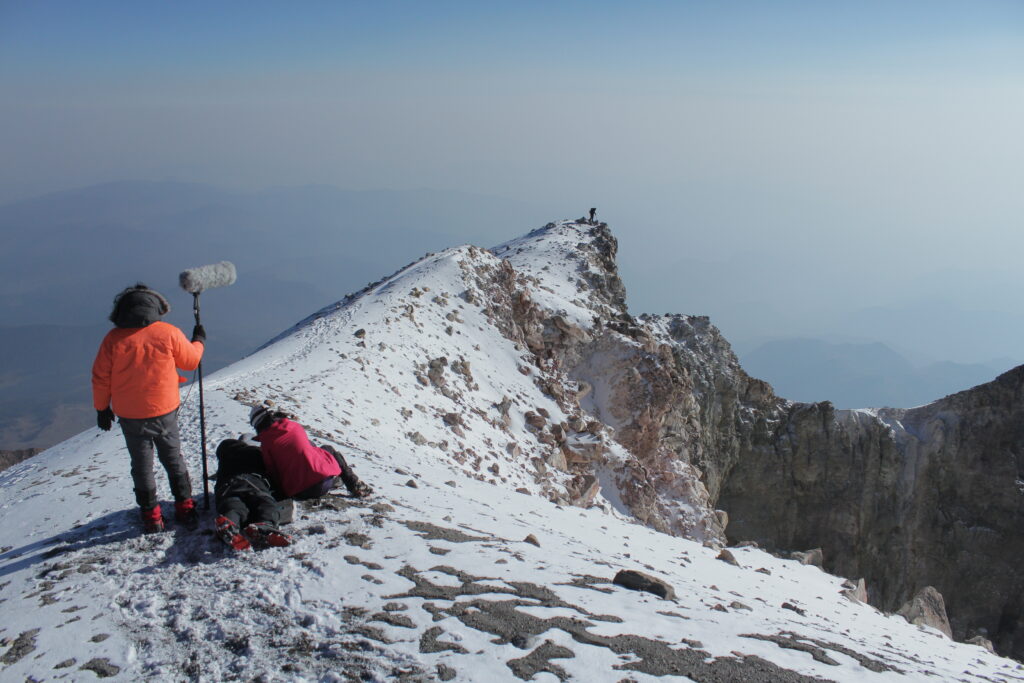
Summit of Pico de Orizaba volcano. Photograph by Rodrigo Suárez, 2019.
This relational field is also an acoustic one. In Río de Niebla, sound is not simply an accompaniment to the image but a mode of inquiry and a conduit, carrying the glacier’s presence across the river and to the shores, collapsing distances of time and space. Listening to the glacier’s retreat means registering more than visible change: the drip of meltwater against stone, the subtle fracture of shifting ice, and the near-silence of collapsing environments. Such sonic amplification unsettles linear time, drawing us into deep temporal entanglements where geological, historical, and political forces converge. Listening here does not promise recovery or reconciliation; it marks an ethical threshold, a way of remaining answerable to processes of disappearance that unfold beyond human timescales yet remain inseparable from human histories.
This attunement aligns with decolonial ecologies, which resist colonial separations—between human and nonhuman, self and other, life and nonlife—by reimagining relational responsibility as response-ability. The disappearance of the Jamapa Glacier is inseparable from colonial and extractive histories, a reminder that the ecological crisis cannot be disentangled from centuries of dispossession and territorial violence. Here, sound becomes a decolonial method: an embodied practice of listening that refuses detachment, insists on proximity, and makes space for more-than-human voices in climate collapse conversations. Framed this way, sound becomes not only a method but a stance— one that situates responsibility within histories of extraction that continue to reverberate through land, bodies, and memory.
In Mesoamerican cosmogonies, volcanoes are considered hierophanies—sacred manifestations of the divine—each imbued with distinct personalities and attributes. They have long offered ways of relating to the world that move beyond Western frameworks of understanding. Within this cosmological and ecological continuum, glacier ecologies link highlands, lowlands, and oceans, tracing interdependencies across vast temporal and spatial scales. The Jamapa Glacier stands as both a visible gauge of how global warming is reshaping planetary temperatures and a living archive of disappearance and decay.
Through Río de Niebla, Ximena challenges Western visual regimes that position the viewer as detached. Instead, her work insists that seeing, listening, and being in place are co-constitutive. We cannot witness a disappearing glacier without acknowledging our participation in its loss. As Jane Bennett writes, “Humanity and nonhumanity have always performed an intricate dance” (2010, 31), a reminder that human agency is always already entangled within broader networks. Ximena’s work makes clear that this entanglement is not metaphorical: it is lived, uneven, and historically produced, binding human action to material processes that continue to unfold long after the image fades.
By attending to sound, territory, and disappearance, Ximena’s work offers what might be called an aesthetics for the end. It is grounded not in mastery or detachment but in proximity, responsibility, and the willingness to be transformed by another’s ways of knowing. Her collaboration with Memo shows how art and science can relinquish the illusion of total comprehension to meet in mutual attunement. Witnessing environmental loss requires entanglement—with people, places, and the more-than-human—and accepting that such entanglement carries risk and responsibility. Listening and care here are not definitive answers but fragile gestures enacted within tangled temporalities. As Mick Smith and Jason Young remind us, “To think with a provisional ecology is to resist both narratives of nature’s providence and the nihilism of indifference” (2022, 10). In this sense, Río de Niebla insists that attunement is not an aesthetic choice but an ethical stance—one that binds listening, care, and response-ability to the fragile work of witnessing disappearance.
References
Barad, Karen. 2007. Meeting the Universe Halfway: Quantum Physics and the Entanglement of Matter and Meaning. Duke University Press.
Bennett, Jane. 2010. Vibrant Matter: A Political Ecology of Things. Duke University Press.
Escobar, Arturo. 2020. Pluriversal Politics: The Real and the Possible. Latin America in Translation. Duke University Press.
Haraway, Donna J. 2008. When Species Meet. University of Minnesota Press.
Haraway, Donna J. 2016. Staying with the Trouble: Making Kin in the Chthulucene. Duke University Press.
Khan, Naveeda. 2019. “At Play with the Giants: Between the Patchy Anthropocene and Romantic Geology.” Current Anthropology 60 (S20): S333–41.
Ontiveros, Guillermo “Memo.” 2024. “Know the Uncertainty.” In Río de Niebla / Un Devenir del Río Jamapa, 1st ed. Aljuir Editorial.
Ruiz, Tania Ximena. 2024. “A Story of Becoming.” In Río de Niebla / Un Devenir del Río Jamapa, 1st ed. Aljuir Editorial.
Smith, Mick, and Jason Young. 2022. Does the Earth Care? Indifference, Providence, and Provisional Ecology. University of Minnesota Press.
Tsing, Anna Lowenhaupt. 2015. The Mushroom at the End of the World: On the Possibility of Life in Capitalist Ruins. Princeton University Press.
Amanda Macedo Macedo is a PhD candidate in Theatre Arts and Performance Studies at Brown University. Her work examines territories marked by colonialism, extraction, and ecological crisis.
Cite as: Macedo Macedo, Amanda. 2026. “Listening, Response-Ability, and the Disappearance of Mexico’s Last Glacier”. In “An Aesthetics for the End”, edited by Naveeda Khan, American Ethnologist website, 18 January. [https://americanethnologist.org/news/listening-response-ability-and-the-disappearance-of-mexicos-last-glacier-by-amanda-macedo-macedo/]
This piece was edited by American Ethnological Society Digital Content Editor Kathryn E. Goldfarb (kathryn.goldfarb@colorado.edu).