Zheng Chong-xiao 鄭崇孝 is a Taiwanese painter born in Taipei in 1988 whose artistic practice includes the use of the imagery of traditional Chinese landscape painting (or shanshuihua 山水畫) to address environmental issues. Within the field of eco-art, his Taiwanese landscapes resonates with a genre of postmodern Chinese landscapes that engage with “customary shanshuihua’s structures […] imbued with traditional aesthetics (Macrì 2017, 33)” while using contemporary visual strategies and media elements (Macrì 2017; Peng 2021). The virtuosity intrinsic to these postmodern ecological landscape paintings stems from maintaining the representation of traditional image sufficiently faithful to the original (when present) to be recognizable as such, while simultaneously depicting the contemporary reality.
In this contribution, I will bring into visual conversation one of Chong-xiao’s recent oil paintings, Jiè yī diǎn wèilái 借一點未來 (2025) or Borrow a Glimpse of the Future with the traditional shanshui masterpiece it references: Zǎo chūn tú 早春圖 or Early Spring, a Northern Song Dynasty (960-1127 CE) landscape painting by Guo Xi’s (郭熙, c. 1020-c.1090). This example will serve to demonstrate how Chong-xiao’s ecological landscape paintings aim for an ethical impact upon its viewers by evoking a sense of uncanniness softened by his unique style. Additionally, it will demonstrate how these feelings are rooted in a landscape aesthetic that, when expressing an environmental message, reinterprets the vision of nature in traditional Chinese landscape painting (Peng 2021; Chu 2012; Macrì 2017). All translations from the traditional Chinese are my own.
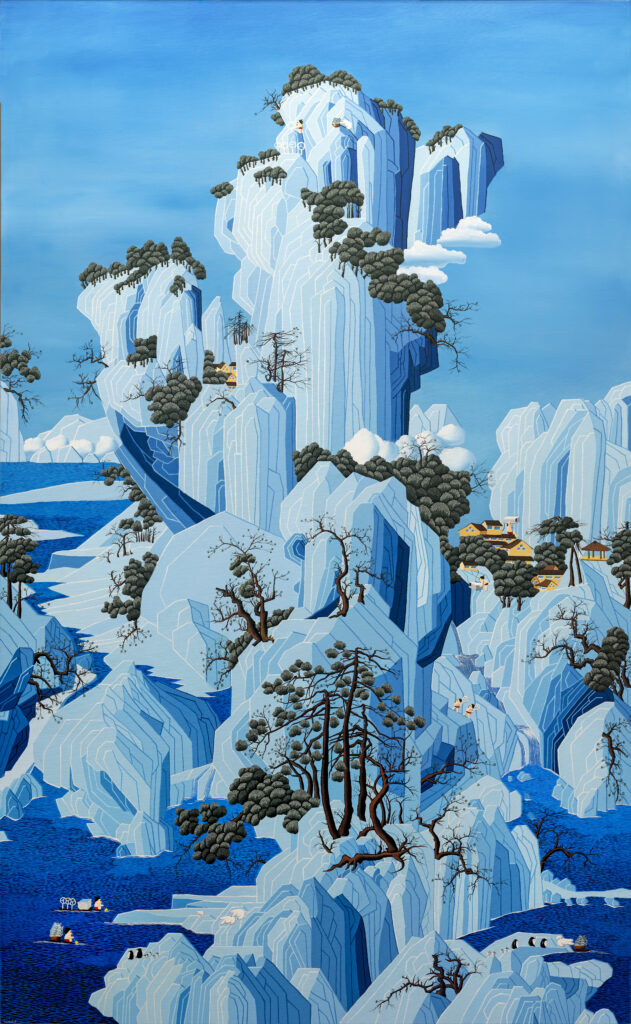
Zheng Chong-xiao 鄭崇孝, Borrow a Glimpse of the future 借一點未來, oil on canvas, 2025, 198 x 122 cm. Photo by Zheng Chong-xiao.

Guo Xi, 郭熙 (c.1020-1090) Early Spring 早春圖, Northern Song dynasty (960-1127), 1072, ink and color on silk, 158,3 x 108,1 cm. National Palace Museum, Taipei. Photo by National Palace Museum.
In Borrow a Glimpse of the Future, Zheng Chong-xiao’s composition faithfully reproduces Guo Xi’s original, especially its privileging of the vertical axis. The mountainous form and the artfully placed trees and shrubs upon them are resonant with Guo Xi’s original. However, the painting is different in the technique used and the subjects portrayed. For instance, Early Spring’s mountain, once the symbol of a hierarchically ordered and harmonious universe (Murashige 1995), is now replaced by a massive iceberg inhabited by penguins and polar bears and slowly melting into the surrounding blue waters. Whereas the depiction of the mountain in the original painting, rendered through various brushstrokes of black ink gradations, gave the feeling of the eternal through revealing nature’s perpetual dynamism (Murashige 1995), the massive iceberg in Chong-xiao’s work seems intentionally transitory, as its dynamic potential is emphasized within the physical landscape through the melting of the iceberg. The colors in Chong-xiao’s canvas are bright and perfectly balanced in their interplay of harmony and contrast, revealing the artist’s meticulous chromatic research. The iceberg itself is rendered using oil paint brushstrokes with a technique that skillfully combines traditional Chinese ink painting, Ukiyo-e, and manga’s descriptive art of linear expressions (Peng 2021). Humans are rendered in small scale in Chong-xiao’s painting as in the original, indicating human insignificance in the face of nature. However, the human figures originally depicted in Guo Xi’s composition (see Murashige 1995) are now replaced by several young boys, shirtless cartoonish figures with large red mouths and red shorts. These are representations of the “pouting boy,” a figure who has shown up in Chong-xiao’s earlier oil paintings as a symbol of the artist himself. The artist, in fact, ironically portrays himself in an environment corrupted by human influence, while simultaneously addressing the serious threat to the natural world, expressing the human being’s imbrication and culpability in the environmental transformations he represents. The pouting boy, with his exaggerated facial features, shows Chong-xiao’s ability to address environmental themes with a humorous touch (Peng 2021).
Although Chong-xiao’s artwork often aims to convey fond memories of his blissful childhood, in Borrow a Glimpse of the Future, the same objects of his childhood imagination, such as polar bears, penguins, and snow, now contrast with the melting ice. The feeling of serene childhood is shot through with environmental anxiety.
Focusing in on the pouting boys on boats, one sees that they are incongruously bringing air conditioners and ice makers to an icy landscape, to a place that, as Chong-xiao explains, “does not belong to them” (Zheng Chong-xiao, interviewed by the author July 10, 2025). As Chong-xiao further observes, humanity’s growing reliance on technology makes it the primary tool for addressing climate change. Yet, if technology is not used with caution, Chong-xiao explains, it risks inadvertently accelerating the same negative impacts it aims to mitigate. In the artist’s thinking this creates a dangerous feedback loop. Borrow a Glimpse of the Future therefore reveals Chong-xiao’s vision of a future both absurd and unsettled where technology produces a series of short-term remedies that are neither lasting nor truly protective of the earth (Zheng 2025).
In its depiction of ordinary technological objects of everyday use such as air conditioners and ice makers, Borrow a Glimpse of the Future also depicts Chong-xiao’s sense of the end. The end, for the artist, is represented as something that does not occur in a flash, but through the gradual accumulation of objects out of place within a given site:
我們每天打開冷氣、製造塑膠垃圾、這些看似微小的選擇、其實都是未來逐漸崩解的積累。而正是這種「日常中的不自覺」、讓終結顯得更加真實也更加令人不安。
Every day, we turn on the air conditioner and produce plastic waste. These apparently insignificant choices actually accumulate to gradually destroy [our] future. Precisely, it is the unconsciousness in everyday life that makes the end seem more real and more unsettling (Zheng 2025).
By engaging with the original painting, Zheng Chong-xiao addresses the environmental issue of melting ice caps while revealing his concerns for the future of the planet.
A sense of uncanniness, operating within a landscape aesthetic that scholar Chu Kiu-Wai defines uncanny yijing, helps to disclose Chong-xiao’s ethical message (2012). Chong-xiao’s painting in fact represents two distinct expressions of aesthetics: a traditional one (yijing), that operates through a symbolic imagery recalling the harmonious relationship between man and nature, and a contemporary uncanny one, that, in this case, operates through the depiction of technological objects. These technological objects reveal the artificial nature of the painting (Chu 2012), while symbolizing technological incursion or environmental disaster. Humans are placed at the site of the destruction of an older order of imagery, making us the cause of its destruction, but also most importantly at the site of the loss of our bearing within the given. That which is before the small figures is both profoundly familiar and unfamiliar. The return of the familiar in a new, absurd form produces the sense of the uncanny. However, this sense of uncanniness is softened by the bright colors of the canvas and the presence of the pouting boy, thus highlighting Chong-xiao’s unique artistic vision.
By reinterpreting this landscape aesthetic through an environmental lens, artists of this genre re-imagine the vision of nature embedded in traditional Chinese landscape painting. Transposing ancient principles into today’s reality, they simultaneously address two themes: the exploitation of nature and the loss of human values. If traditional shanshui paintings aspired to a harmonious relationship between humans and nature (in Chinese often expressed through the concept tianren heyi 天人合一), the postmodern ecological landscape paintings visually represent the inharmonious relationship between them (Macrì 2017; Chu 2013). As Chinese art historian Elena Macrì explains, the harmonious relationship in traditional paintings referred to a metaphysical dimension, while contemporary inharmonious relationship mainly addresses an ethical dimension (2017). Chong-xiao’s meticulous attention to detail in executing the painting constitutes the technical virtuosity through which the artist might share (possibly beyond his original, explicit intention) an ethical environmental concern with the audience (Gell 1998, Gell 1992).
Borrow a Glimpse of the Future, therefore, aims to make the viewers aware that everyday choices directly impact our future. However, despite revealing Chong-xiao’s concern for the environment and conveying a sense of uncanniness to the viewer, embodied in this painting are also Chong-xiao’s hopes for the future. As the artist states (2025), shanshui’s heritage, in this context, “emerges as a glimpse of hope, an inner refuge […] in an age of endings,” as “it teaches us to listen and live with the natural world, instead of dominating it.”
References
Chu, Kiu-wai. 2012. “Constructing Ruins: New Urban Aesthetics in Chinese Art and Cinema.” Modern Art Asia: Papers on Modern and Contemporary Asian Art (Selected Papers Issue 1-8). Enzo Arts and Publishing.
Chu, Kiu-wai. 2013. “Animating Shanshui: Chinese Landscapes in Animated Film, Art and Performance.” In Animated Landscapes: History, Form, and Function, edited by Christopher Pallant. Bloomsbury.
Gell, Alfred. 1992. “The Technology of Enchantment and the Enchantment of Technology.” In Anthropology, Art and Aesthetic, edited by Jeremy Coote and Antony Shelton. Clarendon Press.
Gell, Alfred. 1998. Art and Agency: An Anthropological Theory. Clarendon Press.
Macrì, Elena. 2017. “Being, Becoming, Landscape: The Iconography of Landscape in Contemporary Chinese Art, Its Ecological Impulse, and Its Ethical Project.” Yishu: Journal of Contemporary Chinese Art 16 (1): 32-43.
Murashige, Stanley. 1995. “Rhythm, Order, Change, and Nature in Guo Xi’s Early Spring.” Monumenta Serica 43 (1): 337-64.
Peng, Kang-Chia. 2021. “Journey on Earth: Zheng Chong-Xiao’s Topographic views of contemporary landscape”. Preface to 鄭崇孝 Chong-xiao Zheng 2018-2020: 18-21.Taiwan. Star Gallery. 2021.
Elisa Di Piero is an MA postgraduate student at Ca’ Foscari University of Venice, where she earned her bachelor’s and master’s degrees in 2020 and 2023, majoring in Chinese Art History. Her MA dissertation investigated the connection between the visions of nature in Song Dynasty landscape paintings, framed within their eco-historical context, and Chinese ecological postmodern landscape paintings. Her current research interest covers contemporary eco-art practices across the Sinosphere, with a specific emphasis on landscape art practices.
Cite as: Di Piero, Elisa. 2026. “Depicting the Uncanny: The Environmental Landscapes of Taiwanese artist Zheng Chong-xiao”. In “An Aesthetics for the End”, edited by Naveeda Khan, American Ethnologist website, 18 January. [https://americanethnologist.org/online-content/depicting-the-uncanny-the-environmental-landscapes-of-taiwanese-artist-zheng-chong-xiao-by-elisa-di-piero/]
This piece was edited by American Ethnological Society Digital Content Editor Kathryn E. Goldfarb (kathryn.goldfarb@colorado.edu).