Revisiting Heritage and Homelessness by David Tutchener
by
This piece is part of the “Anthropology that Breaks Your Heart” series, a project inspired by the work of Ruth Behar’s The Vulnerable Observer (1996).
During my final two years of high school in Melbourne, Australia, from 1997 to 1998, I was homeless. I found a place to stay that was run by the Lutheran Church—a form of supported accommodation for homeless youth, located at 1a Bedford Road, Ringwood.
The temporary accommodation I lived in was managed by the Ringwood Extended Family Service. This house was right beside Ringwood Railway Station. At the time, the station was a hub of illegal activity, which became part of our everyday teenage lives. The house was rundown but still usable. The room I stayed in faced the road; each time a train passed, the oven racks would rattle with the vibrations, as would the house itself.
During the year I spent in this house, I met and lived with other young people experiencing homelessness. I have enduring memories of the cold, hunger, and a deep, unforgiving loneliness born of a deeper feeling of abandonment. Friends came and went, sleeping on the floor or a couch. Some friends died, others moved away, and life kept going. I later learned from a colleague that local high schools would tour this house to show how young homeless people lived. These tours were meant to serve as a warning. I never saw these tours come through.
After 27 years (to the day) of never looking back, I decided to embark on my own kind of tour, this time as an archaeologist and anthropologist working for Aboriginal communities in heritage conservation and with not-for-profits. In these roles, I use variations of Participant Action Research approaches to community engagement (Swantz 2008; Tutchener and Turnbull 2023). By then, I had learned to conceal parts of my past from outsiders. Yet Ringwood was the birthplace of my desire to work with people; it was here that I came to understand inequality more broadly, often in ways that my non-homeless friends struggled to grasp. Whether or not I shared these experiences with others, having been homeless deeply affected my approach to life and my work as an academic. On January 7, 2025, I returned to 1a Bedford Road, armed with a scale rod and smartphone, and undertook a place inspection.
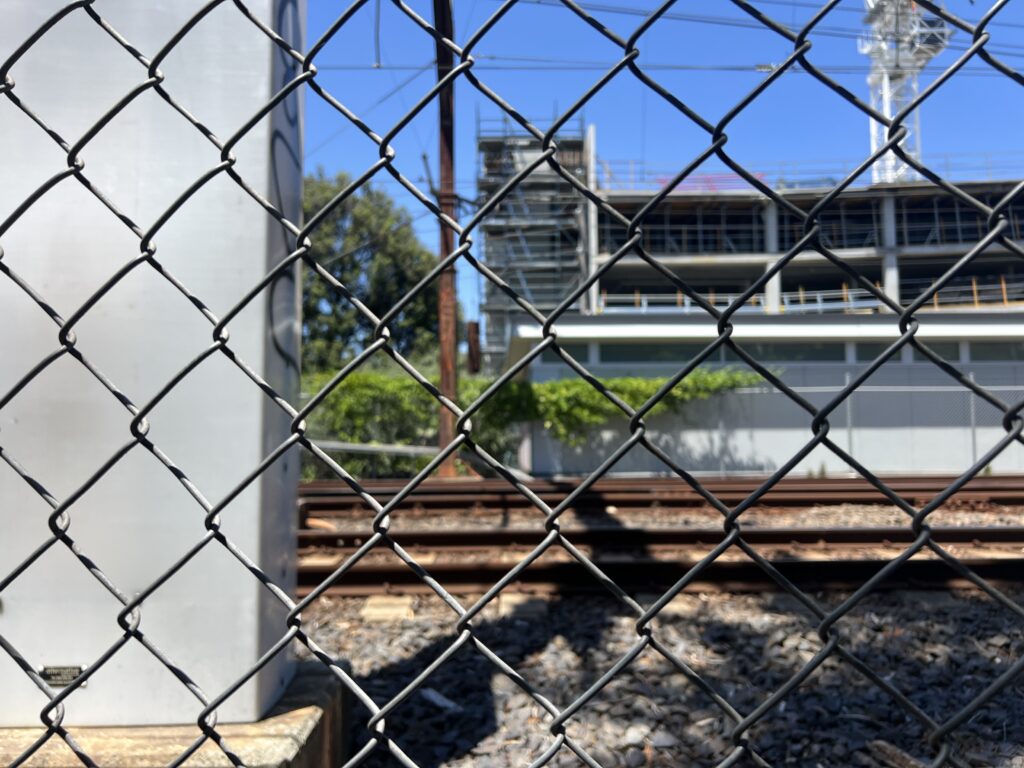
1a Bedford Road, Ringwood today, from across the trainlines. Photo by David Tutchener, 2025
This essay builds upon my previous work on placemaking to affirm the link between heritage and identity. Here, I consider how identity formation affects our positioning as researchers and practitioners within the power inequities of homelessness and the broader framework of heartbreak (Holland and Leander 2004; Schiller 2016). Social scientists have offered a range of narrative approaches to studies of homelessness, including in archaeology and anthropology (Schofield 2024; Zimmerman et al. 2010). Some have done so through a distinctly autoethnographic mode (Rennels and Purnell 2017; Herrmann 2021), though not in an Australian context. This autoethnographic approach is described by Pat Sikes (2021) as “…not simply a way of knowing about the world, it has become a way of being in the world, one that requires living consciously, emotionally and reflexively,” and I apply this approach here.
I set out to visit our old house with an exploratory research question based in an autoethnographic approach of place and heritage. What meanings might emerge through positioning myself within the narrative of this place? I thought a place inspection of our old house, or anything that was left, might help me answer this question.
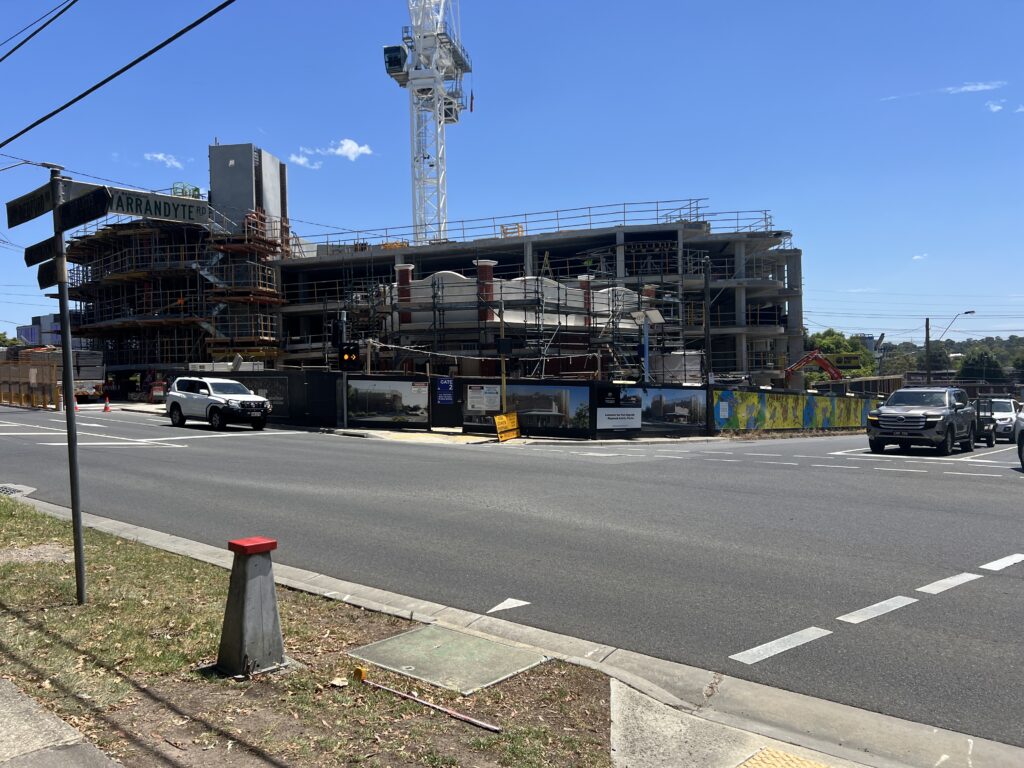
A new multi-story complex under construction where our old house was at 1a Bedford Road, Ringwood. Photo by David Tutchener, 2025.
Upon arrival, I was bitterly disappointed; it was a work site, and I could not enter the property at all. I could only take a series of photos. Where we had lived was now a large multi-story building with a relocated bottle shop barely visible behind the scaffolding on the corner. Cranes and excavators were working away in the 33-degree Celsius, mid-January heat. I remember that same heat in the old house here, and later in winter, the cold. Yet this was still the place—where I felt abandoned, where I was lost and angry, where I swore that a soft heart was only for breaking, where I became tough. This was the place where many of my perspectives on the world were formed. From this loss, the loss of an expected childhood, I gained a life of meaning. Now, at this place, I was both the participant and the researcher, each of these aspects of my identity collapsing into the other.
After such a long time, so much of the area has changed; it is now gentrified. My barefoot, heroin-using buddies and my fire-twirling, hippie friends are ghosts long departed—some from this world entirely. This place has always informed my forward-facing drive, for better or worse. It is fitting, then, that this field visit to my past sparked a new ambition. I decided to explore this place with the tools of my academic training, and undertook some archival research.
Due to the general state of disrepair, the house that we lived in had been condemned and demolished soon after we left in 1998, and a low-impact car park was constructed. As Ringwood grew, this prime location was further developed. The Blood Brother Bottle Shop (a convenient place to illegally buy beer or vodka as a teenager), which had been next door to our lodging, is officially listed as a local heritage place. The shop ended up being relocated to the site of our old home. According to local newspapers, moving this building had been a massive undertaking.
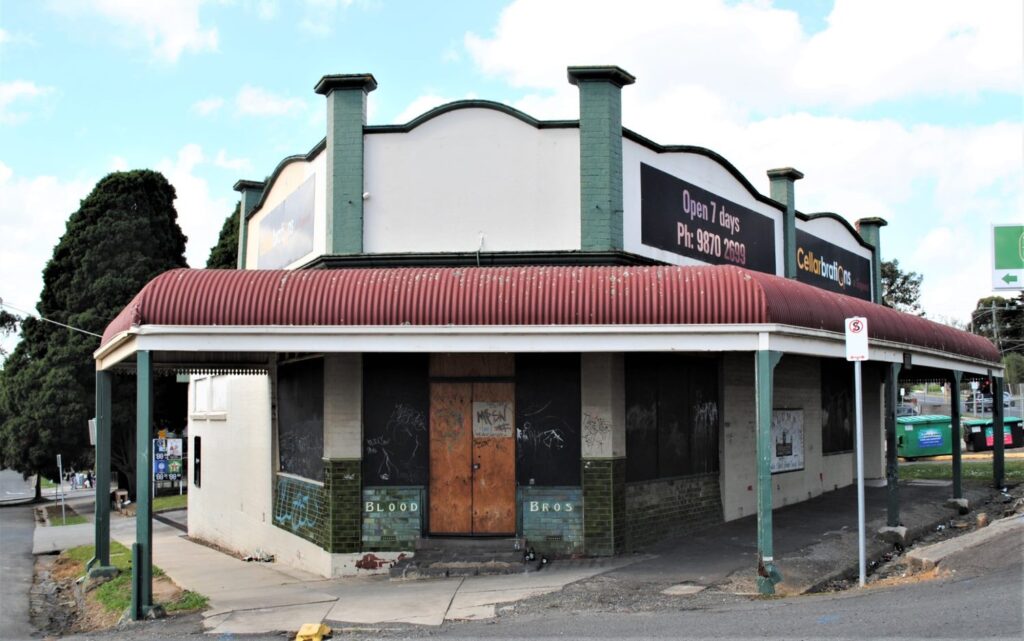
Blood Brothers Bottle Shop. Photo from the National Trust of Australia.
The heritage statement for the former Blood Brothers Bottle Shop, which is included within the Maroondah City Council Planning Scheme, contains no mention of the house that had been next to it. The Statement of Significance for this place notes that:
Bryan’s Ringwood Cellars built in c1914 is a particularly intact corner shop, generally in its original use. It is historically regionally significant to Melbourne as a surviving representative embodiment of Edwardian retail practice, particularly in the retail liquor industry, and the way of life in Edwardian Ringwood. It is architecturally significant as a rare and relatively intact rural Edwardian corner shop. The tile sign is representative of ceramic craftsmanship and of this use of ceramic tiles. It is socially significant as known and valued as a landmark used by the community for orientation and part of the sense of identity of the place (Victorian Heritage Database 2025).
I could not help thinking of how this old/new place was being re/constructed within another place. A place full of stories from people like me. These stories and places are all too often lost as people move through life. This loss exerts particular harm upon marginalized communities, like many of the Aboriginal communities with whom I work. These ‘forgotten’ gaps feel more like a deliberately forgotten history, a forgotten place, a forgotten trauma.
I wish the Planning Scheme’s formal heritage statement would incorporate a deeper history of this place, to include the people who had lived experiences of homelessness here.
The class-based inequalities that became part of my lived experience, and the people I met and lived with in these spaces, profoundly challenged my worldview. Poverty, death, substance-use, drug overdoses, and sexual, physical, and psychological violence had been day-to-day experiences for myself and my peers. This type of heartbreak never really heals. However, our heartbreaks do not have to be a destructive force within our lives; we need not leave them unresolved. When recognized, these heartbreaks can better inform our work. I consider and embrace the enormous shifts in my identity and perspective that happened at this place. I am so lucky and privileged compared to so many.
Despite some of my better efforts to forget this period of my life, an autoethnographic approach to the heritage of my own homelessness as a youth helps me more clearly see my position as a researcher. Perhaps a more transparent approach to the heartbreaks of our pasts can also bring deeper meaning and connections to the communities with whom we work.
References
Herrmann, Andrew F. 2021. “Autoethnography as Acts of Love.” In Handbook of Autoethnography, edited by Tony E. Adams, Stacy Holman Jones, and Carolyn Ellis. Routledge.
Holland, Dorothy, and Kevin Leander. 2004. “Ethnographic Studies of Positioning and Subjectivity: An Introduction.” Ethos 32(2): 127–139.
Rennels, Tony R., and David F. Purnell. 2017. “Accomplishing Place in Public Space: Autoethnographic Accounts of Homelessness.” Journal of Contemporary Ethnography 46(4): 490–513.
Schiller, Nina Glick. 2016. “Positioning Theory: An Introduction.” Anthropological Theory 16(2–3): 133–145.
Schofield, John. 2024. Wicked Problems for Archaeologists: Heritage as Transformative Practice. Oxford University Press.
Sikes, Pat. 2021. “Section Introduction: Doing Autoethnography.” In Handbook of Autoethnography, edited by Tony E. Adams, Stacy Holman Jones, and Carolyn Ellis. Routledge.
Swantz, Marja-Liisa. 2008. “Participatory Action Research as Practice.” In The Sage Handbook of Action Research: Participative Inquiry and Practice, edited by Peter Reason and Hilary Bradbury. Sage Publishing.
Tutchener, David, and Dan Turnbull. 2023. “Aboriginal Cultural Values Framework: Producing and Communicating Bunurong Values and Meanings within Bunurong Country.” Cultural Geographies 30(1): 141–149.
Victorian Heritage Database. 2025. “Statement of Significance: Ringwood Cellars, Former Blood Brothers Premier Store.” Heritage Council of Victoria. Accessed November 30. https://vhd.heritagecouncil.vic.gov.au/places/146889#statement-significance.
Zimmerman, Larry J., Carol Singleton, and Jessica Welch. 2010. “Activism and Creating a Translational Archaeology of Homelessness.” World Archaeology 42(3): 443–454.
David Tutchener has worked extensively as an archaeologist in Australia, the US, and the Caribbean. David holds a PhD in Archaeology from Flinders University. Currently, he is a PhD student in Anthropology at Deakin University. He has collaborated with numerous Aboriginal groups in Australia and currently works in Victoria for the Bunurong Land Council Aboriginal Corporation.
Cite as: Tuchener, David. 2026. “Revisiting Heritage and Homelessness.” In “Anthropology that Breaks your Heart: The Risk of Proximity,” edited by Alexandra Dantzer, Uyen Dang, and Emma Kahn. American Ethnologist website, 27 March. [https://americanethnologist.org/online-content/collections/anthropology-that-breaks-your-heart-the-risk-of-proximity/revisiting-heritage-and-homelessness-by-david-tutchener/]