Makan apa? by Binar (Mentari) Malahayati
by
This piece is part of the “Anthropology that Breaks Your Heart” series, a project inspired by the work of Ruth Behar’s The Vulnerable Observer (1996).
“Makan apa?” is a two-part piece written at the time of finishing my master thesis on the 1965 genocide in Indonesia. It’s written from the point of view of someone who grew up on the other side of ethnography, “the observed”: part of a family of victims of state violence, now attempting to conduct a study within the anthropology of violence. This piece conveys the melancholy and terror, in Begoña Aretxaga’s sense, through experiencing the pains I give myself permission to write.
“Makan apa?” can roughly be translated to “Eat what?” or “What (are) we/you eat(ing)?” This question is not bound by tenses in the original Indonesian. An extremely common colloquial question in Indonesia, different from simply asking “How are you?”, it holds you responsible and captive, for you cannot answer with a dismissive “I’m good.” Even my own mother tongue fails and falters in the face of violence, as Veena Das aptly writes. Here, I attempt to describe the vulnerability I experience amid the intimacy of the ethnographies I conduct.
Instead of racking my mind to find the adjectives to describe the emotion, I give myself an answerable question. I can say that I am eating words, my words, lyrics, inks. I devour them as I’m devoured with an overwhelming bleakness for all the ways I anticipate that my presence in academia will fail victims and their families, just as I myself experienced. I eat all of them, all in vain. It’s an unanswerable hunger and thirst for a fullness that does not exist. Then we move. Spaces are given to deliberately dissecting sentences, phrases, words. Time’s passing is felt throughout the poem.
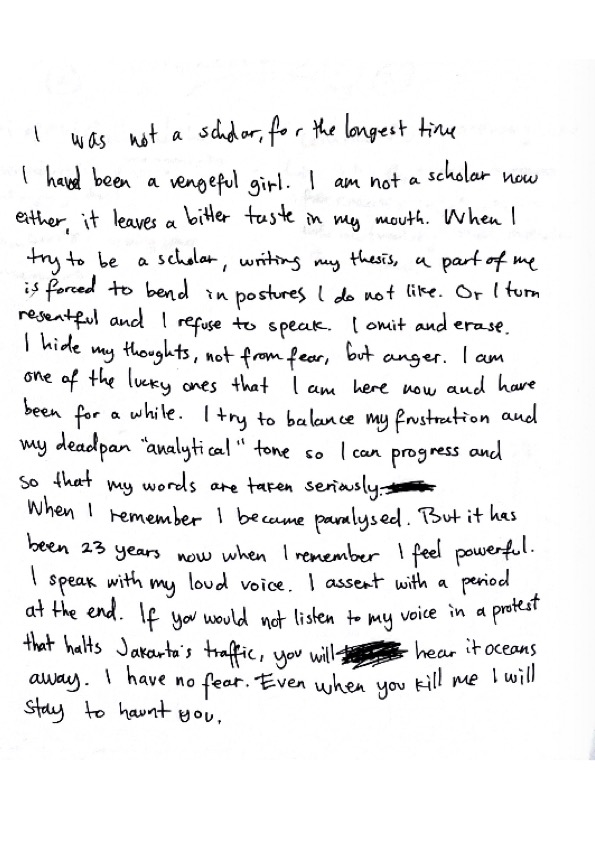
This piece is about the hunger, thirst and movement of my process becoming a scholar: a process that is ceaseless, recurring, and all-consuming, and that tracks my self as an ethnographic subject in the past to becoming an anthropologist. The second image offers a vignette, a private entry reflecting on this process of becoming and unbecoming into anthropology.
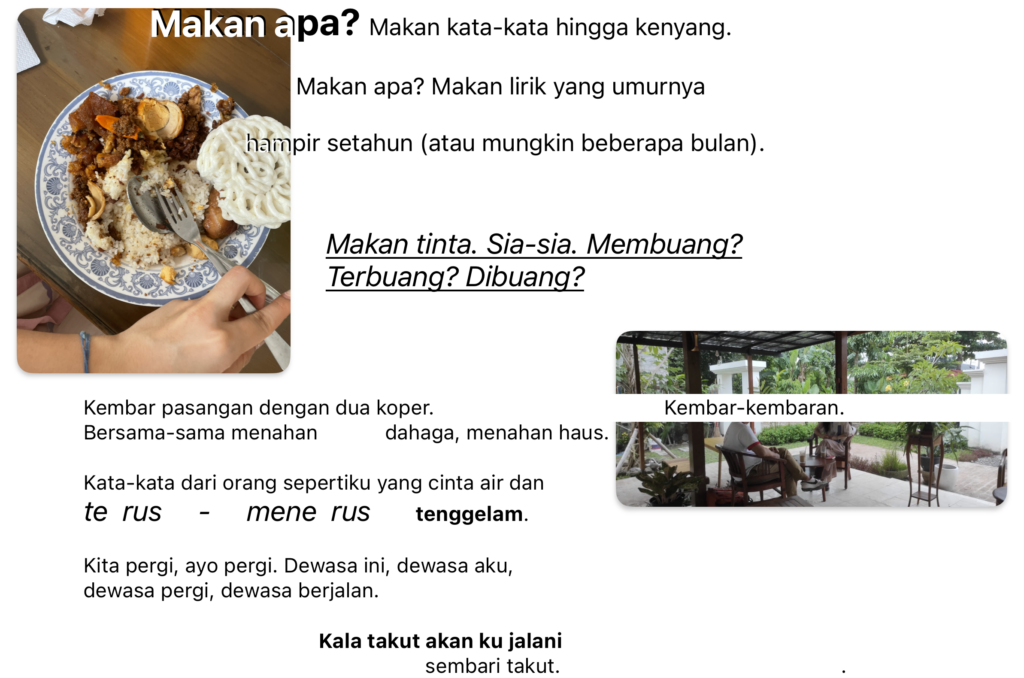
Makan apa? Makan kata-kata hingga kenyang.
Makan apa? Makan lirik yang umurnya
hampir setahun (atau mungkin beberapa bulan).
Makan tinta. Sia-sia. Membuang?
Terbuang? Dibuang?
Kembar pasangan dengan dua koper Kembar-kembaran.
Bersama-sama menahan dahaga, menahan haus.
Kata-kata dari orang sepertiku yang cinta air dan
te rus – mene rus tenggelam.
Kita pergi, ayo pergi. Dewasa ini, dewasa aku,
dewasa pergi, dewasa berjalan.
Kala takut akan kujalani
sembari takut.
I was not a scholar for the longest time
I had been a vengeful girl. I am not a scholar now
either, it leaves a bitter taste in my mouth. When l
try to be a scholar, writing my thesis, a part of me
is forced to bend in postures I do not like. Or I turn
resentful and I refuse to speak. I omit and erase.
I hide my thoughts, not from fear, but anger. I am
one of the lucky ones that l am here now and have
been for a while. I try to balance my frustration and
my deadpan “analytical” tone so I can progress and
so that my words are taken seriously.▬▬
When I remember I become paralysed. But it has
been 23 years now when I remember I feel powerful.
I speak with my loud voice. I assent with a period
at the end. If you would not listen to my voice in a protest
that halts Jakarta’s traffic, you will ▬ hear it oceans
away. I have no fear. Even when you kill me I will
stay to haunt you.
References
Aretxaga, Begoña. 2005. States of Terror. University of Nevada Press.
Das, Veena. 2007. Life and Words: Violence and the Descent into the Ordinary. University of California Press.
Malahayati, Binar Mentari is a PhD researcher for the Anthropology and Sociology department at the Geneva Graduate Institute in Switzerland. Mentari’s recent work has been on memory studies in the context of post-authoritarian regimes in which she explores remembering as a framework of resistance against state violence in Indonesia. Her current project focuses on centering desire in the memory work of political violence as a methodology and theory.
Cite as: Malahayati, Bihar Mentari. 2026. “Makan apa?” In “Anthropology that Breaks your Heart: The Risk of Proximity,” edited by Alexandra Dantzer, Uyen Dang, and Emma Kahn. American Ethnologist website, 27 March. [https://americanethnologist.org/online-content/collections/anthropology-that-breaks-your-heart-the-risk-of-proximity/life-like-a-statement-by-maria-fernanda-olarte-sierra/]
This piece was edited by American Ethnological Society Digital Content Editor Kathryn E. Goldfarb ([email protected]).