Life Like a Statement by María Fernanda Olarte-Sierra
by
This piece is part of the “Anthropology that Breaks Your Heart” series, a project inspired by the work of Ruth Behar’s The Vulnerable Observer (1996).
Prelude
I wrote the below piece after I was diagnosed with a heart condition. This poetry-like format allows me to find refuge in words and phrases that escape academic rigidity and the need for explanation, coherence, and sense. Poetry allows me to inhabit the sense-making process without having to achieve it; it lets me sit with ambivalence or transit it, but never requires me to close it, or explain it, or resolve it, or make it concrete. This sitting with ambivalence through poetry is something I learned from my dear friend Roxani Krystalli (2025). She says that “a good poet tells a story in a poem, through the poem, giving the listener whatever she needs to imagine a world, or perhaps enough confidence to trust that she does not need to know everything in order to understand” (2025, 172, emphasis in original). Experimenting with poetry, as an anthropologist, opens worlds and possibilities to me that I cannot find in academic writing, especially when it comes to attending to and accounting for the enfleshments [1] that my research practice has on me; for tending to the unhealed wounds that my work has left on my flesh and emotion (see Olarte-Sierra 2025).
For more than twelve years, I have worked with forensic experts who identify victims’ bodies from the Colombian armed conflict. The question of why I do what I do is a permanent companion in my journey, and I constantly revisit it in therapy. A year or so ago, when I learned that an alteration in the rhythm of my heart was what had been disrupting my entire life for many months, the first thought that came to mind was: “My heart broke.”
For months, I had been experiencing a fluttering sensation in my chest. When I first described this feeling to my partner and later to my doctors, I relied on the image of butterflies. With the passing of time, however, the sensation became more present, stronger, and the episodes lasted longer. “How is it different now?” asked my partner one day as I was feeling awfully unwell. I could only reply, “The butterflies have turned into bats now; I feel like their leathery pointy wings are flapping around. Frantically. As if wanting to escape.” This imagery of bats flying around inside my chest became my way of expressing my heart’s unease.
Although this is a medical condition that exists in textbooks and requires medication, its origin remains undetermined. In other words, it’s unclear how or why I developed this condition at this point in my life. Regardless of the how, I am sure that the why is driven by the kind of work I do, the topics I engage with, and the way I devote myself to attending to suffering, death, and dying.
In one session right after my diagnosis, Cecilia, my therapist, asked me point-blank, “Why do you think your heart is now like this?” Without really thinking about it, I repeated my initial insight: “My work broke my heart.”
And yet, switching my research focus has never been in question. Rather, my effort lies in doing this work while acknowledging how it shapes my flesh-emotion, and, at the same time, allowing it to affect and transform me. “Why?” asked Cecilia one more time. I remained with the question and took it home with me, to my silence, to my heart. And then I remembered Ruth Behar’s words like a beacon of light: “Call it sentimental, call it Victorian and nineteenth century, but I say that anthropology that doesn’t break your heart just isn’t worth doing anymore” (1996, 177).
The bats are real, and may remain in my chest forever. They are now part of me. And I am learning to become with them.
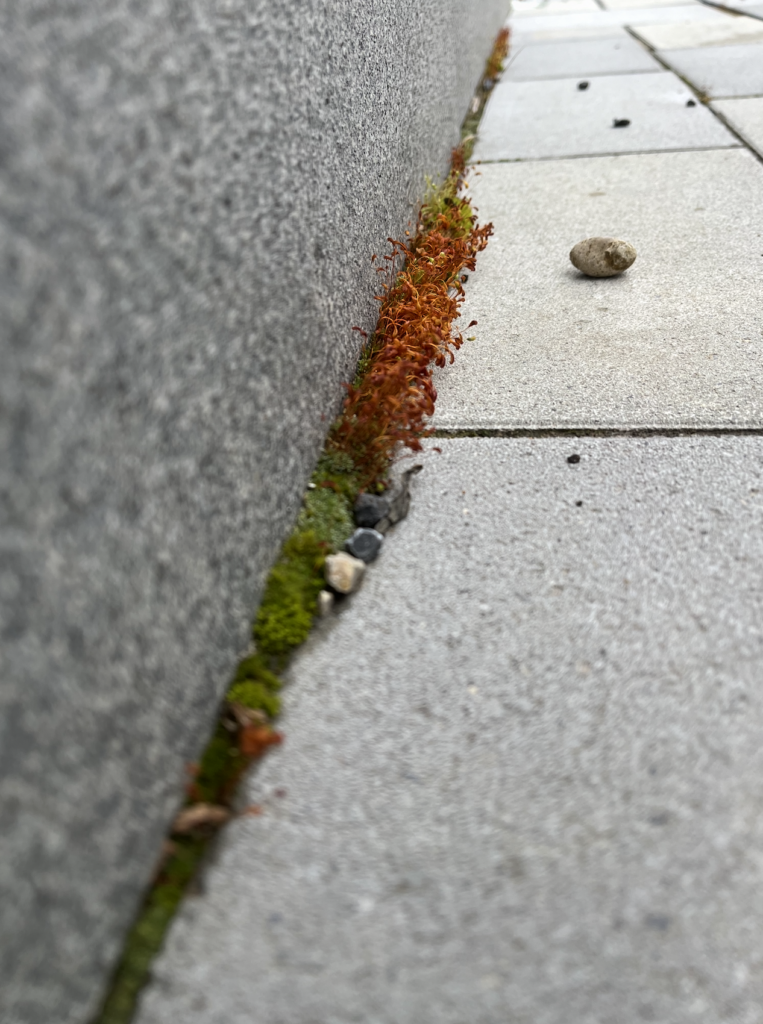
Vivid green and ochre moss growing in the crevice where a concrete floor and wall meet. Viennese unexpected urban spaces that sustain life. Photo by María Fernanda Olarte-Sierra.
I come back to this question over and over again:
Why do I do this research? And the sister question:
Why do I need to see death in the eye and experience unspeakable suffering through the testimonies of my interlocutors?
I still don’t know the answer…
Long days and nights I have heard of broken bones, of screams and unparalleled fear, of grief, of aching bodies, burnt skin, of sleepless nights.
Of smells and sounds that are tattooed in forensic experts’ bodies.
Bodies that seemed to have limitless storage space for stories of grief and sorrow.
So unlike mine,
which is scratched by the smallest grazing of violence,
even in the form of stories.
Wet dirt, pounding rain, helicopters unable to land,
sand in the eyes, forensic experts risking their lives hanging by a thread
and breaking two ribs, and an ankle.
Sirens and hushed voices interrupting the night:
“Come, run, we need to get you out of here, the whole place is wired with bombs that can go off any time.”
Run, breathe, feel.
Pain. “This comes with the job.”
The numbness after the adrenaline shot.
I can feel them on my skin too: the stories, the voices, the rain, the silences.
They all resonate in my head, too.
But not only in my head.
My bones may be intact, but my heart is now broken.
Not shattered in a million pieces, no.
It still holds together: a beating muscle of cracks and creases made of light and sorrow
that feel like a milliard of bats taking flight inside my chest with their pointy leathery wings.
How many times and in how many ways can a heart be broken?
Can a broken heart be repaired?
But this brokenness has brought with it, finally, my claiming of my body.
The ultimate realization that I am a body.
I am alive with and in a skeleton, with skin and flesh.
Guts, muscles, blood, sweat, and tears.
Laughter and love, silence, disgust and fear.
I feel the life inside, which is different from feeling alive,
yet I feel both simultaneously.
Why don’t the bats stop?
It is a pernicious and biased question: if they have wings and are alive, why would they stop?
There is the infinite inside of me, I have a sea –shwwwshhh shcwwwshhh– where the bats can swim and fly until they calm down or go away or I accept them, and, finally, I become I-bat who flies and inhabits the night without trepidation because I learned to trust my radar.
I-bat, I-heart, I-feet, I-hands, I-flesh. I am body and soul
I hold myself and I exist and I am
Heart, feelings, bones, blood, sweat, head, eyes, gut…I am – we are.
Why do I work on death in armed conflict?
I still don’t know,
but in forensic experts’ accounts and stories, I have found hope, care, and compassion.
Paying such close attention to death—to how humans can harm one another and inflict so much pain on their bodies—has brought me closer to kindness and gentleness than any other topic that I have researched.
My heart might be broken, my body might be tired, and my soul bruised,
But I am also mending, even though healing is not possible.
I don’t know why I am doing this work, but I know that I am,
through my creases, able to see life and light within devastation and darkness.
Amidst death, life is always there, like a statement.
And I choose to see it.
Notes
[1] Here, as elsewhere (Olarte-Sierra 2025), I use the term ‘enfleshement’, derived from the Spanish word ‘encarnar.’ I preferred it to the English term ‘embodiment’ (‘incorporar’). While the latter refers to the body, the former is about the flesh and thus involves a shift in focus from the body as a site of colonial intervention and control to the flesh as a site of resistance and rebellion to such interventions (see Hurtado 2017; Lugones 2019; Icaza 2019; Motta and Bermúdez, 2019).
References
Behar, Ruth. 1996. The vulnerable observer: Anthropology that breaks your heart. Beacon Press.
Hurtado, Roberta. 2017. “Language of the Flesh: Colonial Violence and Subversion in the Poetry of Judith Ortiz Cofer.” Chiricù Journal: Latina/o Literature, Art, and Culture 1(2): 107-124.
Icaza Garza, Rosalba. 2019. “Sentipensar los cuerpos cruzados por la diferencia colonial.” In Xochitl Leyva Solano y Rosalba Icaza coord. En tiempos de muerte: Cuerpos, Rebeldías, Resistencias. Institute of Social Studies. PDF (d1wqtxts1xzle7.cloudfront.net)
Krystalli, Roxani. 2025. “The Poetry of Ambivalence: A Nudge toward Tending.” In Ambivalent Activism. Bristol University Press.
Lugones, Maria. 2011. “Hacia un feminismo descolonial.” La Manzana De La Discordia 6(2): 105–117.
Motta, Sara, and Norma Bermudez. 2019. “Enfleshing temporal insurgencies and decolonial times.” Globalizations 16(4): 424-440.
Olarte-Sierra, María Fernanda. 2025. “Epistemological translations and locations of the wounded flesh: thinking with Sandra Harding.” Tapuya: Latin American Science, Technology and Society: 2577507.
María Fernanda Olarte-Sierra is an anthropologist focused on the body and science, and she bases her research practice on feminist and decolonial ethnographic methods. She explores the intersections of health, law, technology, and the body in Latin America, particularly in relation to collective suffering and mass violence. Her primary focus is on forensic victim identification and the search for the forcibly disappeared in the Colombian armed conflict, as well as the experiences and care of childhood cancer in Latin America. In these contexts, she investigates the forms and practices that embody collective care, solidarity, and the sustenance of life amidst adversity and catastrophe. Currently, she is a postdoctoral researcher and lecturer in the Medical Anthropology and Global Health group at the Department of Social and Cultural Anthropology at the University of Vienna in Austria.
Cite as: Olarte-Sierra, María Fernanda. 2026. “Life Like a Statement.” In “Anthropology that Breaks your Heart: The Risk of Proximity,” edited by Alexandra Dantzer, Uyen Dang, and Emma Kahn. American Ethnologist website, 27 March. [https://americanethnologist.org/online-content/collections/anthropology-that-breaks-your-heart-the-risk-of-proximity/life-like-a-statement-by-maria-fernanda-olarte-sierra/]