A Love Letter She Might Never Read by Aika Sato
by
This piece is part of the “Anthropology that Breaks Your Heart” series, a project inspired by the work of Ruth Behar’s The Vulnerable Observer (1996).
To learn is to steal, my mother told me when I was a child.
She was born right before the Great Famine that marked her body. The Cultural Revolution preached ‘dushu wuyong lun,’ that studying was useless, so she never finished middle school; knowledge was illicit before it was anything else. She watched her father, a dock worker loyal to the Party, publicly paraded and shamed for reasons she could never fathom, and he died soon after. She told me to learn, to steal, what had never been meant for her.
So I carried out my theft, hers and mine. “I’m not educated,” she has said all my life. I have heard these words from other Chinese women of her generation, women who spoke of the lack of education as though it were a personal failing, or a complete foreclosure of the future itself. Everything I write grows from that sentence my mother repeats, the one I am still seeking to write toward.
But this theft is never clean. I didn’t just steal a language; I lost the one we shared. Ocean Vuong spoke at Yale’s School of Art in November 2024 about showing his mother his first published poem, only to hear her say, “I wish I could read it.” I wept, as one does, having met someone from a previous life. In On Earth We’re Briefly Gorgeous, Vuong begins with “Dear Ma,” writing to her in the very language that separates them, knowing that every word he puts down is one word further from her. Each word I write, too, carries me further from the life my mother wore thin, raising me not to end up like her. My tongue bends now to discipline, to sharp edges, to institutional articulation.
I wrote the below field-poem during my PhD qualifying exam, when a question about ethnographic writing kept returning me to my mother, and to the uneven ground from which my work emerges. Writing of those for whom language has always been stolen, Trinh T. Minh-ha reminds us that “stolen language will always remain that other’s language” (1989, 20). Self-reflexivity trained me to name the trespass, as though confession were a form of repayment.
My mother doesn’t speak of the past. Where would she begin, when it lives in her bones, in the pain only her body remembers? Shanghainese is not built for such sentimentality. In Singapore and Shanghai, as I search for the afterlives of the Japanese empire, I keep encountering my mother in others’ nightmares, stories, and unmarked buildings. Her silhouette hovers at the edge of each scene, marking the limits of what I dare to imagine.
Victoria Chang writes letters toward ghosts, living and dead, fully aware they will not arrive—to her dead mother, to her father whose stroke took his speech. In Chang, as in the work of Vuong, I recognize a form I know too well: a letter written in advance of its own failure, addressed to someone who cannot read or answer.
Below is a letter toward my own mother.
*
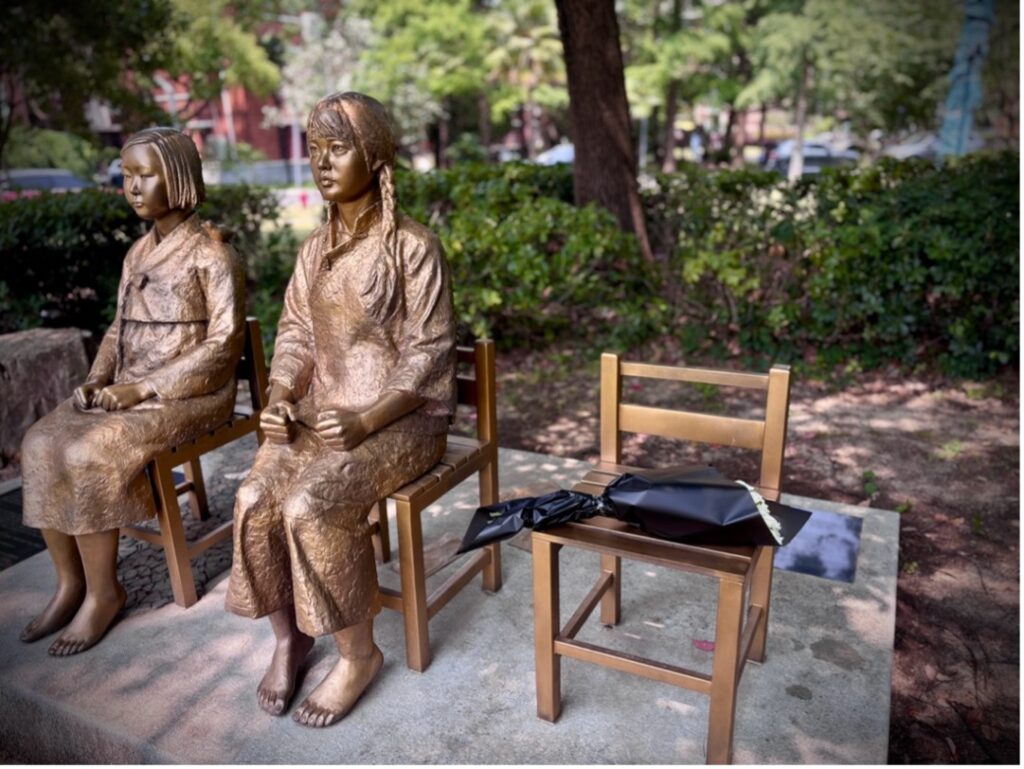
Comfort women statues in the courtyard of Shanghai Normal University. Professors Su Zhiliang and Chen Lifei, along with their students, installed them despite facing enormous pressure from both home and abroad to abandon the project. My own work is deeply indebted to their decades of archival and oral history work, sustained relationships of care with survivors and their families, and efforts to create institutional space for remembrance so that these histories do not disappear. The empty chair, bearing black-wrapped flowers, mourns those history left behind. Photo by Aika Sato.
*
“Japanese coming!”
Kai wakes to his grandmother.
1942 again.
Dementia,
he explains.
“Popo, aiyoh, where got Japanese now!?”
By daylight, she forgets.
That katana,
the mud smeared on face to avoid rape,
heart pounding against ribs too loud to hide.
It all crawls back to creases of wrinkles,
lodged somewhere in Hokkien, Cantonese, Teochew—
languages Kai, raised in English, can barely understand.
Kai says, shrugging,
that’s all he knows of the “Japanese time.”
But I recognize that scream—
the way it tears through
from elsewhere.
*
Some things don’t pass down as stories;
they stow away.
My mother didn’t mean to pass down her scream.
She thought she’d swallowed it—
Locked it behind her molars,
pressed silent against the roof of her mouth.
But it slipped—
down
the umbilical cord,
tucked into the hollow behind my sternum.
Now it flares
in me.
Her exile,
without her knowing,
becoming mine.
Her scream rises—
in the snap of her Shanghainese,
in curses muttered at her endless insomnia,
in drawers choking on words, pills, creased photos,
as if survival
could be stockpiled.
“Don’t make the same mistakes I made.”
Something about the Cultural Revolution.
Wet feet.
Cold fields.
During her period—
blood dripping through thin pants,
no pads, only cloth rags,
soaked in shame.
Barefoot in water that never left her bones.
“Don’t sleep on the floor! Too cold for your waist!”
“Don’t eat ice cream during your period!”
“Don’t leave your hair wet!”
*
She was clawed from the dust by a mother,
who sold her blood, drop by drop, to keep seven babbling mouths alive,
who buried two still warm from the womb,
whose severed thumb bought her kids another winter,
and wore scars cut by Japanese bayonets.
Her father was a loyal Communist, worn thin by shifts and smoke—
rice wine in a chipped cup.
She drank before he did.
Coughed.
He giggled,
and showed her how to swallow without choking.
He cracked the crust from the rice pot—
golden, still steaming—
and dropped it into her open palm.
He smacked her brothers on the head when they misbehaved,
but with her—
just his hand on her head.
*
She told me this once.
Just once.
She was seven,
or nine, maybe.
Small enough that she had to shove through the crowd, ducking between knees,
her arms swinging.
The air was thick with shouting.
And there he was—
her father, whose back used to feel like a wall—
now sagging forward,
his hair crushed flat by a paper hat.
His hands hung stupid at his sides.
He didn’t look up.
He didn’t look at her.
Her body jerked forward.
Someone shoved her back.
So she spat—
hard.
But the air caught it—
and dropped it
at her feet.
*
History never let her finish middle school.
“I’m not educated.”
“Study and go out into the world—
so you don’t end up like me.”
So I did.
I read.
I wrote.
I escaped.
I stole English.
And English,
quietly,
stole her from me.
Each word I write comes out
perfumed, groomed,
each word
she can’t read.
Now silence festers between us,
scorched in a language
that fits in my mouth
but slices in hers.
*
She never liked speaking Japanese either.
She said she doesn’t like how it feels in her mouth.
At the post office.
At the pharmacy.
At the local government bureau.
Her voice misses its landing—
vowels warp
a tone too emphatic.
“Eh?”
That Japanese “Eh?”
The tilt of a head,
eyes slipping away,
air wobbling,
something recoiling in the throat.
And the silence
unzipped her.
She’d try again.
Slower this time.
Each syllable trembling slightly more.
I hear it—
her Chinese edges
oozing through:
in the swallowed vowels,
the mangled consonants,
the final syllables that fall too hard
for dainty Japanese women.
I whipped the excess off her tongue—
folded her voice smaller.
But still,
it spilled—
like the way she scrubs rice too hard,
wears garlic on her skin,
walks too heavy for tatami.
Maybe that’s why
obaachan scored her
95 out of 100.
*
In Shanghai, I met a woman in her seventies.
Her building was once a Japanese comfort station.
No plaque. No memorial.
Only damp walls,
mold creeping into the corners
aching into her joints.
She warned me of ticks
when she saw me hovering at the entrance.
She laughed when I suggested moving elsewhere—
“No money,
and I’m not educated.”
I twitched.
Not educated.
*
Some nights, I wonder
how much of your pain came before me—
how much changed shape
when I arrived.
Maybe I was born
as your curse—
the one who learned to spell.
References
Chang, Victoria. 2021. Dear Memory: Letters on Writing, Silence, and Grief. Milkweed Editions.
Trinh T. Minh-ha. 1989. Woman, Native, Other: Writing Postcoloniality and Feminism. Indiana University Press.
Vuong, Ocean. 2019. On Earth We’re Briefly Gorgeous. Penguin Press.
Aika Sato is a PhD candidate in Anthropology at Yale University whose research traces the afterlives of Japanese Empire in Singapore and Shanghai. She writes from the in-between—of empires, languages, lifeworlds, and ghosts—where memory slips, mutters, and does not quite land. Mostly, she writes so as not to disappear.
Cite as: Sato, Aika. 2026. “A Love Letter She Might Never Read.” In “Anthropology that Breaks your Heart: The Risk of Proximity,” edited by Alexandra Dantzer, Uyen Dang, and Emma Kahn. American Ethnologist website, 27 March. [https://americanethnologist.org/online-content/collections/anthropology-that-breaks-your-heart-the-risk-of-proximity/a-love-letter-she-might-never-read/]