The crown jewel of the musical canon, Beethoven’s Ninth (with its spectacular “Ode to Joy” finale) is so apparently overburdened with meaning that Slavoj Žižek (2007) describes it as an “empty signifier,” a symbol that can stand for anything. A towering monument of Enlightenment thought, utopian aspiration, and nationalist appropriation, the Ninth has been deployed in contexts ranging from the Third Reich to Tiananmen Square to the fall of the Berlin Wall (cf. Buch 2003 and Rehding 2018). It is a site of ecstatic identification and violent misrecognition, a metonym of Western classical music in general.
This cacophonous accumulation of significance is possible due to the inherent ineffability of music and the attendant instability of musical meaning (Kramer 2002; Lee 2023). The academic study of music has continuously grappled with the perhaps impossible task of describing musical phenomena in spite of this ineffability. Music theorists, in particular, have sought to develop a language capable of naming the salient features of musical works, thus facilitating music analysis and criticism.
This essay autoethnographically engages the tension between the language of academic music theory and the embodied experience of musical listening in general, and in Susan McClary’s feminist analysis of Beethoven’s Symphony No. 9 in particular, to offer a musicological perspective on the relationship between listening and inculturation. McClary’s erotic theory of musical cadences (harmonic patterns with an “ending” function), especially as she applies it to Beethoven’s Ninth, is a productively vexing example of the clash between written language and musical experience, which ultimately leads me to look beyond the formal “endings” of classical music for meaning. Connecting McClary’s sexual interpretation of Beethoven to Gilles Deleuze’s analytic of sadomasochism, I argue that the language of music theory—with its emphasis on structure, resolution, and cadential closure—operates within a sadistic framework. I contrast this with a masochistic listening practice, one grounded in receptivity, surrender, and sensuous involvement, which might yield new ways of writing about music and its meaning.
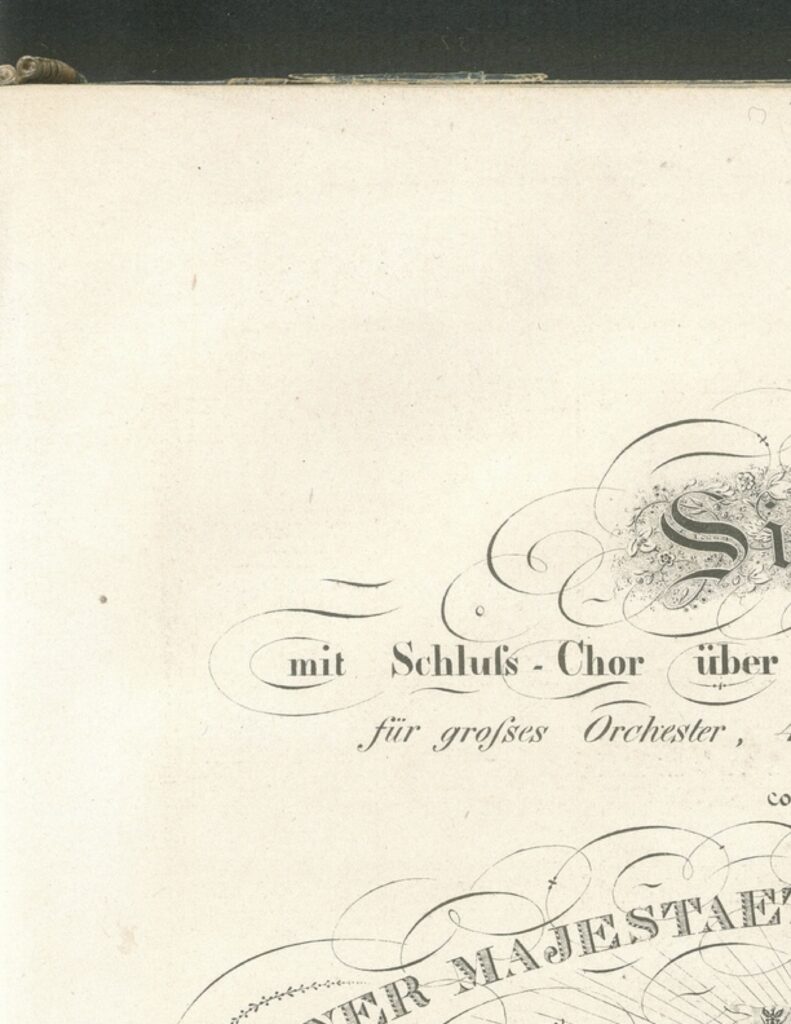
Title page from the first edition of Beethoven’s Symphony No. 9 (1826). IMSLP/Petrucci Music Library.
Listening to the Ninth
The Ninth is a challenging work to sit with. Even as a musically inclined child, taking cello lessons and playing in orchestras, I had never listened to the symphony in its entirety. The music was too long (over an hour!) and too abstract. It didn’t have a groovy bassline I could latch onto, let alone lyrics that spoke to my suburban ennui. The Ninth does have lyrics, of course—in fact it was the first symphony to incorporate singing. In a live performance, a full chorus and four soloists join the orchestra for the finale, in which the instrumentalists recapitulate the thematic motives of the preceding movements until the baritone soloist interrupts:
O Freunde, nicht diese Töne! Sondern laßt uns angenehmere anstimmen, und freudenvollere.
O friends, not these tones! Rather let us tune our voices more pleasantly and more joyously.[i]
Then, as if teaching his gathered friends a drinking song, he launches into Beethoven’s setting of Schiller’s An die Freude—the famous “Ode to Joy.”
When I began college as a cello performance major, the Ninth was assigned for the very first day of my music literature seminar. Dutifully, I curled up with headphones and a score, listening to the 1984 Berlin Philharmonic recording under Herbert von Karajan. I struggled to stay engaged, drifting in and out until—
O Freunde, nicht diese Töne!
From there, the familiarity of the “Ode to Joy” held my attention. Beethoven transforms the melody through shifting textures and affective inflections: a tavern ditty, a hymn, a fugue, a march. And then, about six minutes in, something happened. A visceral rush of—well, joy flooded through me. Beethoven sustains this high for the rest of the movement. The Ninth has been my favorite piece of music ever since this first dedicated hearing. The challenges it poses to listeners yield thrilling new experiences every time I return to it, and I have come to identify the joy it signifies with my own.
Sex, violence, and musical cadences
You can imagine my devastation when, in my first encounter with feminist musicology, I read Susan McClary’s argument in Feminine Endings that “Beethoven’s Ninth Symphony unleashes one of the most horrifyingly violent episodes in the history of music” (1991, 128). In an earlier version of the essay (1987), she describes this moment more specifically as the “murderous rage of a rapist incapable of attaining release” (discussed by Fink 2004, 109, who highlights the discrepancy between the essay versions).
Many dismissed McClary’s analysis outright. Edward Rothstein (1995), writing in The New York Times, lamented that “musicology is going the way of literary criticism.” Others celebrated her work as a sign of long-overdue change (Cook 1992). Richard Taruskin, a fellow Beethoven skeptic, wrote that whether or not one agrees with McClary, her response “weighs heavily against the assumption of Beethoven’s universality” (2009, 78). Some listeners, he observed, do not identify with the messages in Beethoven’s music.
But the trouble for me was that I did agree with McClary’s hearing—and I still identified with the music. I heard a violent sexual fantasy and my own joy echoed in it. How could I make sense of the pleasure I felt?
To begin, McClary’s term “feminine endings” refers to a music-theoretical distinction found in the 1970 Harvard Dictionary of Music, where “masculine” cadences fall on strong beats and “feminine” ones on weak beats. Tonality itself, she argues, operates as a simulation of sexual activity: instilling expectations, withholding fulfillment, and ultimately delivering climax. The musical narrative typically goes:
- Establish the tonic (home key)
- Depart into tension (modulation)
- Return to the tonic via the dominant (the cadence)
This cadence is the musical orgasm: resolution, release. And crucially, McClary shows that this structure maps gendered binaries—strong/weak, normal/abnormal—onto musical form. The feminine becomes a problem to be resolved by the masculine. Her project is to reveal how deeply these sexual and gendered metaphors are embedded in the listening structures we are trained to inhabit.
But there’s a cost to this revelation. Privileging the moment of release, the cadence, even to critique its power, casts everything afterwards as insignificant. This mode of analysis—especially as shaped by the Austrian musicologist Heinrich Schenker, whose theories still dominate music pedagogy despite their now widely acknowledged racism and authoritarianism (cf. Ewell 2021)—treats pleasure as something used up. Once resolution is achieved, the tension disappears.
Music theory enacts a kind of coercive translation of sound into concept. It commodifies listening, inventing a shared language meant to render hearing exchangeable and demonstrable. Terms like “cadence” don’t just describe musical moments; they assert what counts as significant in the musical experience. A “successful” analysis persuades the reader to hear as the theorist does. It is fundamentally disciplinary.
This is why I argue that music theory is sadistic, perhaps even more so than other forms of analysis because its object is not only aesthetic judgment but sensory experience itself. Its method is demonstration: showing how a piece “works,” laying bare its logic with clarity and force. As Deleuze writes, “demonstration is identical to violence” (19). The analyst occupies the role of instructor or surgeon, someone who repudiates affective entanglement in favor of reasoned distance. Deleuze compares this logic to that of the torturer. It is analytic, institutional, and structurally coercive. McClary’s reading of the Ninth, then, can be seen as a self-aware feminist deployment of sadistic tools—mastering Beethoven with the language of theory in order to critique his domination. But it remains within the analytic frame.
A masochistic listening practice
Let’s try listening masochistically instead. For this, I turn to Suzanne Cusick’s queer theory of listening (2006). Cusick suggests we might choose to listen “as a lesbian bottom”—an erotic and highly attuned subject position. The masochist, in addition to this, is open to displeasure as much as pleasure. However, she is not a mere victim but someone who constructs meaning through consensual submission. As Deleuze writes, masochism is contractual, imaginative, and aesthetic. The masochist scripts her own surrender.
Masochistic listening is not passive. It is an active, affective orientation that declines the violence of explanation. Where the sadist listens to conquer, the masochist listens to be transformed. She opens herself to obscure intensities and lets the music rewrite her body. “Words are at their most powerful,” Deleuze writes, “when they compel the body to repeat the movements they suggest” (18). That’s true of analysis—but even more true of music itself, which moves us without explanation.
Masochistic listening disrupts the hegemonic, institutional mode of hearing that enshrines the Ninth as a monument. Instead, it affirms the symphony’s significance as something extrinsic, embodied, unfixed. It doesn’t reject knowledge but insists on locating it in the porous and inarticulate interface between listener and sound.
This mode of listening asks: What if understanding is something that happens to us, not something we impose? What if we gave ourselves over to music—not to dissect or explain it, but to be undone by it? This surrender doesn’t require detachment or distance. Instead, it invites a queer fidelity to ambiguity and risk, a willingness to be reshaped by our attachments even when they implicate us in structures we seek to resist.
To cultivate a masochistic listening practice is to refuse the fantasy of the all-knowing analyst and embrace a more erotic, uncertain, and participatory encounter with sound. To do so may offer a way forward for anthropologists and music theorists alike, a theoretical move through embodiment past the inadequacy of language and towards silence (Hirschkind 2020).
This is what I mean by a future of feminine endings: not a correction to past readings, but a transformation in how we hear, how we desire, how we theorize. A masochistic listener doesn’t let Beethoven off the hook. She lingers in the tension between coercion and joy, violence and transcendence, domination and surrender. She refuses closure even as she seeks connection.
What comes after the violent cadence in the Ninth is, after all, the “Ode to Joy.” Feminine endings, in this context, are not weak cadences to be resolved, but unfinished acts of relation. The act of listening masochistically, of dwelling in the end, and listening beyond it, may generate new modes of engaging with sound, making meaning that gestures beyond the limits of language.
Notes
[i] Translated by Steven Ledbetter: https://www.columbia.edu/itc/music/modules/summa3/ summa3_print.html.
Acknowledgements
Thank you to Carolyn Rouse for her fearless leadership of the 2025 School of Criticism and Theory, to my classmates for sharing their expertise and fellowship in our seminar, and especially to Naveeda Khan for her wisdom, joy, and generosity.
References
Buch, Esteban. 2003 [1999]. Beethoven’s Ninth: A Political History. Translated by Richard Miller. University of Chicago Press.
Cook, Susan C. 1992. “Musicology and the Undoing of Women.” American Quarterly 44 (1): 161. https://doi.org/10.2307/2713188.
Cusick, Suzanne G. 2006. “On a Lesbian Relationship with Music: A Serious Attempt Not to Think Straight.” In Queering the Pitch: The New Gay and Lesbian Musicology, 2nd ed., edited by Philip Brett, Elizabeth Wood, and Gary C. Thomas, 67–84. Routledge.
Deleuze, Gilles. 1991 [1967]. “Coldness and Cruelty.” In Masochism, translated by Jean McNeil, 9–138. Cambridge, MA: MIT Press.
Ewell, Philip. 2021. “Music Theory and the White Racial Frame.” Music Theory Online 26 (2).
Fink, Robert. 2004. “Beethoven Antihero.” In Beyond Structural Listening? Postmodern Modes of Hearing, edited by Andrew Dell’Antonio. University of California Press.
Hirschkind, Charles. 2020. “On the Virtues of Holding Your Tongue.” Critical Times 3 (3): 471–77.
Karajan, Herbert von, and Berliner Philharmoniker. 1984. Beethoven: Symphony No. 9 [album]. Deutsche Grammophon.
Kramer, Lawrence. 2002. Musical Meaning: Toward a Critical History. Berkeley: University of California Press.
Lee, Gavin S. K., ed. 2023. Queer Ear: Remaking Music Theory. Oxford: Oxford University Press.
McClary, Susan. 1987. “Getting Down off the Beanstalk: The Presence of a Woman’s Voice in Janika Vandervelde’s Genesis II.” The Minnesota Composers Forum Newsletter.
McClary, Susan. 1991. Feminine Endings: Music, Gender, and Sexuality. Minneapolis: University of Minnesota Press.
Rehding, Alexander. 2018. Beethoven’s Symphony No. 9. Oxford: Oxford University Press.
Rothstein, Edward. 1995. “Musicologists Roll Over Beethoven.” New York Times, November 26, 1995.
Taruskin, Richard. 2009. The Danger of Music and Other Anti-Utopian Essays. University of California Press.
Žižek, Slavoj. 2007. “‘Ode to Joy,’ Followed by Chaos and Despair.” New York Times, December 24, 2007.
Hannah Waterman is a PhD candidate in Critical Music Studies at Stony Brook University. Her dissertation, “Imaginary Soundscapes in Early Modern Scientific Thought,” examines how sonic imagination shaped scientific inquiry in the seventeenth century, tracing intersections between music, natural philosophy, and emerging theories of perception. Her research draws on archival sources, the history of science, and historical sound studies to illuminate the role of auditory speculation in early modern epistemologies. Outside of her academic work, she is an active performer on the Baroque cello. She can be reached at <[email protected]>.
Cite as: Waterman, Hannah. 2026. “Beyond Feminine Endings, A Masochistic Listening Practice”. In “An Aesthetics for the End”, edited by Naveeda Khan, American Ethnologist website, 18 January. [https://americanethnologist.org/online-content/beyond-feminine-endings-a-masochistic-listening-practice-by-hannah-waterman-stony-brook-university/]
This piece was edited by American Ethnological Society Digital Content Editor Kathryn E. Goldfarb ([email protected]).