Kashmir, which received global attention recently for bringing the countries of India and Pakistan to the brink of a major war, has been a much-contested area and the site of multiple wars between the two nation-states since they came into being in 1947. Both India and Pakistan lay claim to the territory in full. Today, Indian-occupied Kashmir remains a place of heavy surveillance. This system was put in place by the AFSPA (Armed Forces Special Powers Act) in the 1990s, allowing the Indian Army to use lethal force and other means in maintaining control. With its imposition, Indian presence in Kashmir reveals itself to be occupation turned to settler colonialism in terms of land seizure, social engineering, and resource appropriation (Kanjwal 2023, 16). This is not unlike other countries that were formerly colonies but that engaged in similar forms of colonization and occupation after achieving independence, exposing communities internal to them to war, dispossession, and militarization, such as Indonesia’s colonization of West Papua. For these communities, postcoloniality never came; they transitioned from one state of colonization to another.
Indian cinema, particularly Bollywood, has played a significant role in presenting India’s occupation of Kashmir as legitimate, depicting Kashmir as the land of eternal beauty, a “territory of desire” (Kabir 2009) which is a part of the Hindu homeland, and championing the Hindutva cause of saving this sacred land from the hands of Islamic outsiders. Alternatively, they present Islamic militancy in Kashmir as threatening India as a secular democratic nation. Notable films include Roja (1992) and Mission Kashmir (2001), both of which were popular successes in India and among the Indian diaspora.
Vishal Bhardwaj’s film Haider (2014) is different from other Bollywood films that disseminate nationalist and majoritarian narratives. It is an adaptation of Shakespeare’s Hamlet and locates the story within the period of unrest in Kashmir Valley in the 1990s after rigged elections and a mass protest against the Indian state, which brought on the heavy hand of AFSPA. The film is based on Kashmiri journalist Basharat Peer’s memoir Curfewed Night (2008), which documents his life growing up during this period of unrest, and its screenplay is co-written with the journalist. Haider goes beyond a mere adaptation of Hamlet, complicating its central motif of justice or revenge, instead expressing the collective trauma and injustice experienced by the people inhabiting Kashmir.
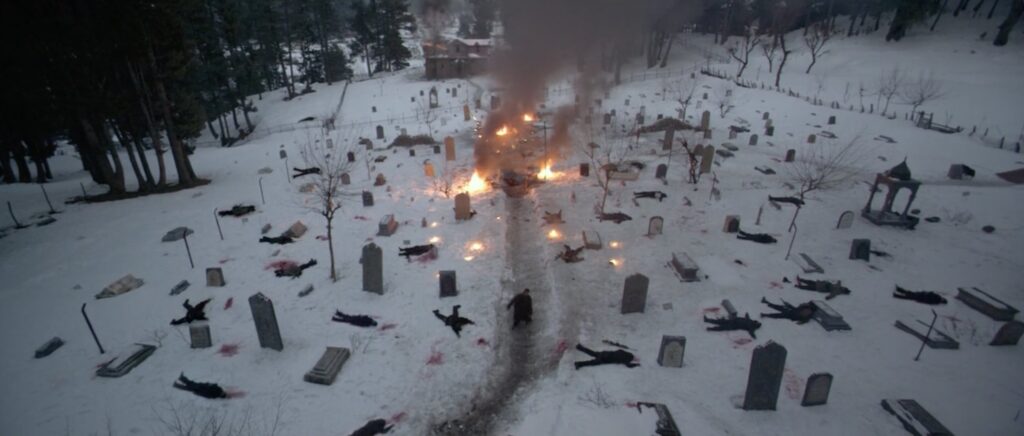
Closing scene where a limping Haider is leaving a bloodied graveyard without avenging his father’s death. Screen shot from Vishal Bhardwaj’s film Haider (2014).
This contribution to the curated collection on “An Aesthetics for the End” explores how the film Haider depicts the state of “postcolonial coloniality” (Kanjwal 2023, 14) in Kashmir. In this state, the end of colonialism never comes. This state goes unnoticed as colonialism is commonly understood as only that which the West can wield, ignoring the complex dynamics that exist within the former colonies of the West. I argue that Bhardwaj’s cinematic brilliance rests in making visible this state of unending coloniality and the widespread trauma that comes from it. He renders this trauma by showing how deaths in the Kashmir Valley under these conditions can only be the state of perpetual suspension. I employ the Islamic eschatological concepts of ‘ruh’ (spirit) and ‘barzakh’ (the in-between) as explicated by Stefania Pandolfo in her work on the Moroccan postcolonial space, to elaborate this state of being. As Pandolfo explains in the introduction to her book, Impasse of Angels, concepts from the Moroccan qsar or village can “act as epistemological and aesthetic guides in a hermeneutical journey” (Pandolfo 1998, 6) to displace “the categories of classical and colonial reason and open a heterological space of intercultural dialogue” (Pandolfo 1998, 5). By bringing these concepts that have been used to understand the Maghribi postcolonial present marked by fractures, wounds, and contradictions, I aim to explore the trauma that the continued occupation in the Kashmir has brought forth and that make us question the putative end of colonialism in India.
At the start of the film we see Haider, the protagonist who represents Hamlet, coming back to Anantnag (a city in Kashmir) where his ancestral home has been demolished and his father has been arrested by the army on charges of treason. The notion of displacement is brought forth early on screen as the character struggles to recall memories he has of his home; of any stability and security he ever felt in what is now a decimated site. His recollection sets in motion his feelings of ambivalence, even alienation towards this home with which he struggles throughout the film. It represents the complexity of Kashmiri subjectivity, which I argue is akin to the postcolonial subjectivity that Pandolfo identifies as “a modernist dwelling of the ‘betweens’” (Pandolfo 1998, 6) or an exilic sense of belonging.
This complex feeling of being in exile in one’s home becomes prominent in another scene in which Hilaal, the father of Haider and the character representing King Hamlet, is in a detention camp maintained by the Indian Army where he is being tortured for suspected treason. While suspended from the ceiling, he enters into conversation with another person who is similarly suspended next to him. Roohdaar, presumably another inmate in the camp, is identified in the film as one of the militants involved in the uprising. However, his name as ruh (spirit or soul) suggests that he may be Hilaal’s soul, positing possibilities of multiple coexisting representation and identities. ‘Ruh’ is an Islamic concept and can be seen at work in Pandolfo’s Morocco and in the context of Kashmir where Muslims form the majority.
Hilaal: It seems we will be killed together as well.
Roohdaar: You can die doctor, but I won’t.
Hilaal: And how is that?
Roohdaar: Because you are the body and I’m the soul… You are mortal and I’m immortal!
Hilaal: Are you a Shia or a Sunni?
Roohdaar: I am the river and the tree… The Jhelum and the chinar… Fortitude and forbidden… A Shia and a Sunni, I’m both… A Pandit as well… I always was… I am… I will always be… (Bhardwaj and Peer 2014, 122)
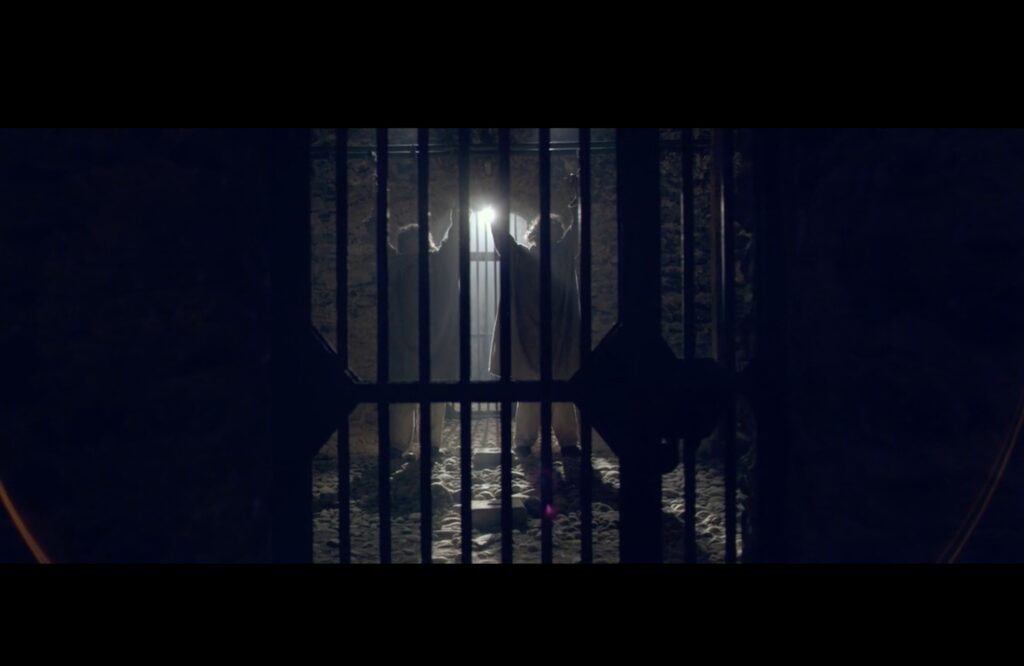
Scene from prison where Roohdaar and Hilaal are being tortured. Screen shot from Vishal Bhardwaj’s film Haider (2014).
In Impasse of Angels, Pandolfo delineates the ruh through the accounts of Si Lhassan u Ahmed, one of her key interlocuters. We see how in Islamic eschatology, the ruh refers to spirit in all senses, meaning it can be the spirit of those alive and dead, even used to refer to spiritual entities such as the “jinn,” God’s creation of smokeless fire. Si Lhassan quotes the Qur’an to suggest how God takes the soul at the moment of death (to keep) and also when one is sleeping (to be sent back to the body upon awakening) (Pandolfo 1998, 84). When a person is dreaming, the ruh journeys out of their body and comes in contact with the “arwah” (plural of ruh) of those who have died. The ruh may then travel unfettered by its body to the past, the future, or other places. However, when a person dies, the ruh comes out of its body, disengaging from it entirely, and goes to the barzakh, an intermediate space where it awaits the Day of Judgement. I contend that Roohdar may be taken to be a ruh tethered to the waking Hilaal but unknown to him, and who ultimately becomes his ruh upon Hilaal’s death, but without the possibility of exit from Kashmir.
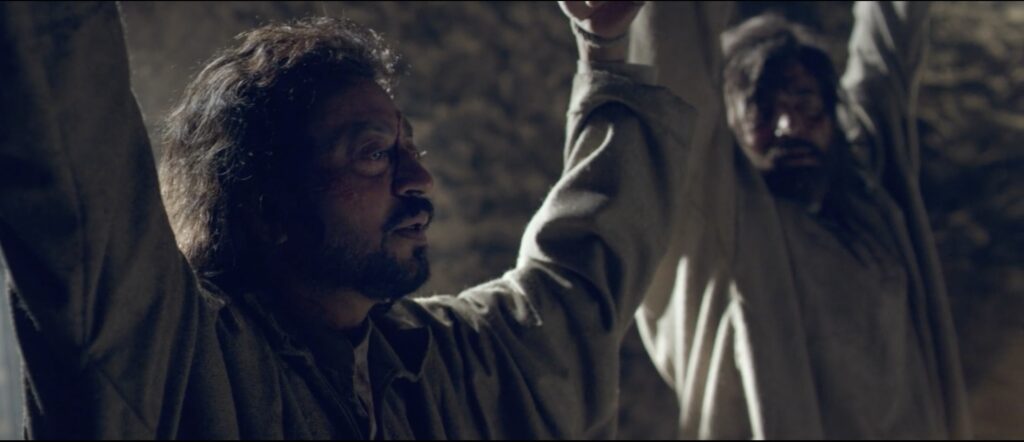
Roohdaar introducing himself to Hilaal. Screen shot from Vishal Bhardwaj’s film Haider (2014).
The scene in Haidar of Hilaal and Roohdar appears uncanny for the depiction of the tortured body and soul tied together but standing side by side, mirroring each other. They suggest the fractured self, both due to the physical torment of torture and the postcolonial condition of alienation where one is unable to recognize oneself. Hilaal’s non-recognition of his soul hints at the same sense of alienation expressed by Haidar in not recognizing or identifying with his own home. Roohdar reminds Hilaal of the place that he is rooted to, the home that is no longer recognizable, through his reference to Jhelum, one of the tributaries of River Indus that cuts through Kashmir in flowing to Pakistan. In a way, Roohdaar appears to be resisting what has been termed as “memoricide,” the settler colonial practice of writing over the histories and memories of others (Mushtaq and Amin 2021, 3012). The spirit refuses erasure and battles appropriation and forgetfulness. It is he who informs Haider of the fate his father ultimately meets in the camp, suggesting that he take revenge for it.
In so far as the figures are suspended, we can also speculate that Roohhar is not just the container of the soul of Hilaal but an embodiment of the Kashmiri spirit existing in suspension. We may understand better this state of suspension of the body and soul within Kashmir by turning to the meaning of barzakh in The Impasse of Angels. Pandolfo explains that it is the isthmus, an in-between space, a limit and a limbo that separates and conjoins at once. She quotes from the Qur’an,
He has let free the two bodies of flowing water; one palatable and sweet, and the other salt and bitter; yet he made a barrier between them [barzakh], a partition which is forbidden to be passed (quoted in Pandolfo 1998, 188).
The Valley of Kashmir, standing between two massive mountain ranges, may be thought to be a barzakh containing countless fractured selves akin to Haidar and Hilaal. Even Ghazala, Haider’s mother, rendered as a half-widow because of her missing husband, and a half-bride because of her affair with Haider’s uncle, may be yet another emblem of how Kashmiri bodies are caught in-between, in a limbo because of the ongoing strife, between mourning and desiring (Kabir 2022, 85). The film’s depiction of unidentified bodies thrown into the waters of River Jhelum after being tortured in detention camps or buried in unmarked graves further accentuates the tormented and suspended state of the ruh of Kashmiris. The river is also depicted in a song in the film titled “Jhelum Dhoonde Kinara” (Jhelum is Searching for its Bank) as searching for its limit, which I understand as an escape from the misery of ongoing-ness without end.
The madness that this impels among Kashmiris is rendered through Haider’s monologue in which he speaks the famous “to be or not to be” speech as the ramblings of a madman:
According to the UN council resolution number 47 of 1948… Article 2 of the Geneva convention and article 370 of the Indian Constitution… There is but one question! Do we exist or do we not? If we do… then who are we? If we don’t… then where are we? If we exist, then why do [we] stand here? If we don’t exist, where did we lose ourselves? Did we exist at all? or not? Our suffering comes from their chutzpah… (Bhardwaj and Peer 2014, 143).

Haider’s monologue. Screen shot from Vishal Bhardwaj’s film Haider (2014).
This scene not only presents the alienation that the protagonist experiences but marks the moment when he realizes the permanent fracture that is Kashmir, an eternal conflict zone, its beauty marred by continued violence and bloodshed. Reconciliation with self is no longer possible: “Law and order… Order order… Law and order…There is no law, there is no order. Whose laws? Whose order? Made on order… Law and order…” (Bhardwaj and Peer 2014, 145). And soon his voice is overlaid by that of the state’s as he breaks into the nationalist song, “A world better than the world, our India. We are her children…” (Bhardwaj and Peer 2014, 146). Yet Haider’s hands cocked as a gun to his temple unravels the hollow nation-state structure, the sham of democracy, to reveal the ongoing-ness of colonialism without an end and the trauma that accompanies it.
Acknowledgements
I am indebted to Professor Naveeda Khan for her guidance, critical insight and encouragement throughout the entire writing process. I would also like to thank my peers at the Cornell School of Criticism and Theory (2025) for their generous feedback and intellectual support all of which has significantly shaped the ideas in this project.
References
Bhardwaj, Vishal, dir. 2014. Haider. UTV Motion Pictures.
Bhardwaj, Vishal, and Basharat Peer. 2014. Haider: The Original Screenplay. Harper Collins.
Kabir, Ananya Jahanara. 2009. Territory of Desire: Representing the Valley of Kashmir.University of Minnesota Press.
Kabir, Ananya Jahanara. 2022. “Hortus Interruptus: A Time for Alegropolitics in Kashmir.” In Routledge Handbook of Critical Kashmir Studies, edited by Mona Bhan, Haley Duschinski, and Deepti Misri. Routledge.
Kanjwal, Hafsa. 2023. Colonizing Kashmir: State-building under Indian Occupation. Stanford University Press.
Mushtaq, Samreen, and Mudasir Amin. 2021. “‘We Will Memorise Our Home’: Exploring Settler Colonialism as an Interpretive Framework for Kashmir.” Third World Quarterly 42 (12): 3012–29.
Pandolfo, Stefania. 1998. Impasse of the Angels: Scenes From a Moroccan Space of Memory. University of Chicago Press.
Peer, Basharat. 2008. Curfewed Night. Scribner.
Anantaa Ghosh is a PhD student in the Department of Comparative Literature at the University of Oregon. Her research interests lie at the intersection of Indigenous Studies and Environmental Humanities, with a particular focus on South Asia.
Cite as: Ghosh, Anantaa. 2026. “Spirits in Suspension and the Postcolonial ‘Barzakh’ in Kashmir”. In “An Aesthetics for the End”, edited by Naveeda Khan, American Ethnologist website, 18 January. [https://americanethnologist.org/online-content/spirits-in-suspension-and-the-postcolonial-barzakh-in-kashmir-by-anantaa-ghosh/]
This piece was edited by American Ethnological Society Digital Content Editor Kathryn E. Goldfarb ([email protected]).